
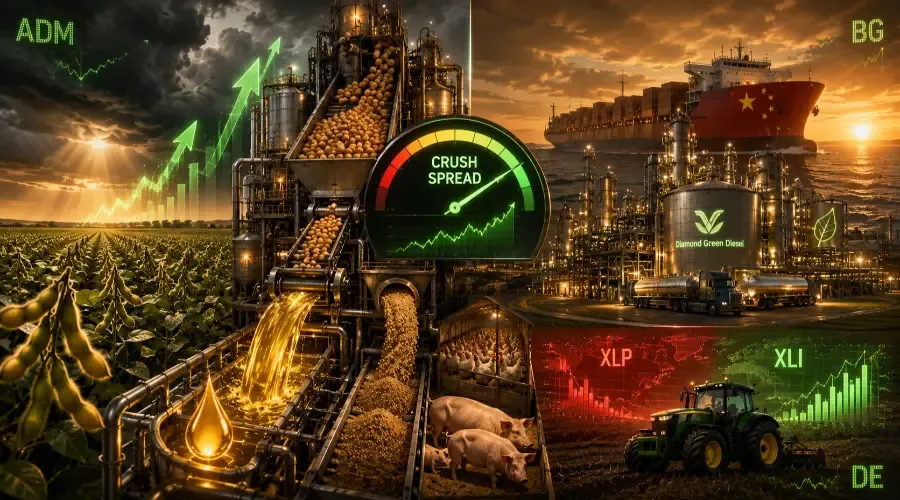
Farm Progress asked the question directly in 2024: will US soybean prices crash if China doesn't buy? The answer came in the data. International Banker tracked the continued price fall throughout 2024. FoodNavigator documented why prices were falling. AgWeb tracked whether China trade talks would provide relief. And BLS has a historical record of soybean price increases since 2000 that reads like a case study in how one country's purchasing decisions can determine the fate of an entire US commodity market. Soybeans are the most geopolitically sensitive major agricultural commodity in US markets – the one where a single trade partner's decision to buy or not buy can move prices by 30% in a quarter. The sector rotation that follows a sharp soybean move is fundamentally different from wheat or corn, and the primary equity expression is a company most retail traders never think about when they hear the word agriculture.
Why This Matters More Than Most Traders Realize
Soybeans occupy a unique structural position in US agricultural markets that makes them categorically different from every other crop in the commodity universe. Where wheat is primarily a food grain and corn is split between food, fuel, and feed, soybeans serve two completely different markets simultaneously through a single processing step: every bushel of soybeans crushed by a processing company yields approximately 11 pounds of soybean oil and 44 pounds of soybean meal. These two products serve entirely different end markets – soybean oil goes into cooking oil, packaged food manufacturing, and increasingly into renewable diesel fuel production; soybean meal goes into the animal feed industry as the primary protein source for poultry, hog, and aquaculture operations.
This dual-product structure means that when soybean prices move sharply, the transmission chain splits immediately at the crushing stage – and the direction of the move matters differently for different parts of the downstream chain. A soybean price spike is bad for livestock feeders but potentially good for renewable diesel investors. A soybean price crash is good for XLP food manufacturers but devastating for US farm income and the agricultural equipment companies that depend on it.
The China variable compounds the complexity. China imports approximately 60% of globally traded soybeans annually – more than 95 million metric tonnes in peak years. No other major commodity has this degree of single-country demand concentration. When China buys aggressively, CBOT soybean futures rise regardless of US weather or supply conditions. When China slows purchases – whether from trade war tariffs, economic slowdown, or domestic herd liquidation – prices can fall 20–30% within a quarter even when US crop conditions are poor. Understanding soybean price moves requires understanding China's agricultural calendar and trade policy as much as US weather. [LINK: Agriculture Hub]
The Chain Reaction: How Sharp Soybean Moves Flow Through the Economy
The first sector to receive the soybean price signal is always the crushing industry – and the primary equity expressions are not in XLB or XLY but in companies that straddle the agricultural and food processing landscape: Archer-Daniels-Midland (ADM) and Bunge Limited. These two companies collectively process the majority of US soybeans and are the most direct equity market expressions of soybean price volatility. Understanding their economics requires understanding the crush spread – the margin between the price of raw soybeans and the combined value of soybean meal and soybean oil produced from crushing them – rather than the absolute price of soybeans alone.
Crucially, the crush spread is a specific, observable number. On the CME, it is quoted as the difference between the combined futures value of 44 pounds of soybean meal and 11 pounds of soybean oil (per bushel) and the price of one bushel of soybeans. When this number widens, crushers earn a higher processing margin; when it narrows, their margins compress, regardless of where the outright soybean price sits.
When soybean prices spike, ADM and Bunge face a complex margin dynamic. If the spike is demand-driven – China buying aggressively – the crushers benefit from high throughput volumes and potentially wider crush margins if meal and oil prices rise faster than bean input costs. If the spike is supply-driven – drought or weather shock reducing crop size – the crushers face higher input costs that compress their margins if meal and oil prices cannot keep pace. The crush spread, published daily on the CME Group website, is the indicator that reveals which scenario is unfolding in real time.
The second movement runs through the renewable diesel channel – a transmission unique to soybeans with no equivalent in the wheat or corn post. Soybean oil has become the primary feedstock for renewable diesel production in the United States, following the EPA's expansion of the Renewable Fuel Standard to include biomass-based diesel. When soybean prices spike and soybean oil prices rise with them, the input cost economics of renewable diesel production tighten – affecting XLE energy companies that operate renewable diesel refinery capacity. Diamond Green Diesel (a joint venture within Valero Energy in XLE) and other renewable diesel producers face feedstock cost pressure when soybean oil spikes. However, this cost pressure is partially offset by the D4 RIN (Renewable Identification Number) market. Renewable diesel producers generate D4 RINs; when feedstock costs rise and production margins narrow, D4 RIN prices often climb, cushioning the margin compression for integrated producers like Valero. The net XLE impact is therefore milder than the raw soybean oil price movement alone would suggest.
The third movement reaches the livestock industry through the soybean meal channel. Soybean meal is the primary protein source in poultry and hog feed – more critical than corn for protein content – and a spike in soybean prices immediately raises the cost of every pound of chicken, pork, and farmed fish produced. Tyson Foods, Pilgrim's Pride, and Smithfield Foods within XLP face COGS pressure within one to two quarters as their contract feed costs are reset at higher soybean meal prices. This livestock-to-XLP transmission is broader and faster than the direct wheat flour transmission, because virtually every major protein category in US food manufacturing depends on soybean meal as the primary feed protein.
The fourth movement, unique to the downward direction of a sharp soybean price move, flows through US farm income and its downstream effects. When soybean prices crash – as they did throughout 2024 when CBOT futures fell from above $14 per bushel to below $10 – US farm income declines significantly. Soybeans are among the highest-value crops per acre, and a 30% price decline compresses farm profitability to levels where equipment replacement is deferred, farmland values soften, and rural bank credit portfolios face stress. This farm-income channel connects soybean crashes specifically to agricultural equipment (Deere within XLI), farmland REITs (a sub-sector of XLRE), and rural community banks within XLF.
Sector-by-Sector Impact: Who Wins, Who Loses, and When
Materials (XLB) – Mixed – Immediate. Unlike the wheat and corn post where XLB fertiliser companies surge, soybeans produce a more nuanced XLB signal. Phosphate fertiliser demand – Mosaic Company's primary market – is relevant to soybean production, but soybeans are nitrogen-fixing crops that require less nitrogen fertiliser than corn. A soybean price spike therefore generates less fertiliser demand uplift than an equivalent corn spike. The XLB signal in a soybean spike is modestly positive through the fertiliser channel but less significant than in the wheat-corn post. In a soybean crash, XLB faces mildly negative sentiment as agricultural commodity weakness broadly pressures the materials complex. Expect 1–2% relative impact in either direction – the fertiliser angle is real but less powerful than in the grain post.
Energy (XLE) – Mixed – 1–3 Months. The soybean-to-renewable-diesel channel creates a unique XLE dynamic that does not exist in any other agricultural commodity. When soybean oil prices spike on demand – particularly when renewable diesel capacity is running at high utilisation and competing for soybean oil supply – renewable diesel producers within XLE face feedstock cost pressure. When soybean oil falls, the renewable diesel economics improve. The signal is concentrated in the renewable diesel sub-sector (Valero's Diamond Green Diesel operations) and has limited impact on crude oil producers within XLE. Expect 1–2% relative impact in the renewable diesel sub-sector; broader XLE is approximately neutral to soybean price moves.
Industrials (XLI) – Moderate Negative (Crash) / Mild Positive (Spike) – 1–3 Months. Agricultural equipment demand – John Deere, AGCO Corporation – follows farm income closely. When soybean prices spike, farmer revenue improves and equipment replacement and upgrade decisions follow. When soybean prices crash, as in 2024, farm income compression leads to equipment purchase deferrals. Deere's quarterly earnings calls explicitly reference commodity prices as a driver of equipment demand. The 2024 soybean price crash contributed to Deere guiding lower on equipment sales volumes. Expect 3–5% relative underperformance in agricultural equipment names within XLI during a sustained soybean crash; 2–3% relative outperformance during a sustained spike.
Utilities (XLU) – Mild Negative (Spike) / Neutral (Crash) – 1–3 Months. A soybean spike that feeds into broader food inflation raises CPI expectations, which pressures bond-proxy sectors through the interest rate channel. The connection is second-order and modest. A soybean crash is approximately neutral for XLU as food deflation reduces CPI pressure and rate expectations soften modestly. Expect 1% relative impact in either direction.
Real Estate (XLRE) – Mild Negative (Spike) / Mild Negative (Crash via Farmland) – 1–3 Months. A spike creates a minor rate-expectations headwind through the CPI channel. A crash creates a specific farmland valuation headwind – farmland values are directly tied to the income-producing capacity of the land, which is a function of crop prices and yields. When soybean prices fall 30%+ and stay low, farmland values in the US Midwest soften over one to two years. Farmland-focused REITs (Farmland Partners, Gladstone Land within the REIT sub-sector) are directly affected by soybean and corn price trends in ways that standard commercial REITs are not. For a trader seeking a purer, more direct expression of the farm income and land value channel than broad XLRE, these farmland REITs are the cleanest instrument.
Technology (XLK) – Mild Negative (Spike) – 1–3 Months. The food inflation-to-Fed-policy channel creates a modest XLK headwind when soybean spikes contribute to CPI. In a soybean crash, XLK is approximately neutral – there is no meaningful direct connection between falling soybean prices and technology company economics. Expect 1% relative underperformance in spike scenarios, neutral in crash scenarios.
Consumer Discretionary (XLY) – Moderate Negative (Spike) / Mild Positive (Crash) – 3–9 Months. The livestock meal channel connects soybean prices to meat prices with a two to three quarter lag – when soybean meal costs rise, poultry and pork prices rise at the retail level, which crowds out discretionary spending in the same income-substitution mechanism documented in the wheat/corn post. Restaurant chains serving protein-intensive menus (chicken sandwiches, pork dishes) face both higher COGS (through supply chain meat costs) and softer consumer traffic (through the income substitution effect). When soybeans crash, the reverse applies – lower meat costs eventually support restaurant margins and consumer spending capacity. Expect 2–4% relative underperformance in spike scenarios; 1–2% relative outperformance in sustained crash scenarios.
Consumer Staples (XLP) – Significant Negative (Spike) / Moderate Positive (Crash) – 1–3 Months. This is the most direct large-cap equity market impact of soybean price moves. The soybean-to-XLP channel runs through three simultaneous pathways: soybean oil is a direct ingredient in cooking oils, salad dressings, margarine, and thousands of packaged food products (increasing COGS for food manufacturers); soybean meal raises the cost of the poultry and pork inputs that meat processors within XLP use; and lecithin from soybeans is a common emulsifier in processed foods and infant formula. ADM and Bunge as agricultural processors sit at the intersection of XLP supply chains – their crush margins affect the price at which food manufacturers purchase soybean-derived ingredients. In a spike scenario, XLP faces simultaneous pressure across multiple ingredient categories. In a crash, XLP receives simultaneous relief across those same categories. Expect 3–5% relative underperformance in spikes; 2–3% relative outperformance in sustained crashes.
Communication Services (XLC) – Mild Negative (Spike) / Neutral (Crash) – 3–9 Months. Consumer stress from food price inflation reduces discretionary media and entertainment spending, and food company advertising budgets soften when revenues are compressed by input costs. The magnitude is modest and the lag is long. Neutral in crash scenarios.
Healthcare (XLV) – Mild Negative (Spike) – 3–9 Months. Nutritional stress and the rate-expectations channel both produce minor XLV headwinds in spike scenarios. Neutral in crash scenarios.
Financials (XLF) – Moderate Negative (Crash) / Mild Positive (Spike) – 1–3 Months. The farm income channel creates the most specific XLF exposure in a soybean crash. Rural community banks – particularly those in Iowa, Illinois, Indiana, and other major soybean-producing states – carry significant agricultural loan portfolios. When soybean prices remain depressed for two or more quarters, operating loan stress rises as farmers cannot service input financing at the current crop revenue levels. The FDIC publishes agricultural bank stress data quarterly – this indicator leads headline XLF credit metrics by two to three quarters in agricultural downturns. In a soybean spike, agricultural borrowers' creditworthiness improves, producing a mild positive signal for rural-exposed XLF names. However, broad XLF ETF contains large money-center banks with negligible agricultural loan exposure. A more targeted expression of this channel is through individual small-cap Midwest bank stocks with heavy farm loan concentration, or through farmland REITs (FPI, LAND) that directly track the farm income cycle. Relying on a broad XLF underweight to capture rural stress will introduce significant domestic credit noise.
Historical Cases That Confirm the Pattern
2007–2008 | Global Food Crisis Spike – The Protein Crush
Soybean prices rose from approximately $7 per bushel in mid-2007 to a peak of $16.63 in July 2008 – a 138% surge in twelve months driven by the combination of a global food price crisis, a US drought in 2007, and surging Chinese demand as per capita protein consumption rose with income growth. The BLS historical analysis documented the ripple effects clearly: poultry and pork prices rose significantly within two to three quarters as the soybean meal cost increase flowed through livestock feeding economics. Tyson Foods and Pilgrim's Pride within XLP reported their worst margin quarters in years. ADM and Bunge saw crush margins initially compress (as bean costs rose faster than meal and oil prices) before recovering when soybean oil prices surged on biodiesel mandate demand in late 2007. Agricultural equipment orders accelerated as farmer revenue improved – Deere reported record order books in 2008. The farm income improvement and the XLP cost compression played out simultaneously, confirming the dual-direction impact documented in this post's framework. Lag window: ADM and Bunge crush margin impact within weeks; XLP livestock processor COGS within two quarters; XLI agricultural equipment orders within one quarter.
2018–2019 | US-China Trade War – The China-Demand Crash
This is the definitive case study for the China-demand channel and the most important historical reference for understanding soybean price risk. When China imposed 25% retaliatory tariffs on US soybeans in July 2018 – the most targeted agricultural weapon in the US-China trade war – CBOT soybean futures fell from approximately $10 to below $8 per bushel within weeks, a 20% decline driven entirely by the loss of Chinese purchase commitments. US soybean farmers, who had been the largest single supplier of China's import needs, watched their primary export market evaporate overnight as Chinese crushers pivoted to Brazilian and Argentine suppliers. ADM and Bunge faced a sharp decline in US export volumes – one of the most direct impacts on agricultural processing companies from trade policy in modern market history. Deere reported softening equipment orders as farm income projections fell. Rural community banks in Iowa and Illinois flagged rising agricultural loan stress in their Q3 and Q4 2018 earnings calls. The US government's Market Facilitation Program – direct payments to affected farmers – provided partial income support but did not restore the lost export volumes. XLP food manufacturers saw their soybean oil and soybean meal input costs soften – a modest positive that arrived with a one to two quarter lag. Lag window: ADM and Bunge volume impact within weeks of the tariff announcement; XLI agricultural equipment softening within two quarters; rural XLF credit stress flagged within two quarters; XLP input cost relief within two quarters.
2024 | The Sustained Price Collapse – Supply Abundance Meets Demand Uncertainty
The 2024 soybean market produced a sustained price decline from above $14 per bushel in early 2024 to below $10 by late 2024 – driven by record South American harvests from Brazil and Argentina expanding global supply, combined with slower-than-expected Chinese import demand growth as China's domestic economy softened. International Banker, FoodNavigator, and AgWeb all covered the collapse in real time, with AgWeb specifically tracking whether US-China trade talks could provide price relief. The record US renewable diesel capacity build-out that year also created unprecedented domestic soybean oil demand, providing a structural floor under soybean prices that partially cushioned the export-driven decline. The transmission played out exactly as the framework predicts: Deere guided lower on agricultural equipment sales volumes, citing commodity price pressure on farmer income. ADM reported compressed crush margins as competition from South American processing capacity intensified. XLP food manufacturers received modest input cost relief as soybean oil and meal prices fell. Rural bank loan monitoring intensified. The case confirms that the downward soybean move produces a distinct set of sector signals – XLI agricultural equipment negative, ADM and Bunge margin compression, XLP cost relief positive – that are the mirror image of a spike but not its exact reverse. Lag window: ADM and Bunge margin pressure within one quarter; Deere guidance revision within one quarter; XLP cost relief within two quarters.
The Reversal Signal: When the Soybean Move Is Over
For a spike: Watch CBOT soybean futures for the first post-harvest break below the prior marketing year's average price – typically occurring in October or November as the US harvest comes to market and supply pressure returns. Soybean spikes driven by weather concern tend to resolve at harvest when actual yield data replaces forecast data. The USDA October WASDE report – which provides the first comprehensive post-harvest supply estimate – is the definitive reversal signal for weather-driven spikes.
For a crash: The most reliable reversal indicator is China's monthly soybean import volume, published by China's General Administration of Customs approximately two weeks after each month-end. When China's monthly imports recover to within 10% of the prior three-year average for that month – confirming that the purchasing disruption is resolving – CBOT futures historically begin recovering within four to eight weeks. AgWeb's China trade talk monitoring is the right approach: any confirmed Phase agreement or tariff reduction announcement is the catalyst signal. Additionally, watch the Brazilian Real (BRL). A sharp depreciation in the Real makes Brazilian soybeans cheaper in dollar terms, undermining US export competitiveness and potentially delaying a CBOT recovery even if Chinese buying resumes. A stable or strengthening Real is a confirmatory signal alongside Chinese import data; a weakening Real is a caution flag.
The crush spread as the universal indicator: Regardless of direction, watch the CBOT crush spread (soybean versus meal and oil futures, tracked on CME Group's website) as the indicator that tells you when the ADM and Bunge processing margin is recovering. When the crush spread widens above the five-year average, the processing economics are favourable – a bullish signal for crushers. When it narrows below the five-year average, the processing margin is under pressure – a bearish signal for crushers regardless of the absolute soybean price level.
The Before/During/After Playbook
Before: What to Watch for Early Warning
Monitor China's National Bureau of Statistics soybean import data monthly and the weekly USDA Export Inspections report (published every Monday by USDA Agricultural Marketing Service). The USDA Export Inspections report shows actual physical export quantities inspected for shipment each week, broken down by destination country. When weekly soybean inspections destined for China fall below the prior three-year average for that week for three consecutive weeks, it signals that China is reducing purchase commitments – the earliest US-available indicator of the China demand signal that eventually moves CBOT prices.
Track the CBOT crush spread weekly (available free on CME Group's website as the difference between nearby soybean futures and the equivalent value of nearby soybean meal plus soybean oil futures). The crush spread is the single most important forward profitability indicator for ADM and Bunge – more important than the absolute soybean price. When the crush spread widens to more than $1.50 per bushel above the five-year seasonal average, processing margins are exceptional and ADM and Bunge earnings revisions are likely positive. When the crush spread narrows below $0.80, the processing economics are stressed regardless of the headline soybean price.
Watch South American soybean production estimates from CONAB (Brazil's National Supply Company, at conab.gov.br, published monthly) and Argentina's Ministry of Agriculture. South America now produces more soybeans than the United States, and Brazilian and Argentine harvest outcomes directly determine whether the US can maintain its export market share. When CONAB raises its Brazilian soybean production estimate for the second consecutive month – typically in January or February – US export competitiveness deteriorates and CBOT futures face downward pressure in the subsequent one to two months.
During: Positioning When Soybeans Are Moving Sharply
In a spike scenario: Underweight XLP food manufacturers relative to benchmark for the one to three quarter margin compression window. The ADM and Bunge crush margin question must be assessed before adding any processing company exposure – a spike with widening crush spread is positive for crushers; a spike with narrowing crush spread (input costs rising faster than product prices) is negative. Add XLI agricultural equipment exposure through Deere when farmer revenue projections are improving, sized for a two to three quarter time horizon.
In a crash scenario: Add XLP as a cost-relief beneficiary after the second consecutive quarterly USDA WASDE report shows supply abundance confirmed – not on the first week of the price decline, but after the market has confirmed that lower prices are structural rather than transient. Reduce XLI agricultural equipment names, specifically targeting Deere's agricultural segment guidance commentary in their quarterly calls as the most specific signal of demand deterioration. Monitor rural community bank sub-sector of XLF for loan loss provisioning language – when rural banks begin increasing agricultural loan provisions, the farm income stress is confirmed.
In both directions: Watch ADM's and Bunge's quarterly earnings call language as your primary crusher health indicator. When ADM management discusses "robust crush margins" and "record volumes," the processing economics are favourable regardless of absolute soybean price levels. When they discuss "compressed margins" or "challenging processing environment," the crush spread has narrowed and the processing economics are stressed.
After: The Lagged Rotation Trade
After a spike: Enter XLP on the first earnings call where food manufacturing management confirms soybean-derived ingredient costs are stabilising in their forward procurement. General Mills, Kraft Heinz, and Conagra management typically discuss their commodity hedging programs in detail – when they indicate that the next one to two quarters of soybean oil and soybean meal procurement are hedged at lower prices than the current quarter's elevated levels, the forward COGS improvement is locked in and XLP is positioned for margin recovery.
After a crash: Rebuild XLI agricultural equipment exposure when CBOT soybean futures have recovered more than 15% from their trough and held that recovery for four or more weeks – the signal that farmer income projections are improving and equipment purchase deferrals are being reversed. Deere's quarterly order intake data is the most direct confirmation: rising order intake is the leading indicator of the XLI agricultural equipment recovery trade.
Monitor USDA farm income projections (published quarterly by USDA Economic Research Service at ers.usda.gov) as the comprehensive signal that ties all the downstream effects together. When USDA's net farm income projection for the current year rises above the five-year average – the level at which equipment investment and operating loan servicing both normalise – the full suite of agricultural-income-dependent trades is positioned for recovery.
The 3 Mistakes Most Retail Traders Make
Mistake 1: Ignoring the Crush Spread and Focusing Only on Soybean Price
The most analytical costly mistake in soybean trading is treating CBOT soybean futures as the primary indicator of ADM and Bunge profitability. These companies are processors – they buy soybeans and sell meal and oil. Their profitability depends on the spread between those inputs and outputs, not on the absolute level of the input price. ADM can be highly profitable when soybeans are at $8 per bushel if crush margins are wide, and struggle when soybeans are at $14 if crush margins have narrowed. Traders who buy ADM on a soybean price spike without checking the crush spread are making a directional bet on the wrong indicator. The crush spread is available for free on CME's website and takes thirty seconds to check. It is the only number that matters for crusher profitability.
Mistake 2: Treating Soybean Price Moves as Weather-Only Events
The second mistake is assuming that soybean price volatility is driven by US weather – drought, floods, planting delays – and positioning accordingly with a one to two growing season time horizon. The 2018 trade war case proved that geopolitical demand destruction can be more severe and more sustained than any weather event. A drought reduces one year's supply; a trade war can redirect an entire country's purchasing relationships for years. When China imposed tariffs in 2018, Brazil and Argentina permanently captured market share that the US has only partially recovered. Traders who positioned for a weather-driven price recovery with a one-to-two quarter horizon were holding positions through a structural demand shift that took two years to partially resolve. The diagnostic: if the price move is accompanied by Chinese import data showing a sustained reduction in US-destined purchases, the timeline is measured in trade negotiations – months to years – not growing seasons.
Mistake 3: Confusing the Spike and Crash Sector Rotation Directions
The third mistake is applying the spike rotation to a crash scenario or vice versa – specifically, selling XLP because soybeans are moving when the direction is a crash (which makes XLP a buyer, not a seller) or buying agricultural equipment when soybeans are spiking and farmer income is improving while also buying XLP as a defensive. The soybean post is unique in the series because the two directions produce partially opposite sector outcomes: XLP is a buyer on crash and a seller on spike; XLI agricultural equipment is a buyer on spike and a seller on crash. Getting the direction wrong on soybean moves means the sector rotation is backwards in two of the most important sector positions in the trade.
Bottom Line: The One-Sentence Institutional Framework
When soybeans move sharply, check the crush spread first to assess ADM and Bunge processing economics, then determine direction – spike means underweight XLP and add XLI agricultural equipment; crash means add XLP as a cost-relief beneficiary and reduce XLI – and treat China's monthly import data as the primary leading indicator in both directions.
This framework works across cycles because soybeans' dual-product structure and China-dependency are structural and permanent features of the market. The crush spread will always determine crusher profitability independently of absolute price levels. China will always represent the majority of global soybean trade demand. US-China relations will always be the most important geopolitical variable for US soybean farmers' income – regardless of whether the specific mechanism is tariffs, currency management, or diplomatic relations.
The retail edge is treating soybeans as a fundamentally bidirectional trade where direction matters more than magnitude – and knowing that the wrong direction call produces a backwards rotation in two of the four most important sector positions in the trade.
Frequently Asked Questions
Q1. Why do soybean prices move so sharply?
Soybean prices move sharply because of China’s import demand, US weather conditions, South American crop production, trade wars, and global livestock feed demand.
Q2. What is the soybean crush spread?
The soybean crush spread measures the margin between raw soybean prices and the combined value of soybean meal and soybean oil after processing. It is the key profitability indicator for ADM and Bunge.
Q3. Why is China so important for soybean prices?
China imports roughly 60% of globally traded soybeans, making it the single biggest demand driver in the soybean market.
Q4. How do soybean prices affect food companies?
Soybean oil and soybean meal are critical food and livestock feed inputs. Rising soybean prices increase costs for food manufacturers and meat producers within XLP.
Q5. Which stocks benefit from soybean spikes?
ADM, Bunge, and agricultural equipment companies like Deere can benefit during soybean spikes, depending on crush margins and farm income trends.
Q6. How do soybean prices affect renewable diesel?
Soybean oil is a major renewable diesel feedstock. Rising soybean oil prices increase renewable diesel production costs and impact margins for biofuel operators.
Q7. Why do soybean crashes hurt farm equipment companies?
Lower soybean prices reduce US farm income, causing farmers to delay equipment purchases and capital spending.
Q8. What data should traders monitor for soybean markets?
Traders should monitor China soybean import data, the USDA Export Inspections report, the CBOT crush spread, and South American production estimates from CONAB.
This post is part of the BreakoutBulletin "What Happens When" series. [LINK: Agriculture Hub] · [LINK: Series Pillar Page]
Educational content only. Not investment advice. Past sector performance patterns do not guarantee future results.