
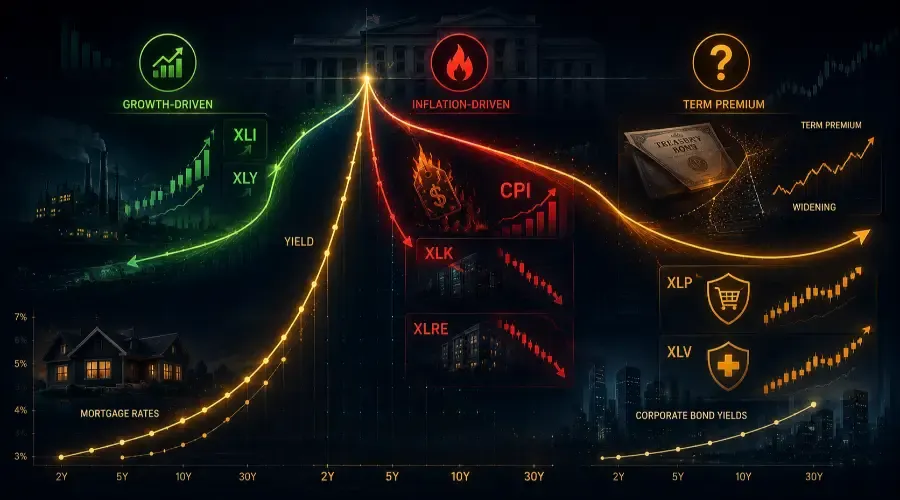
When the 10-year Treasury yield spikes, the single biggest mistake traders make is reacting to the number on the screen instead of asking what’s driving it. Growth, inflation, or fear–each tells a completely different story for your portfolio.
Morgan Stanley's 2025 note on higher bond yields pressuring stocks documented what institutional investors had been watching in real time: the 10-year Treasury yield spiked toward 5% in late 2023, and the equity market's reaction was immediate, severe, and sector-specific. Investopedia explains why the 10-year matters. Chase and Schwab explain the mechanism. Merrill Edge and Janus Henderson track the path. What none of those sources convert the move into is a practical US sector winners-and-losers framework – because the most important variable in a 10-year yield spike is not the level the yield reaches. It is the speed at which it gets there, and the underlying cause driving it. Those two variables determine whether the yield spike is a signal to buy cyclicals or retreat to defensives, and they produce sector rotations that point in completely opposite directions from the same headline number.
Why This Matters More Than Most Traders Realize
The 10-year US Treasury yield is the single most important number in global finance. It is the benchmark rate from which thirty-year mortgage rates, investment-grade corporate bond yields, municipal bond rates, and equity discount rates are all derived. When the 10-year moves, everything priced off it moves – which means every sector of the equity market is affected, every leveraged balance sheet reprices, and every capital allocation decision made by every CFO in the S&P 500 becomes either more or less attractive.
The specific data point that frames the stakes: a 100 basis point rise in the 10-year yield reduces the theoretical value of a thirty-year bond by approximately 15%. For equity markets, a 100bps rise in the discount rate applied to a growth stock trading at 40x forward earnings reduces its theoretical fair value by 20–25% under static earnings assumptions. These are not academic estimates – they are the arithmetic of discounted cash flow valuation, and they explain why a yield spike produces immediate, large, and sector-differentiated equity market responses.
What the strongest competing analyses miss is the decomposition that determines whether a yield spike is bullish or bearish for risk assets. A 10-year yield spike driven by improving growth expectations – the economy accelerating faster than the bond market anticipated – is historically associated with equity bull markets. A 10-year yield spike driven by inflation expectations rising – the bond market repricing the likelihood of sustained price pressure – is historically associated with multiple compression and sector rotation away from growth. A 10-year yield spike driven by term premium expansion – investors demanding more compensation to hold long-duration US government debt due to fiscal concerns or supply dynamics – is historically associated with broad equity market stress regardless of economic growth. Same number on the screen, three completely different investment environments. [LINK: Macro Events Hub]
Why the Surprise Is the Trade, Not the Number
The 10-year Treasury yield is publicly observable in real time. Unlike an NFP report that is released at 8:30am and processed by markets in seconds, the 10-year yield moves continuously throughout the trading day. This means the absolute level you see on the screen – 4%, 4.5%, 5% – is rarely the whole story. The real question is how far the yield has moved relative to what the market had priced in before the move started.
When the 10-year yield spikes 50 basis points faster than consensus expected – as it did during the 2013 Taper Tantrum (100bps in two months) and the 2022 rate shock (275bps in nine months) – the surprise element forces rapid repositioning by every institution that was positioned for a different rate environment. Mortgage REITs that were leveraged at a certain rate assumption must sell assets. Bond funds facing outflows as price declines accelerate must liquidate positions. Equity managers whose models assumed a lower discount rate must mechanically reduce equity targets. This forced repositioning is what converts a yield increase into an equity market shock – not the yield level itself.
The practical implication: when you are monitoring the 10-year yield for a trading signal, the relevant comparison is not "is the yield high?" but "is the yield higher than the consensus expected one month ago?" The CME FedWatch tool and Treasury futures markets provide daily visibility into where the market expected the 10-year to be – deviations from those consensus expectations are the actual trade catalyst. The absolute level does carry some weight – it sets the cost of capital baseline for countless instruments – but the velocity and surprise are what trigger the abrupt sector repricings that hurt traders who were late to adjust.
Consensus vs Reality: How Markets Were Positioned
Every major 10-year yield spike in market history has been preceded by a period of consensus positioning in the opposite direction. Understanding the positioning that is being unwound explains the speed and magnitude of the equity market response.
The 2022 case illustrates the mechanism clearly. At the beginning of 2022, the median Wall Street forecast for the 10-year yield at year-end 2022 was approximately 2.1%. The 10-year ended 2022 at 3.88% – a deviation of approximately 178 basis points from consensus. Every institutional portfolio that was positioned for the 2.1% forecast – overweight long-duration bonds, overweight high-multiple technology stocks, overweight REITs – was simultaneously wrong and forced to reposition. The magnitude of the equity market decline (S&P 500 down 19%, XLK down 33%, XLRE down 29%) reflected not just the yield level but the mass repositioning of capital that had been allocated to the wrong rate environment.
The 2023 spike to 5% created a second consensus failure. After the 2022 hiking cycle, the consensus expected the 10-year yield to decline as the Fed paused and inflation fell. Instead, the 10-year rose from approximately 3.5% in April 2023 to nearly 5% by October – surprising a market that was positioned for yield stability or decline. BNP Paribas' June 2025 investment strategy note captured the resulting repositioning pressure: equity valuations were under stress from the unanticipated yield extension, even as economic growth remained relatively resilient.
The consensus positioning check – the most important pre-trade diagnostic for a 10-year yield spike – uses three observable indicators: the 10-year Treasury futures positioning (CFTC Commitments of Traders report, published Friday afternoons), the spread between current yield and the Bloomberg consensus year-end forecast (available through financial data terminals), and TLT (iShares 20+ Year Treasury Bond ETF) fund flow data. When speculative positioning in Treasury futures is heavily long bonds (betting on lower yields) and TLT is seeing inflows, the consensus is positioned for yields to fall – and the squeeze from an unexpected yield spike is most severe.
The Market's Reaction Scorecard: Sector by Sector
Real Estate (XLRE) – Strong Negative – Immediate.
XLRE is the most yield-sensitive equity sector in the S&P 500, for the same mathematical reason that makes it rate-sensitive in a Fed hiking cycle: its valuation is a direct function of the discount rate applied to rental income streams. The 10-year yield is the specific benchmark that drives mortgage rates and real estate capitalisation rates – more directly than the Fed funds rate itself. A 100bps 10-year yield spike typically adds roughly 100bps to thirty-year mortgage rates within four to six weeks, reducing housing affordability by 8–10% at any given monthly payment. Historically, XLRE has fallen 3–5% for every 50bps unexpected rise in the 10-year yield, making it the sector with the highest yield sensitivity coefficient. The relationship isn’t perfectly linear–market positioning, absolute rate levels, and the growth backdrop all matter–but the direction is overwhelmingly negative.
Utilities (XLU) – Strong Negative – Immediate.
XLU's bond-proxy valuation is directly challenged by any 10-year yield spike. When Treasury yields rise, the yield differential between utility dividends and risk-free Treasury income narrows or inverts – making utilities relatively unattractive as yield instruments. Utility companies also face higher financing costs for infrastructure projects. The XLU reaction to a 10-year spike is faster and more complete than any other sector: institutional managers who hold XLU for its yield characteristics rebalance toward direct Treasury holdings when Treasury yields become more competitive.
Technology (XLK) – Significant Negative – 1–3 Months.
Long-duration growth stocks face DCF multiple compression from any yield spike, regardless of cause. A technology company trading at 40x forward earnings with earnings growth projected fifteen years forward sees its present value fall roughly 20% from a 100bps rise in the discount rate, under static earnings assumptions. This arithmetic essentially makes XLK the second-most yield-sensitive sector after XLRE. In practice, earnings rarely sit still–if the spike is growth-driven, stronger earnings can partially offset the multiple compression. The degree of XLK pain scales directly with the multiple: the highest-multiple unprofitable technology companies fall the most; profitable, lower-multiple technology companies are more insulated. The 2022 yield spike and the 2023 extension both produced outsized XLK losses relative to the market.
Financials (XLF) – Complex Mixed – Immediate and Evolving.
The 10-year yield spike creates the most nuanced XLF signal of any sector. The initial reaction is frequently positive: a rising 10-year yield steepens the yield curve (if the short end stays anchored), which is the most favourable NIM environment for banks – they borrow short and lend long. However, a spike driven by term premium or fiscal concern rather than growth expectations eventually raises credit risk as economic conditions deteriorate and mortgage delinquencies rise. The XLF response to a 10-year spike is positive in the first one to two months if the short end stays stable, and turns negative if the yield spike reflects broader financial stress or triggers a mortgage market disruption.
Industrials (XLI) – Mild Mixed – 1–3 Months.
When the 10-year spike is growth-driven – reflecting genuine economic acceleration – XLI benefits from the improved demand environment even as financing costs rise modestly. When the spike is inflation or term-premium driven, XLI faces higher capital expenditure financing costs without the compensating demand improvement. The XLI response requires cause identification: growth-driven spike = buy XLI; inflation or term-premium spike = reduce XLI.
Consumer Discretionary (XLY) – Moderate Negative – 1–3 Months.
The mortgage rate linkage is direct and fast: thirty-year mortgage rates follow the 10-year with a four to six week lag. A 100bps 10-year spike that adds 100bps to mortgage rates reduces monthly payments capacity by approximately $200–$300 on a $400,000 mortgage – removing the marginal buyer from the housing market within weeks. Auto loan rates similarly move with Treasury yields. XLY housing-related names (homebuilders, home improvement) and auto-adjacent names face demand headwinds within one to two quarters of a significant yield spike.
Consumer Staples (XLP) – Mild Positive Relative – Immediate.
As rate-sensitive and growth sectors sell off on a yield spike, defensive capital rotates toward XLP. The defensive premium in consumer staples improves when yield spikes create growth uncertainty. However, XLP's absolute yield appeal diminishes as Treasury yields rise – the same mechanism that pressures XLU also pressures XLP's dividend yield attractiveness. The net signal is mildly positive relative to the market but potentially flat to negative in absolute terms during large spikes.
Materials (XLB) – Mixed – 1–3 Months.
Growth-driven yield spike: XLB benefits from improved economic demand expectations, particularly for industrial metals. Inflation-driven spike: XLB benefits from the commodity price appreciation that is simultaneously driving inflation. Term-premium spike: XLB faces the stronger dollar headwind as US yield differential attracts foreign capital. The XLB response is cause-dependent, with the dollar impact being the most reliable negative across all three causes.
Energy (XLE) – Mild Negative (Dollar) / Mild Positive (Growth) – 1–3 Months.
The dollar strengthening that typically accompanies a US yield spike creates headwinds for dollar-denominated commodity prices – a mild negative for XLE through the currency channel. A growth-driven yield spike that reflects improving economic activity is also positive for energy demand. The two effects partially offset, making XLE approximately neutral in a growth-driven spike and mildly negative in an inflation or term-premium driven spike.
Communication Services (XLC) – Mild Negative – 1–3 Months.
Higher discount rates compress the long-duration valuation of digital advertising platforms, and consumer spending caution from mortgage and financing cost increases reduces advertising budget growth. XLC underperforms modestly – 2–3% relative – in most yield spike scenarios.
Healthcare (XLV) – Mild Negative – 1–3 Months.
Multiple compression from higher discount rates affects XLV's growth-oriented names (biotech, medical technology). The defensive characteristics partially offset the valuation headwind. Expect 1–2% relative underperformance in most yield spike scenarios, with better relative performance in term-premium spikes where the defensive premium becomes more valuable.
Magnitude Matters: Mild Spike vs Shock Spike
The equity market reaction scales non-linearly with the speed of the yield spike. A 25–50bps rise over three months produces manageable, rotation-based adjustments. A 100+bps spike in under three months produces forced institutional repositioning that amplifies the initial mathematical repricing.
Mild spike (25–50bps, over 3+ months): XLRE and XLU underperform by 3–5%. XLK faces 5–8% multiple compression. Defensive rotation is modest and temporary. The mean-reversion probability is high – markets absorb the move within one to two quarters.
Moderate spike (50–100bps, over 2–3 months): XLRE and XLU underperform by 8–15%. XLK faces 10–15% multiple compression. Mortgage market disruption begins appearing in housing data. Forced institutional repositioning amplifies the mathematical effect. The 2013 Taper Tantrum (100bps in two months) and the H2 2023 extension fell in this category.
Shock spike (100+bps, under 2 months): The 2022 cycle – 175bps in under six months – and the 1994 bond market crash – 225bps in twelve months – represent shock territory. At this scale, the yield spike triggers systemic repositioning, margin calls on leveraged fixed income portfolios, and mortgage market disruption severe enough to reduce housing transaction volume by 20–30%. Every sector feels the shock; the differentiated rotation framework matters less because the broad deleveraging effect overwhelms it.
Beyond the direct sector impacts, a sharp 10-year yield spike often strengthens the US dollar, tightening global financial conditions. For portfolios with international equity or commodity exposure, that dollar drag can amplify domestic equity headwinds–another reason to pay attention to what's driving the spike, not just the number.
Historical Cases Sorted by Surprise Magnitude
1994 | The Bond Market Massacre – The Defining Shock Case
The Federal Reserve surprised markets with seven rate hikes totalling 300 basis points in twelve months beginning February 1994. The 10-year Treasury yield rose from approximately 5.8% in January 1994 to 8.0% by November – a 220bps spike that produced a 20% decline in 30-year Treasury bond prices. The surprise magnitude was extreme: Wall Street consensus entering 1994 had expected the yield to remain near 5.5–6.0%. XLRE and XLU equivalents fell sharply. The bond market disruption rippled through Orange County (which declared bankruptcy from leveraged Treasury positions) and into global emerging markets. The S&P 500 ended 1994 approximately flat – contained damage because the economic backdrop was healthy, but specific rate-sensitive sectors experienced peak-to-trough declines of 20–30%. The case establishes that shock-magnitude yield spikes produce systemic dislocations beyond normal sector rotation. Lag window: XLRE and XLU immediate; equity market contained by strong growth backdrop; fixed income leveraged positions blew up within weeks.
2013 | The Taper Tantrum – Speed Matters as Much as Level
Fed Chair Bernanke's May 2013 hint at tapering QE sent the 10-year yield from approximately 1.6% to 3.0% in five months – a 140bps spike at a speed that surprised a market positioned for continued yield suppression through QE. XLRE fell approximately 15% from its May peak by September. XLU dropped 12%. XLK was affected but less severely than XLRE and XLU because the economic growth expectations that accompanied the tapering signal partially supported technology earnings. The S&P 500 declined approximately 5% in June 2013 before recovering, as markets processed the distinction between "tapering QE" and "raising rates" – the growth signal embedded in the tapering discussion eventually supported equities. The case demonstrates that the cause decomposition matters: a yield spike from tapering (policy normalisation) is less damaging than a spike from pure inflation fear, because the growth signal embedded in tapering partially offsets the discount rate headwind. Lag window: XLRE and XLU immediate; XLK recovered within two quarters as growth signal dominated; market overall recovered by August 2013.
2022–2023 | The Fastest Sustained Spike in Four Decades
The 10-year yield rose from approximately 1.5% in January 2022 to 4.25% by October 2022, then extended to nearly 5.0% by October 2023 – a total spike of 350bps over twenty-two months with no material period of relief. The 2022 portion was predominantly inflation-driven (CPI at 9%), producing the worst sector rotation for long-duration assets since 1994: XLRE fell 29%, XLK fell 33%, XLU was relatively insulated early but fell as the hiking cycle extended. The 2023 extension occurred despite inflation declining – suggesting term premium was the dominant cause as markets grew concerned about US fiscal deficits and Treasury supply. Morgan Stanley's 2025 research retrospective confirmed that the term premium expansion in 2023 was the least economically justified of the three causes and produced the most indiscriminate equity pressure. Lag window: XLRE and XLK immediate in 2022; second XLK decline in 2023 as the yield extension surprised a market positioned for stability; XLF initially positive in 2022 on NIM expectations before turning negative in 2023 on credit concerns.
The Trading Playbook
Before: What to Watch for Early Warning
Monitor the 10-year Treasury yield daily relative to the Bloomberg consensus forecast (available through financial data terminals and summarised in weekly strategy notes from major banks). The most actionable signal is not the yield level but the deviation between current yield and the six-week-prior consensus. When the 10-year has moved more than 30bps above where the consensus expected it to be six weeks ago, the surprise element is sufficient to trigger the forced institutional repositioning that amplifies the sector rotation. Set an alert at 30bps above the rolling six-week consensus as the threshold for applying the full sector defensive rotation.
Decompose the yield move using the TIPS market daily (fiscaldata.treasury.gov, 10-year TIPS yield). The 10-year nominal yield can be split into 10-year TIPS yield (real rate) and 10-year breakeven inflation rate (BEI). When the TIPS yield is rising and the BEI is flat, the move is largely growth-driven – a signal to reduce XLRE but not necessarily XLK. When the BEI is rising and TIPS is flat, the spike points toward inflation fears – reduce both XLRE and XLK aggressively. When both TIPS and BEI are flat but the nominal yield is rising, term premium is expanding – apply the broadest defensive rotation across all long-duration sectors. In practice, these components rarely move in isolation; they often shift together in overlapping fashion. The decomposition is a first-cut guide, not a perfect sorting mechanism. If the picture is unclear, weight the dominant mover and avoid over-committing to a single narrative.
Watch TLT (iShares 20+ Year Treasury Bond ETF) fund flows weekly (ETF.com flow data, updated weekly). When TLT is experiencing outflows of more than $500 million per week for three consecutive weeks, institutional liquidation of long-duration Treasury positions is underway – the forced selling that amplifies yield spikes. TLT outflow acceleration is a leading indicator of the yield spike intensifying, because the selling of long-duration bonds is itself part of the mechanism driving yields higher.
During: Positioning When the 10-Year Is Spiking
Immediately reduce XLRE and XLU to below-benchmark weight upon confirming a 30bps+ surprise deviation from consensus. The mathematical repricing of these sectors begins within days of a yield spike of this magnitude, and the recovery takes weeks to months – there is no "wait and see" opportunity cost from acting quickly. Use the iShares US Real Estate ETF (IYR) or XLRE alongside XLU as the reduction vehicles.
Apply cause-specific secondary positioning after the core XLRE/XLU reduction. Growth-driven spike: maintain or add XLI and XLY for the demand recovery signal embedded in the yield move. Inflation-driven spike: add XLE and XLB commodity producers that benefit from the inflationary environment causing the yield rise; reduce XLK aggressively. Term-premium spike: apply maximum defensive rotation – add XLP and XLV, reduce XLK and XLY, treat as a broad risk-off event.
Use TLT as a real-time position management indicator. When TLT's daily price decline moderates – falling less than 0.5% on days when the broader market is under pressure – the forced institutional selling is exhausting. This deceleration in TLT decline is the early signal that the yield spike is approaching its near-term peak, which is the trigger for beginning to rebuild XLRE and XLU positions.
After: The Mean-Reversion Question
The 10-year yield spike is the event in this series most prone to mean-reversion – and determining whether this spike is a temporary overshoot or a structural regime change is the most important post-spike analytical question.
Examine the cause. Growth-driven yield spikes historically mean-revert within one to two quarters as the market's initial optimism moderates. Inflation-driven spikes are more persistent – they typically require several consecutive sub-consensus CPI prints before the yield retreats meaningfully. Term-premium spikes are the most unpredictable – they can resolve quickly (if fiscal concerns are addressed) or persist indefinitely (if the underlying supply-demand imbalance in Treasury markets continues).
Watch the 10-year yield making three consecutive weekly lower closes after a spike peak as the mean-reversion confirmation. This signal – three weekly lower closes – has historically marked the point at which rebuilding XLRE and XLU positions generates positive returns within the subsequent two quarters. Acting on the first lower close is premature; waiting for the third provides sufficient confirmation that the spike is exhausted. Be aware that this is a conservative rule: it prevents whipsaws, but it will lag the exact turning point, especially in fast-moving shock spikes.
Rebuild XLK on the first confirmed weekly 10-year yield decline of more than 15bps from the spike peak.Technology stocks lead the equity market recovery from yield spikes more reliably than any other sector, because DCF multiple expansion responds immediately to yield decline. The XLK recovery trade from a confirmed yield peak has historically produced 10–20% outperformance versus SPY in the two quarters following the yield peak confirmation.
The Mean-Reversion Question: Does This Reverse?
Every yield spike eventually reverses – but the timeline spans weeks to years depending on cause and magnitude. The three historical outcomes:
Taper Tantrum (2013): 140bps spike, resolved within twelve months as the market accepted tapering without recession. Full reversal – yield fell back toward 2% within eighteen months. XLRE and XLU fully recovered within twelve months of the spike peak.
2022 Inflation Spike: 275bps spike, partially reversed to approximately 3.5% as inflation fell from 9% to 3% over eighteen months. Partial reversal – the new equilibrium yield was higher than the pre-spike level, reflecting genuine policy normalisation. XLRE and XLU recovered partially but established a new lower valuation level rather than fully reverting.
1994 Bond Massacre: 220bps spike, fully reversed within eighteen months as the Fed successfully cooled inflation and began cutting rates in 1995. Full reversal – Greenspan's "insurance cuts" in 1995 sent yields back toward 6% and initiated a five-year equity bull market.
The mean-reversion baseline: growth-driven and policy-normalisation spikes typically fully reverse within twelve to eighteen months. Inflation-driven spikes partially reverse once inflation is controlled. Term-premium spikes are the least mean-reverting – they can establish a new permanently higher equilibrium if the underlying fiscal or supply concerns are structural rather than cyclical.
The 3 Mistakes Most Retail Traders Make
Mistake 1: Treating the 10-Year Yield Level as the Signal
The most costly mistake is watching the 10-year yield reach a "high" absolute level – 4%, 4.5%, 5% – and concluding that equities must sell off because "yields are high." The yield level alone is rarely the trade signal. The 10-year at 5% during the 1990s technology boom was associated with equity bull markets because earnings growth exceeded the discount rate increase. The 10-year at 3% in 2022 was devastating because markets had been positioned for 1.5%. The signal is the deviation from consensus expectations, not the absolute level. A yield that is "high" but expected produces no equity disruption. A yield that is "lower than last year" but 50bps above what the market had priced creates a significant dislocation. Context around expectations matters far more than any single number.
Mistake 2: Ignoring the Cause Decomposition and Applying One-Size Rotation
The second mistake is seeing the 10-year yield spike and mechanically applying the full defensive rotation – selling XLRE, XLU, and XLK, buying XLP and XLV – regardless of whether the spike is growth-driven, inflation-driven, or term-premium-driven. In a growth-driven spike, this defensive rotation sells exactly the wrong things: XLI and XLY benefit from the growth signal embedded in the rising yield, and selling the market into a growth-acceleration signal is the wrong direction. The TIPS decomposition – two minutes, one free website – provides a first-cut guide to the correct sector-specific response. Applying the wrong response to a growth-driven spike costs the opportunity cost of missing the cyclical rally that follows.
Mistake 3: Buying XLRE and XLU Immediately on the First Sign of Yield Stabilisation
The third mistake is treating a single day of yield stability as the reversal confirmation and aggressively rebuilding XLRE and XLU positions before the spike has exhausted. Yield spikes frequently consolidate – pausing for two to three days – before resuming higher. The 2022 yield spike produced multiple false stabilisation signals that trapped early XLRE buyers. The three-weekly-lower-close confirmation requirement prevents this mistake by requiring three consecutive weeks of evidence rather than one day of relief.
Frequently Asked Questions
What happens when the 10-year Treasury yield spikes?
When the 10-year Treasury yield spikes, borrowing costs rise across the economy. Mortgage rates, corporate bond yields, and equity discount rates increase, pressuring sectors like real estate and technology.
Why is the 10-year Treasury yield important?
The 10-year Treasury yield is the benchmark rate used to price mortgages, corporate debt, and stock valuations. Changes in the yield impact nearly every major financial asset.
Which sectors are hurt most by rising Treasury yields?
XLRE and XLK are typically the most negatively affected because their valuations are highly sensitive to rising discount rates.
Why do technology stocks fall when yields rise?
Higher Treasury yields increase the discount rate applied to future earnings, reducing the present value of long-duration growth companies.
How do rising Treasury yields affect real estate?
Higher yields push mortgage rates higher, reducing housing affordability and increasing capitalization rates, which pressures REIT and property valuations.
Can rising Treasury yields ever be bullish for stocks?
Yes. If yields rise because economic growth is accelerating, sectors like industrials and financials may benefit from stronger demand and improved lending conditions.
What is a term premium spike?
A term premium spike occurs when investors demand higher compensation for holding long-term government debt, often due to fiscal concerns or heavy Treasury supply.
Why do banks sometimes benefit from rising yields?
XLF can initially benefit because a steeper yield curve improves bank net interest margins. However, prolonged yield spikes may eventually hurt credit quality.
What is the biggest mistake traders make during yield spikes?
Many traders focus only on the absolute yield level instead of understanding whether the move is driven by growth, inflation, or term premium expansion.
How long do Treasury yield spikes usually last?
Yield spikes can last from a few weeks to over a year depending on inflation trends, Federal Reserve policy, and economic growth conditions.
Bottom Line: The One-Sentence Institutional Framework
When the 10-year yield spikes more than 30bps above the six-week consensus expectation, immediately reduce XLRE and XLU, decompose the spike into TIPS versus BEI components to identify the cause, apply cause-specific secondary rotation – growth spike means hold XLI; inflation spike means add XLE/XLB and reduce XLK; term premium spike means maximum defensive rotation – and use three consecutive weekly lower closes in the yield as the confirmation to rebuild rate-sensitive positions.
This framework works across cycles because the yield's deviation from consensus is the actual market-moving variable in every historical spike – not the yield level, not the Fed's actions, not any single economic data point. The consensus deviation forces institutional repositioning, and that repositioning is the mechanism that transmits the yield move into equity sector prices. Understanding the deviation rather than the level is the analytical step that separates the correct sector rotation from four different wrong answers.
In a Nutshell
A 10-year Treasury yield spike isn’t automatically a sell signal–it’s a signal to slow down and read the labels. Growth-driven spikes reward cyclicals, inflation-driven spikes crush long-duration technology and real estate, and term-premium expansions demand outright defense. The playbook always starts the same way: measure the surprise, decompose the cause, trim XLRE and XLU first, and wait for confirmed stabilization before rebuilding. Do that, and you’ll stop trading the number and start trading what’s actually moving the market.
Educational content only. Not investment advice. Past sector performance patterns do not guarantee future results.