
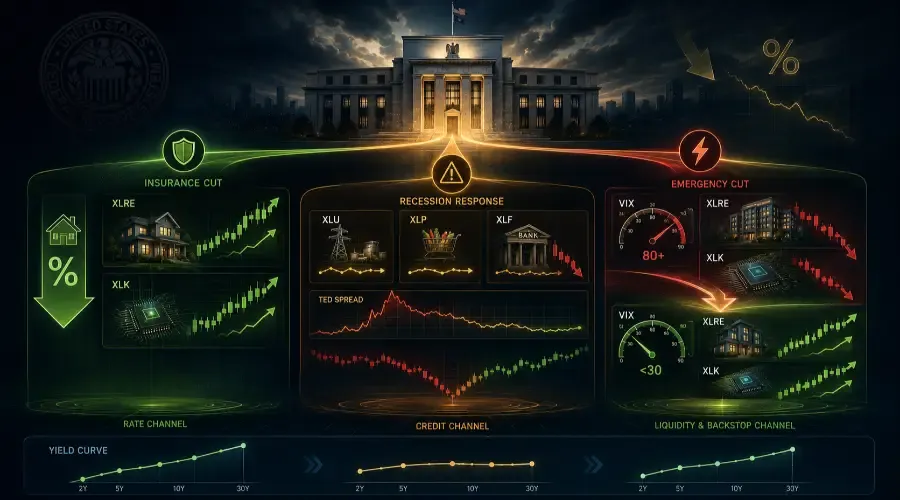
A Federal Reserve rate cut looks like a straightforward buy signal–until you realize that the “why” behind the cut matters more than the cut itself. Here’s how to read what the Fed is really telling you.
Northeastern, Navy Federal, NerdWallet, Forbes Advisor, and Charles Schwab all describe Fed rate cuts with the same framing: cheaper borrowing costs support stocks and bonds, consumers benefit from lower loan rates, and the economy gets a growth boost. Every statement is true in isolation. None of them tells you the one thing that determines whether a Fed rate cut produces a multi-year equity bull market or six more months of declining stock prices: why the Fed is cutting. The Fed cut rates aggressively in 2001 and equities fell another 40%. The Fed cut rates in 2019 and equities rallied 25%. The Fed cut to zero in March 2020 and equities initially crashed another 15% before staging the most rapid recovery in market history. Same tool, three completely different outcomes – determined entirely by whether the cut was a preventive adjustment, a recession response, or an emergency intervention.
Why This Matters More Than Most Traders Realize
A Federal Reserve rate cut is the single most misread bullish catalyst in financial markets. The popular narrative – "the Fed cuts rates, stocks go up" – is accurate often enough to be believed and wrong often enough to be costly. The reason traders consistently overpay for the wrong equity exposure around Fed rate cuts is that they treat the cut as the signal when it is actually just the mechanism. The signal is the economic condition that prompted the cut.
The quantitative evidence makes the distinction stark. In the three insurance cut cycles of the modern era – 1995, 1998, and 2019 – the S&P 500 was up 15–30% in the twelve months following the first cut. In the three recession response cut cycles – 2001, 2007, and 2020 – the S&P 500 was down 20–40% in the twelve months following the first cut, even as the Fed cut aggressively throughout. The cut itself was not the differentiating variable. The economic condition prompting it was.
What the strongest competing analyses miss is the cut-type diagnostic – the analytical step that determines which sector rotation framework applies before any positioning decision is made. Each cut type produces not just different equity returns but fundamentally different sector sequencing, different timing windows, and different exit signals. The sector-by-sector winner-and-loser map that applies in an insurance cut cycle is the wrong map for a recession response cut cycle – and applying it generates losses in exactly the environments where the most aggressive positioning feels most justified. [LINK: Macro Events Hub]
Data Event vs Regime Change: The Policy Shift Distinction
A Federal Reserve rate cut is not a data event. It is a regime change – the establishment of a new monetary policy environment that will persist for months to years and affect every sector of the economy continuously through its duration, not as a one-time shock that the market processes and moves past.
The key distinction from a data event like a CPI print or an NFP miss: a rate cut changes the operating environment for every company simultaneously. Lower borrowing costs reduce interest expense for every leveraged company. Lower mortgage rates improve housing affordability for every potential homebuyer. Lower Treasury yields compress the discount rate applied to every equity valuation model. These changes compound over time – each month in a cutting regime, the cumulative effect of lower rates builds in corporate balance sheets, consumer spending capacity, and asset valuations.
The regime framing also explains why the "sell the news" phenomenon is more common around rate cut announcements than around rate hike announcements. Markets price expected future rate cuts weeks or months before they occur, through the expectations channel. By the time the first actual cut is announced, a significant portion of the rate-sensitive sector repricing has already happened. The announcement itself can produce a "sell the news" reaction if the market had priced a more aggressive cutting path than what the Fed's language confirms. Understanding what the market had already priced going into the cut announcement is as important as understanding the cut itself.
The critical regime dimension unique to cutting cycles: cuts come in sequences. The first cut is rarely the last. The total magnitude and pace of the cutting cycle – which may span six months or three years – determines the cumulative economic stimulus delivered to the sectors that benefit from lower rates. Positioning for one cut versus positioning for a full cutting cycle produces completely different position sizes and time horizons.
The Three Cut Types: The Diagnostic That Changes Everything
Before making any sector rotation decision around a rate cut, determine which of three cut types is active. This diagnostic determines the correct sector map, the correct timing, and the correct exit signal.
Type 1: Insurance Cut (Preventive / Mid-Cycle Adjustment). The Fed cuts rates while the economy is still healthy – GDP is positive, unemployment is low, corporate earnings are growing – to prevent a potential slowdown from becoming an actual recession. The economy does not need the cut to survive; it uses the cut to extend the expansion. Historical examples: 1995 (three cuts following the bond market shock of 1994), 1998 (three emergency cuts following the LTCM and Russian debt crisis), 2019 (three cuts following trade war uncertainty). Equity market outcome: broadly bullish. All sectors eventually benefit from the improved financial conditions. Risk assets recover fastest. The "buy the first cut" rule works reliably in insurance cut cycles.
Type 2: Recession Response Cut (Reactive Easing). The Fed cuts rates because a recession has either begun or is clearly imminent – GDP is contracting or about to, unemployment is rising, and corporate earnings are deteriorating. The cuts are necessary but insufficient to prevent significant economic and earnings damage before the stimulus takes effect. Historical examples: 2001 (Fed cut from 6.5% to 1% over twenty-five months while equities fell 49%), 2007-2008 (Fed cut from 5.25% to 0.25% while equities fell 57%). Equity market outcome: negative for twelve to twenty-four months despite aggressive cutting, because the earnings deterioration and credit losses outpace the stimulus. The "buy the first cut" rule fails catastrophically in recession response cut cycles.
Type 3: Emergency Cut (Crisis Intervention). The Fed cuts to zero in response to a sudden external shock – a financial system crisis, a pandemic, a geopolitical emergency – that threatens systemic stability. The cuts are accompanied by extraordinary measures (QE, credit facilities, swap lines) beyond the rate itself. Historical examples: 2008 Lehman (combined with QE), 2020 COVID (cuts to zero plus $3T QE in twelve weeks). Equity market outcome: initial crash phase continues despite the cut (because the emergency is still developing), followed by a sharp and rapid recovery once the policy backstop establishes a floor and the emergency is perceived to be contained. The "buy the cut" rule fails in the initial phase and then spectacularly succeeds in the recovery phase.
A word of caution on the diagnostic in real time: At the moment of the first cut, GDP is sometimes still positive while leading indicators are deteriorating rapidly. In September 2007, unemployment stood at 4.7% and GDP was still growing – a snapshot that might have suggested a Type-1 “insurance” cut. The weight of evidence matters: pay attention to the direction and speed of change in unemployment, credit spreads, and ISM data, not just the absolute level at the moment of the first cut.
The diagnostic test: Is unemployment below 5% and GDP positive, with credit markets stable? Insurance cut. Is unemployment rising and GDP contracting or near zero, with credit stress building? Recession response. Did the Fed cut 50+ basis points at an emergency intermeeting session? Emergency cut. The answer to these three questions determines your entire sector rotation framework before you look at any price chart.
Which Transmission Channel Is Active?
Channel 1: The Rate Channel (Primary and Immediate). Lower rates reduce the discount rate applied to all future cash flows – directly lifting the mathematical valuations of real estate, utilities, and long-duration technology stocks. This channel activates within days of a cut announcement through the Treasury market and mortgage rate repricing. It is the most immediate and most reliable channel for XLRE and XLU recovery regardless of cut type.
Channel 2: The Credit Channel (1–3 Month Lag). Lower rates reduce the cost of new borrowing and encourage banks to extend credit on more favourable terms. The Federal Reserve's Senior Loan Officer Opinion Survey measures credit availability quarterly – when the SLOOS shifts from tightening to easing standards, the credit channel has activated. This channel benefits XLI (capital expenditure financing becomes viable), XLY (auto and home purchase financing improves), and XLRE (development financing reopens). The credit channel takes longer to activate than the rate channel and depends on banks' willingness to lend, not just the Fed's policy rate.
Channel 3: The Wealth Effect Channel (3–6 Month Lag). As asset prices recover on lower rates, household net worth improves, and consumer confidence and spending gradually recover. This channel primarily benefits XLY consumer discretionary and XLC advertising-dependent sectors through the income and confidence effects of rising equity and real estate valuations. It is the slowest channel and most dependent on whether the broader economic backdrop supports spending recovery.
A Short Note on Fiscal Policy and Global Spillovers
Rate cuts don't happen in a vacuum. In 2020, the Fed’s emergency cuts were accompanied by enormous fiscal stimulus; in 2008, fiscal responses were stickier and less coordinated. The presence or absence of fiscal support massively influences the speed with which the credit and wealth-effect channels feed through. Additionally, when the Fed cuts rates, the US dollar often weakens, loosening global financial conditions. Capital flows into emerging markets and commodity-linked currencies, which can lift international equities more than domestic cyclicals in certain phases. This piece focuses on US sector positioning, but any cutting-cycle playbook should be cross-checked against what fiscal authorities are doing and what the dollar is signalling.
Sector Re-rating: Immediate vs Structural
The time windows below are typical ranges; actual lags depend on the speed of rate transmission, fiscal tailwinds, and the broader economic momentum.
Real Estate (XLRE) – Strong Positive – Immediate.
XLRE is the mathematical first beneficiary of any rate cut regardless of type. Lower discount rates directly increase the present value of real estate cash flows – the same arithmetic that made XLRE the worst performer in a hiking cycle makes it the best early performer in a cutting cycle. Mortgage rates fall within weeks of a Fed cut, improving housing affordability and transaction volume. REITs are revalued upward as capitalisation rates compress. In insurance cut cycles, XLRE historically gains 15–25% in the twelve months following the first cut. In recession response cycles, XLRE gains on the rate channel but faces offsetting headwinds from deteriorating occupancy and rent growth as the economic slowdown reduces demand. Size the XLRE position proportional to cut type: maximum in insurance cuts, moderate in recession response, smaller in emergency cuts until the crisis is visibly contained.
Utilities (XLU) – Moderate Positive – Immediate.
XLU's bond-proxy premium is restored when rates fall – the yield differential between utility dividends and Treasury yields widens in favour of utilities as Treasury yields decline. This repricing is immediate and reliable regardless of cut type. XLU's defensive revenue characteristics also provide earnings stability during the economic uncertainty that often accompanies recession response and emergency cuts, making it doubly attractive in those scenarios. Expect 8–15% relative outperformance in the first six months of an insurance cut cycle; similar or better in recession response cycles where the defensive premium additionally supports XLU.
Financials (XLF) – Complex Negative – Immediate and Sustained.
XLF is the mirror of its hiking cycle performance: the NIM expansion that made banks early-cycle winners in a hiking regime becomes NIM compression in a cutting regime. As rates fall, banks earn less on their loan and investment portfolios while deposit rates adjust downward more slowly – compressing the spread that drives earnings. In insurance cut cycles, the NIM compression is modest and partially offset by higher loan volumes and better credit quality. In recession response cycles, the NIM compression combines with rising loan loss provisions and credit deterioration – producing sustained XLF underperformance. Expect 5–10% relative underperformance in recession response cutting cycles; modest underperformance in insurance cut cycles. XLF is the clearest sector sell in a rate cut regime, reversing the early-cycle buy that applied in the hiking regime.
Technology (XLK) – Moderate to Strong Positive – Generally 1–6 Months.
DCF multiple expansion is the rate cut benefit for XLK – the reverse of the multiple compression that hurt high-growth technology stocks in the hiking cycle. As the discount rate applied to future earnings falls, the present value of technology companies' long-duration earnings streams rises, particularly for the highest-multiple growth names. In insurance cut cycles, this multiple expansion combines with continued earnings growth to produce strong XLK returns – the 2019 cuts contributed to XLK's 48% return that year. In recession response cuts, multiple expansion is partially offset by earnings deterioration as the economic slowdown reduces enterprise and consumer technology spending. The XLK positioning in a cut cycle depends on whether the economic backdrop supports continued earnings growth (insurance cut: strong buy) or earnings are under pressure (recession response: wait for earnings trough before buying).
Consumer Discretionary (XLY) – Moderate Positive – Typically 3–12 Months.
The consumer benefit from rate cuts arrives with a longer lag than the financial asset repricing because it depends on the transmission from lower Fed funds rate to lower mortgage rates to actual consumer borrowing decisions. The thirty-year mortgage rate typically falls 50–75 basis points within the first three months of a cutting cycle – improving affordability – but the actual increase in home purchase activity takes six to twelve months to appear in economic data. Auto loan rates fall similarly, supporting vehicle demand. The insurance cut cycle context is most favourable for XLY; recession response cuts face the complication that the economic conditions prompting the cuts also reduce consumer confidence and employment-dependent spending capacity.
Industrials (XLI) – Moderate Positive – 1–6 Months.
Lower financing costs revive capital expenditure projects that were deferred during the hiking cycle. When companies can finance factory expansions, fleet replacements, and equipment purchases at 4% instead of 7%, projects that were marginal become economically viable. In insurance cut cycles, this capex revival is visible in durable goods orders data within two to three quarters. In recession response cycles, the demand-side weakness from the recession can overwhelm the financing cost benefit – XLI companies may have cheaper financing available but face lower order volumes from their customers.
Materials (XLB) – Mild Positive – 3–12 Months.
Demand recovery from improved economic activity and lower financing costs for construction projects eventually lifts XLB. However, the dollar typically weakens during cutting cycles – providing an additional commodity price tailwind as dollar-denominated materials become more expensive in other currencies, boosting XLE and XLB commodity complex revenues. The XLB recovery is the latest cyclical recovery and depends on the overall economic recovery being established rather than just the rate channel activating.
Energy (XLE) – Mild Positive – 3–12 Months.
The demand recovery channel and the dollar weakness channel both support XLE in cutting cycles, but the timing is long and the magnitude depends on whether the cut cycle produces genuine economic acceleration. In insurance cuts, XLE benefits from both stronger demand and the softer dollar. In recession response cuts, the demand headwind from the recession itself can offset the dollar and financing cost benefits.
Consumer Staples (XLP) – Mild Negative Relative – 1–6 Months.
As confidence in the rate cut regime builds and risk appetite returns, the defensive premium that XLP accumulated during the hiking cycle unwinds. Capital rotates from defensives to cyclicals and rate-sensitive growth sectors. XLP's absolute returns may be flat to positive, but its relative performance versus the S&P 500 deteriorates as the risk-on environment develops. The exception is recession response cuts where XLP's defensive characteristics remain relevant – in those scenarios, XLP maintains its defensive premium longer before the rotation to cyclicals occurs.
Communication Services (XLC) – Moderate Positive – 3–12 Months.
Advertising revenue recovery follows consumer confidence and corporate profit growth – both of which lag the rate channel by two to four quarters. XLC benefits from the improving economic conditions that follow insurance cut cycles but faces headwinds in recession response cuts where advertising budgets are among the first corporate expenses reduced.
Healthcare (XLV) – Mild Positive – 1–6 Months.
Lower financing costs reduce the cost of capital for capital-intensive hospital systems and medical device manufacturers. Healthcare's defensive revenue characteristics also provide stability during the uncertainty that often accompanies the beginning of a cut cycle. XLV is a reasonable holding across all three cut types, with the highest relative appeal in recession response and emergency cuts where its defensive characteristics are most valuable.
Historical Regime Cases: Three Full Cycles
2019 | Insurance Cuts – The Textbook Mid-Cycle Adjustment
The Federal Reserve cut rates three times in 2019 – July, September, and October – taking the Fed funds rate from 2.50% to 1.75%, a 75 basis point total reduction. The economic backdrop at the time of the first cut: US unemployment at 3.7%, GDP growth at approximately 2.3%, corporate earnings growing modestly (all total-return figures below). The cuts were explicitly described as insurance against trade war uncertainty and slowing global growth – not a response to actual economic contraction. XLRE gained 29% in 2019 (best performing sector). XLU gained 26%. XLK gained 48% – the technology multiple expansion from falling rates combined with continued earnings growth. XLY housing-related sub-sectors began recovering as mortgage rates fell 75 basis points through H2 2019. XLF underperformed modestly as NIM compression materialised but was offset by higher loan volumes and strong credit quality. The S&P 500 returned 31.5% in 2019. This is the definitive insurance cut case study: rate cuts in a healthy economy produce sustained and broad equity bull markets. Duration of regime: three cuts over four months, then hold – the cycle was interrupted by COVID rather than concluded naturally.
2007–2008 | Recession Response Cuts – The Dangerous "Buy the Cut" Trap
The Federal Reserve began cutting rates in September 2007 – reducing from 5.25% with urgency that signalled genuine concern – and continued cutting through December 2008, reaching 0.25%. The total reduction was 500 basis points in fifteen months. Retail investors who "bought the first cut" in September 2007 purchased the S&P 500 near 1,520. Over the next fifteen months, despite seventeen Fed actions including emergency cuts and unprecedented stimulus, the S&P 500 fell to 666 – a 56% decline (approximate peak-to-trough). XLRE fell roughly 70% (peak-to-trough) despite the rate cuts because the housing market's credit crisis was the underlying cause of the recession, not a consequence of high rates. XLF fell roughly 75% (peak-to-trough) because the bank credit losses from mortgage-backed securities dwarfed any NIM benefit from lower rates. The rate cut made conditions less bad than they would have been – they did not make conditions good. This is the definitive recession response cut case study: buying equities into aggressive rate cuts when recession is the context produces catastrophic losses. The correct approach is to wait for credit market normalisation signals – specifically TED spread (interbank lending risk) falling below 50 basis points – before rebuilding risk exposure.
2020 | Emergency Cut – The Pandemic Shock and Policy Backstop
In March 2020, the Fed cut the federal funds rate to 0.00–0.25% in two emergency intermeeting moves, just as the COVID-19 pandemic brought the global economy to a sudden stop. Massive QE, swap lines, and fiscal transfers followed within weeks. The S&P 500 initially continued falling, losing roughly 34% peak-to-trough into late March, despite the rapid rate cuts. That early-phase selloff demonstrated why “buy the first cut” fails in an emergency: the shock was still intensifying. Once the VIX retreated below 30 and the policy backstop was digested, however, equities staged one of the fastest recoveries on record. XLK and XLRE, hammered during the crash, rebounded sharply as the discount-rate channel and fiscal lifelines kicked in. The S&P 500 recovered its pre-pandemic level within five months. This case study underlines the emergency-cut playbook: do not buy into the cut announcement itself; wait for the acute crisis phase to end (VIX below 30 for five consecutive days), then add XLK and XLRE aggressively. Duration of regime: the Fed held rates near zero until March 2022, making this the longest period of rock-bottom rates in modern history.
How Long Does This Last? The Duration Framework
Cutting cycles have lasted between three months (1998) and twenty-five months (2007–2008) in the modern era. Three variables determine duration:
Economic recovery speed. The Fed stops cutting when the economy shows sufficient strength – typically when GDP exceeds 2% annualised for two consecutive quarters and unemployment is stable or falling. The faster the economy responds to cuts, the shorter the cutting cycle.
Inflation response. The Fed cannot cut indefinitely without risking re-igniting inflation. When core PCE begins rising toward 2.5% or above, the cutting cycle typically ends and a pause begins. Monitor monthly PCE data for this signal.
Financial stability restoration. In emergency and recession response cycles, the Fed maintains low rates until credit markets fully normalise – TED spread below 30 basis points, commercial paper markets functioning, SLOOS showing easing lending standards. Only when these financial stability metrics are restored does the cutting cycle formally conclude.
The Before/During/After Playbook
Before: What to Watch for Early Warning
Monitor CME FedWatch cut probabilities daily (cmegroup.com/markets/interest-rates/cme-fedwatch-tool.html). When the probability of a rate cut at the next FOMC meeting crosses 70% – and the cut expectation has been building for two or more weeks – the expectations channel is activating. XLRE and XLU historically begin outperforming six to eight weeks before the first actual cut, as the rate channel moves on expectations rather than realisations. The optimal entry for rate-sensitive sector positioning is when FedWatch shows 50–70% probability – before the trade is consensus but after the signal is clear.
Read the Fed Chair's press conference language closely for the phrase "meeting-by-meeting basis" versus "will be appropriate to reduce." Meeting-by-meeting language signals the Fed is not committed to a cutting cycle – this is consistent with a single insurance cut or a pause after initial cuts. "Will be appropriate to reduce" language signals the Fed is committing to a directional shift – consistent with a sustained cutting cycle. The language precision is the difference between positioning for one cut and positioning for a regime.
Check the diagnostic test before positioning. Unemployment above 4.5% and rising – recession response, apply recession response sector map. Unemployment below 4%, GDP positive – insurance cut, apply insurance cut sector map. Fed cutting 50bps or more in an emergency intermeeting session – emergency cut, wait for initial crisis phase to complete before rebuilding risk. As emphasized earlier, give extra weight to the rate of change in jobs data and credit spreads when the picture is mixed.
During: Positioning When the Cut Regime Is Active
Insurance cut scenario: Add XLRE and XLU at the first confirmed cut, sized for a twelve-month holding period. Add XLK with a slight tilt toward highest-multiple quality growth names that most benefit from DCF expansion. Reduce XLF modestly to account for NIM compression. Set reminders to add XLY consumer discretionary in month three to four, when mortgage rate and auto loan rate declines begin reaching consumer behaviour.
Recession response scenario: Maintain defensive positioning in XLP, XLV, and XLU through the initial cutting phase. Add XLRE immediately for the rate-channel mathematical benefit, but smaller than insurance cut sizing. Wait for the credit market normalisation signal – TED spread below 50 basis points and SLOOS showing easing lending standards – before adding XLK and XLI cyclical exposure. The credit market normalisation typically arrives six to twelve months after the first recession response cut.
Emergency cut scenario: Do not buy equities into the emergency cut announcement. Wait for the VIX to fall below 30 and hold below 30 for five consecutive trading days – the signal that the acute fear phase has passed. Then add XLK and XLRE aggressively, as emergency cut cycles with QE accompaniment historically produce the fastest and sharpest equity recoveries.
After: The Exit Signal – What Ends the Cutting Regime
The primary exit signal is a shift in Fed language from "appropriately accommodative" back to "meeting-by-meeting." This language shift signals the Fed believes it has delivered sufficient stimulus and is no longer committed to further cuts. Begin reducing XLRE and XLU overweights when this language change appears, as the rate-channel repricing benefit has been fully delivered.
The secondary exit signal is core PCE inflation rising above 2.5% for three consecutive months. When inflation re-accelerates above the threshold that would prompt the Fed to shift from neutral back toward tightening, the cutting cycle has ended and the hiking regime cycle clock begins again. At this point, the entire sector rotation framework from the hiking post applies – immediately.
Rebuild XLF to benchmark weight when the Fed clearly signals a pause – the point at which further NIM compression from additional cuts is no longer expected. XLF's underperformance during the cutting cycle ends when the forward rate path flattens, which typically occurs when the Fed explicitly signals that its policy rate is at or near its terminal level for the cycle.
The 3 Mistakes Most Retail Traders Make
Mistake 1: Buying Equities Immediately Into the First Recession Response Cut
The most dangerous rate cut trading error is treating every rate cut as a buy signal for broad equities, regardless of why the Fed is cutting. Traders who applied the 2019 insurance cut playbook to the 2001 and 2008 recession response cycles experienced devastating losses despite being "right" that the Fed was cutting aggressively. The diagnostic test – unemployment above 4.5% and rising, credit markets stressed – takes thirty seconds to run and prevents the single most costly mistake in rate cut trading.
Mistake 2: Holding XLF Through the Cutting Cycle Because "Banks Love Rate Changes"
The second mistake is conflating XLF's performance in hiking cycles (positive early) with its performance in cutting cycles (negative throughout). Banks benefit from rising rates through NIM expansion; they suffer from falling rates through NIM compression. This is not symmetric – it is opposite in direction. Traders who buy XLF because "it did well last cycle" in a hiking cycle and then expect the same in a cutting cycle are applying a framework in the wrong environment. XLF should be reduced at the first cut announcement and rebuilt only when the Fed's cutting cycle ends and rate normalisation begins.
Mistake 3: Missing the Consumer Lag and Exiting XLY Too Early
The third mistake is adding XLY consumer discretionary at the first rate cut, expecting an immediate consumer spending recovery, and then exiting after one quarter of flat consumer spending data. The mortgage rate and auto loan rate reduction that drives the XLY recovery takes two to four months to reach consumers – and the actual change in purchase behaviour based on those lower rates takes another two to four months to appear in spending data. The XLY trade in a cutting cycle is a six to nine month position, not a one-quarter trade. The exit signal is not "consumer spending hasn't improved yet" – it is a Fed pivot back toward tightening or a significant deterioration in employment that undermines the spending recovery thesis.
Frequently Asked Questions
What happens when the Fed cuts interest rates?
When the Federal Reserve cuts interest rates, borrowing costs fall across the economy. Mortgage rates, loan rates, and Treasury yields typically decline, which can boost sectors like real estate and technology while pressuring bank profitability.
Which sectors benefit most from Fed rate cuts?
XLRE and XLK often benefit the most because lower interest rates improve valuations and reduce financing costs.
Why do banks struggle when the Fed cuts rates?
XLF faces pressure because falling rates compress net interest margins, reducing the spread banks earn between loans and deposits.
Are Fed rate cuts always bullish for stocks?
No. Rate cuts during healthy economic conditions can support strong bull markets, but cuts during recessions or financial crises may coincide with major market declines before recovery begins.
What is an insurance cut?
An insurance cut is a preventive rate cut made while the economy is still relatively strong. The Fed cuts rates to extend the economic expansion and avoid a slowdown turning into a recession.
What is a recession response cut?
A recession response cut occurs when the economy is already weakening. The Fed cuts aggressively to support growth, but markets can still fall sharply because earnings and credit conditions deteriorate.
Why do technology stocks rise when rates fall?
Lower rates increase the present value of future earnings, which particularly benefits high-growth technology companies whose valuations depend heavily on long-term cash flows.
Why is real estate highly sensitive to rate cuts?
Lower mortgage rates improve affordability and transaction activity, while falling Treasury yields reduce capitalization rates, helping REIT and property valuations recover.
How long do Fed cutting cycles usually last?
Historically, Fed cutting cycles have lasted anywhere from 3 months to over 2 years depending on inflation, economic growth, and financial stability conditions.
What is the biggest mistake traders make during Fed cuts?
Many traders assume every Fed rate cut is bullish for stocks without identifying whether the cuts are preventive, recessionary, or emergency-driven.
Bottom Line: The One-Sentence Institutional Framework
When the Fed cuts rates, run the three-question diagnostic first – insurance cut means buy XLRE and XLK immediately and add XLY in three to four months; recession response means buy XLRE for rate math only and wait for credit normalisation before adding cyclicals; emergency cut means wait for VIX below 30 for five days then buy XLK and XLRE aggressively – and reduce XLF in all three scenarios because NIM compression is the one rate cut impact that applies regardless of cut type.
This framework works across cycles because the economic condition prompting the cut is always more important than the cut itself – and that condition is visible in the unemployment rate, credit market spreads, and GDP data that are publicly available before every rate decision. The Fed's cut is the tool. The economic environment is the signal. Reading the signal correctly determines whether the cut produces a 31% equity rally or a 56% equity decline in the following twelve months.
The retail edge is the diagnostic discipline to identify cut type before making any positioning decision, and the patience to hold XLY for six to nine months rather than exiting after one quarter of consumer data that has not yet reflected the financing cost improvement.
Summary: Your Rate Cut Playbook in One Glance
When the Fed cuts interest rates, the first question to ask is never “how much should I buy?”–it’s “why are they cutting?” Insurance rate cuts reward early aggression in rate-sensitive sectors like XLRE and XLK, with consumer discretionary joining a few months later. Recession response cuts demand a defensive posture until credit markets normalize, no matter how many times the Fed eases. Emergency cuts punish early bravery, but once volatility breaks, they can produce some of the sharpest recoveries in history. Keep XLF underweight in nearly every cutting regime, watch the TED spread and VIX for your entry windows, and always let the economic context–not the headlines–dictate your positioning.
This post is part of the BreakoutBulletin "What Happens When" series. [LINK: Macro Events Hub] · [LINK: Series Pillar Page]
Educational content only. Not investment advice. Past sector performance patterns do not guarantee future results.