
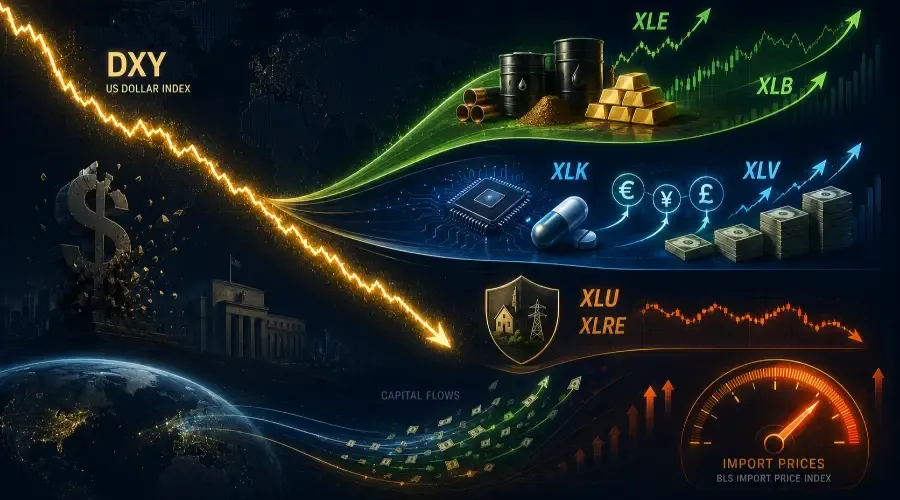
Northeastern tracked the impact in May 2025 as the US dollar's value dropped on a combination of tariff uncertainty, fiscal deficit concerns, and global growth rebalancing. Morgan Stanley published analysis on dollar declines and their implications. T. Rowe Price issued specific positioning guidance for investors navigating dollar weakness. Yahoo Finance documented what a weaker dollar means for household purchasing power. Every source correctly identifies that dollar weakness helps exporters and multinationals while raising import costs. None of them converts that observation into the sector-by-sector framework that tells you which specific ETFs benefit, which face the partial offset, why XLE and XLB flip from the worst-performing sectors in a dollar rally to among the best-performing in a dollar decline, and why the 2025 episode carries a structural dimension that the 2020-2021 cyclical weakness did not.
Why This Matters More Than Most Traders Realize
The instinctive response to dollar weakness – "buy multinationals because their overseas revenues will translate into more dollars" – captures the most important first-order effect but misses two critical second-order dynamics that determine the full sector rotation.
The first second-order dynamic is the inflation import channel. A weaker dollar raises the cost of every imported good and material that enters the US economy – from consumer electronics to agricultural inputs to raw materials. This import cost inflation creates a systematic headwind for domestic consumers and for companies that source internationally-priced inputs. The same dollar weakness that lifts Apple's reported revenues by 3% simultaneously raises the cost of components Apple imports from Taiwan and South Korea. The net effect for multinationals is positive but smaller than the gross translation tailwind. The net effect for domestic-only businesses is negative – they face higher import costs without any translation benefit.
The second second-order dynamic is the commodity lift. Commodities are priced globally in US dollars. When the dollar weakens 10%, the dollar price of oil, copper, gold, and agricultural commodities rises approximately 6–8% – providing a direct tailwind to XLE and XLB that is the exact opposite of the compression those sectors face during dollar rallies. The elasticity varies depending on whether dollar weakness is driven by a safe-haven unwind, rate differentials, or structural concerns, but the direction is consistent. This commodity lift makes dollar weakness uniquely positive for the energy and materials sectors simultaneously with the multinational translation tailwind – creating a broader and more impactful sector rally than the simple "multinationals win" narrative suggests.
The quantitative scale: T. Rowe Price's positioning guidance documented that a 10% dollar decline has historically produced approximately 3–5% earnings tailwinds for the internationally exposed portion of the S&P 500, and 6–10% commodity complex appreciation – making dollar weakness one of the most broadly supportive macro environments for US equities when the underlying cause is benign. However, these are average-cycle figures; actual pass-through depends on hedging programs, revenue mix, and whether the dollar decline is accompanied by shifting global demand.
Why the Surprise Is the Trade, Not the Level
Like its counterpart rally post, the dollar weakening signal is about the surprise deviation from consensus rather than the absolute DXY level. A gradual, well-telegraphed dollar decline – fully priced into analyst currency assumptions – produces no earnings surprise and therefore no sector rotation trade beyond what the market has already positioned for.
The dollar weakness surprise signal fires when the DXY falls faster or further than the rate differential between the US and its trading partners would predict. This happens through four distinct mechanisms:
Mechanism 1: Risk-On Dollar Unwind. The dollar accumulates safe-haven demand during global stress episodes. When the stress resolves – the crisis is contained, a trade deal is reached, geopolitical tensions de-escalate – the safe-haven dollar premium unwinds rapidly. The March 2020 to January 2021 dollar decline (DXY from 103 to 89, a 14% fall) occurred as COVID crisis safe-haven demand unwound and global growth recovered. This mechanism produces the fastest and most complete reversal because it is emotional positioning unwinding rather than fundamental change.
Mechanism 2: Fed Cutting While Others Hold. When the Fed begins a cutting cycle while other major central banks maintain rates, the US-foreign rate differential narrows – reducing the yield advantage that attracts foreign capital to dollar assets. This produces a gradual, sustained dollar decline that is fundamentally driven and therefore more persistent. The 2024 cycle – where the Fed began signalling cuts while the ECB maintained – contributed to the dollar softening that Morgan Stanley documented.
Mechanism 3: US Fiscal Concern / Structural Weakness. When the dollar weakens because markets are concerned about US fiscal sustainability – rising deficit projections, debt ceiling crises, credit rating downgrades – the signal is structurally different from cyclical weakness. The 2025 weakness Northeastern documented combined tariff uncertainty (which raised concerns about US growth) with ongoing fiscal deficit discussions. Structural weakness is less mean-reverting than cyclical weakness because it reflects a change in the fundamental assessment of dollar-denominated assets rather than a temporary positioning adjustment.
Mechanism 4: Global Growth Rebalancing. When non-US economies grow faster than the consensus expected – European recovery surprises, Chinese stimulus exceeds forecasts, EM growth accelerates – global capital flows partially away from US assets toward higher-growth alternatives, weakening the dollar. This mechanism is typically the most broadly positive for global risk assets because it reflects genuine global economic improvement rather than US weakness.
Consensus vs Reality: How Markets Were Positioned
The dollar weakness trade is most powerful when the market was positioned for dollar stability or strength and then the dollar declines unexpectedly. The CFTC Commitments of Traders report reveals this positioning weekly.
2020–2021: Entering 2020, consensus was approximately neutral on the dollar. The COVID crisis briefly spiked the dollar as safe-haven demand surged – then the Fed's emergency response (cutting to zero, $3T QE) drove the dollar down 14% from its March 2020 peak to early 2021. Every multinational in the S&P 500 that had hedged for dollar stability found themselves with FX tailwinds. Apple's 2021 revenues benefited from approximately $6 billion in positive currency effects year-over-year. Commodity companies saw oil and copper prices surge in dollar terms simultaneously. The combination produced one of the strongest multinational earnings environments in a decade – primarily driven by the dollar decline rather than volume growth.
2025: Northeastern's May 2025 coverage documented a dollar decline driven by a more complex mix: tariff uncertainty reducing confidence in US economic management, fiscal deficit concerns similar to those that triggered the 2023 debt ceiling episode, and global growth rebalancing as European and Asian economies showed resilience. Morgan Stanley's analysis noted that dollar weakness in this environment carried structural elements – not purely cyclical – that made the positioning trade more complicated than the clean 2020–2021 case. Because the 2025 episode remains in motion and lacks a definitive endpoint, it serves as an illustrative caution rather than a textbook case: structural concerns can keep the trade alive but introduce cross-currents that require closer monitoring. T. Rowe Price's explicit positioning guidance acknowledged that dollar weakness was creating opportunities in internationally-exposed equity sectors but that the inflation import channel required monitoring as a partial offset.
The Market's Reaction Scorecard: Sector by Sector
Technology (XLK) – Strong Positive – 1–3 Months.
Technology is the mirror winner of the dollar weakness trade, for the exact same reason it was the primary victim of dollar strength: 55–65% international revenue exposure produces a translation tailwind that lifts reported revenues without any volume improvement. Apple, Microsoft, Meta, and Google/Alphabet all report FX tailwinds in earnings commentary when the dollar weakens – the positive surprise to reported revenues is the mechanism that drives XLK outperformance. The 2020–2021 period produced consistent quarterly revenue beats in technology that reflected dollar weakness as much as organic growth. Expect XLK to outperform SPY by 5–10% in a sustained dollar weakness cycle exceeding 10%.
Healthcare (XLV) – Significant Positive – 1–3 Months.
Global pharmaceutical and medical device companies generate 40–60% of revenues internationally. When the dollar weakens, every euro, yen, and pound of international pharmaceutical revenue translates into more dollars – producing earnings beats that drive XLV outperformance. Johnson & Johnson, Pfizer, Abbott, and Medtronic all disclose positive currency effects in their earnings when the dollar declines. The XLV translation tailwind is the second largest in the S&P 500 after XLK. Expect 4–7% relative outperformance in sustained dollar weakness exceeding 10%.
Energy (XLE) – Strong Positive – Immediate.
The commodity lift mechanism makes XLE one of the fastest and most directly positive sectors in a dollar weakness episode. Oil is priced in dollars – when the dollar weakens 10%, oil rises approximately 6–8% in dollar terms even with no change in physical supply or demand. XLE revenue – which is a direct function of the oil price in dollars – rises correspondingly. This commodity lift is additive to any translation tailwind from international operations. The combination makes XLE one of the clearest buys in a dollar decline, particularly when the weakness is driven by risk-on or global growth rebalancing rather than US fiscal stress (which might simultaneously pressure demand expectations). Expect XLE to outperform SPY by 8–15% in sustained dollar weakness exceeding 10%.
Materials (XLB) – Strong Positive – Immediate.
Like XLE, XLB benefits from the commodity lift that dollar weakness creates across metals, mining, and agricultural commodities. Copper prices, aluminium prices, gold prices, and fertiliser prices all rise in dollar terms when the dollar weakens. XLB mining companies – which produce commodities priced in dollars but incur costs in local currencies – see their margins expand in dollar terms when the dollar weakens: their revenues rise but their local-currency costs stay fixed. The double benefit of commodity price lift and margin expansion in dollar terms makes XLB one of the strongest performers in sustained dollar weakness. Expect 10–15% relative outperformance in a sustained dollar weakness cycle.
Consumer Staples (XLP) – Mixed – 1–3 Months.
XLP presents the partial offset dynamic most clearly of any sector. Multinational food and household products companies (Procter & Gamble, Coca-Cola, Colgate-Palmolive) receive significant translation tailwinds from their 55–65% international revenues – positive for the same reason as XLK and XLV. But simultaneously, domestic-facing XLP companies and the COGS structure of even multinational staples companies face the inflation import channel: when the dollar weakens, imported food ingredients, packaging materials, and international commodity inputs cost more in dollar terms. As a rough net-effect guide, a 10% dollar decline may deliver a 1-3% net sector tailwind after input cost offsets, but this shifts with each episode’s commodity mix. The net XLP signal is modestly positive – 1–3% relative outperformance – as the translation tailwind exceeds but does not overwhelm the import cost headwind. The distinction between multinational XLP names and domestic XLP names is critical: P&G benefits more than a domestic regional food brand.
Consumer Discretionary (XLY) – Moderate Positive – 1–3 Months.
Dollar weakness benefits XLY through two channels: translation tailwinds for internationally-exposed luxury and premium brands, and the commodity lift that eventually reduces energy costs (benefiting consumer disposable income). However, the import cost channel partially offsets: consumer electronics, clothing, and household goods sourced from Asia cost more in dollar terms when the dollar weakens, potentially pressuring retailer margins. The domestic retail sub-sector of XLY faces this import cost headwind without compensating translation benefits. The net XLY signal is moderately positive – 2–4% relative outperformance – concentrated in internationally-exposed brand companies rather than domestic retailers with high Asian sourcing exposure.
Industrials (XLI) – Moderate Positive – 1–3 Months.
US industrial exporters – aerospace manufacturers, defence contractors with international sales, heavy machinery producers – become more price-competitive globally when the dollar weakens. A Boeing aircraft priced in dollars becomes cheaper for European and Asian buyers when the dollar falls against their currencies – improving US export competitiveness with a six to twelve month lag as order books adjust. Additionally, XLI companies with international revenues receive translation tailwinds. The net XLI signal is moderately positive – 3–5% relative outperformance – with the translation benefit appearing within one to two quarters and the competitiveness benefit appearing over one to two years.
Financials (XLF) – Mild Positive – 1–3 Months.
Dollar weakness creates a specific XLF positive through the EM channel that dollar strength's negative was its mirror: when the dollar weakens, EM borrowers servicing dollar-denominated debt face lower local-currency costs, improving their creditworthiness and reducing default risk for US banks with EM loan portfolios. EM equity and bond markets also typically surge during dollar weakness episodes, improving the value of international portfolios held by major US financial institutions. US banks and asset managers with significant EM exposure – JPMorgan, Citibank, BlackRock – typically outperform the broader XLF in dollar weakness environments. Expect 2–4% relative outperformance, concentrated in globally-exposed large-cap financials rather than domestic community banks.
Utilities (XLU) – Mild Negative Relative – Immediate.
The mirror of utilities' outperformance during dollar rallies: in a dollar weakness environment, the rotation away from defensive domestic-revenue sectors toward internationally-exposed multinationals that benefit from translation tailwinds reduces the relative appeal of utilities. XLU faces no fundamental headwind from dollar weakness – its revenues and costs remain entirely domestic – but it underperforms relatively as capital rotates toward sectors with direct dollar weakness benefits. Additionally, dollar weakness is typically associated with improving global risk appetite and rising commodity prices – an environment that favours cyclicals over defensives. Expect 1–3% relative underperformance, entirely from the rotation-driven perspective rather than fundamental deterioration.
Real Estate (XLRE) – Mild Negative Relative – Immediate.
Like XLU, XLRE underperforms relatively during dollar weakness because its purely domestic revenue structure makes it a source of capital for rotation into sectors with direct dollar weakness benefits. The rotation from domestic-insulated sectors to internationally-exposed multinationals is the mechanism: the same logic that made XLRE a safe haven during dollar strength makes it a relative underperformer during dollar weakness. Expect 1–2% relative underperformance.
Communication Services (XLC) – Moderate Positive – 1–3 Months.
Digital advertising platforms (Meta, Google/Alphabet) generate 40–50% of revenues internationally, producing translation tailwinds in dollar weakness. Global advertising markets also tend to improve as international economies benefit from the conditions driving dollar weakness – global growth rebalancing and EM recovery create stronger advertising demand outside the US. Expect 3–5% relative outperformance in sustained dollar weakness, concentrated in the globally-exposed digital advertising names.
Magnitude Matters: Mild Decline vs Structural Decline
Mild decline (DXY -3–5% over 3+ months): Translation tailwinds are visible in earnings commentary but modest. XLK and XLV earnings beats of 1–2% from FX effects. Commodity lift of 3–5% supports XLE and XLB. The mean-reversion probability is high – this is likely cyclical positioning adjustment.
Moderate decline (DXY -8–12% over 2–3 months): Translation tailwinds produce consistent quarterly earnings beats across multinationals. XLK and XLV report 3–5% FX tailwinds. Commodity prices surge 6–10%. The 2020–2021 decline and the 2002–2007 supercycle decline both fell in this category – producing multi-year bull markets in commodities and multinational earnings.
Structural decline (DXY -15%+ with no clear mean-reversion catalyst): When the dollar declines on concerns about US fiscal sustainability or reserve currency status – as 2025 contained elements of – the translation tailwind and commodity lift remain positive, but the underlying concerns about US economic management create cross-currents that complicate positioning. Gold tends to outperform even more than other commodities in structural declines, as the de-dollarization narrative elevates gold's monetary value. Inflation import pressure becomes more sustained and eventually forces a policy response that can reverse the equity tailwind.
A Short Note on International Spillovers
Dollar weakness doesn’t stop at US borders. It loosens global financial conditions: dollar-denominated EM debt becomes cheaper to service, capital often flows into emerging markets, and non-US equities – particularly in commodity-exporting economies – frequently outperform alongside the US multinational recovery. Commodity-linked currencies (AUD, CAD, BRL, ZAR) tend to strengthen, reinforcing the commodity lift in their local markets. If you hold international positions, dollar weakness amplifies the tailwinds you’re already capturing through your US sector rotation – and it’s worth checking whether your portfolio is inadvertently underweight the EM and commodity-linked assets that benefit most.
Historical Cases Sorted by Surprise Magnitude
2002–2007 | The Commodity Supercycle Dollar Decline – 40% Over Five Years
The dollar declined approximately 40% against major trading partners between 2002 and 2007 – the most sustained dollar weakness in the modern era. The causes were multilateral: the post-dot-com US recession, the Fed's accommodative response (cutting to 1%), and the emergence of eurozone growth as a genuine alternative investment destination. The commodity supercycle that defined this period was substantially dollar-weakness driven: oil rising from $25 to $147/barrel, copper tripling, gold quadrupling – all in a period when physical demand was rising, but the dollar's decline amplified every commodity price move in dollar terms. XLE and XLB were the dominant equity performers for the entire five-year period. Multinational technology and healthcare companies reported consistent FX tailwinds throughout. The dollar's sustained weakness and the commodity supercycle it enabled created one of the most documented cases of the translation tailwind compounding quarter after quarter. Lag window: XLE and XLB immediate from the dollar trend; XLK and XLV translation tailwinds appearing each quarterly earnings cycle; domestic-insulated sectors underperforming throughout.
2020–2021 | COVID Recovery Weakness – 14% in Ten Months
The dollar's 14% decline from its March 2020 safe-haven peak to its January 2021 trough was the cleanest recent case of risk-on dollar weakness. The Fed's emergency response – cutting to zero and expanding the balance sheet by $3T – simultaneously reduced US rates and flooded global financial markets with dollars, weakening the currency as risk appetite recovered. XLE surged over 60% from its 2020 lows as oil prices recovered in dollar terms and actual demand recovered simultaneously. XLK produced its strongest twelve-month period on record – partially from dollar weakness translation and partially from the technology spending boom. XLB mining and metals companies surged as commodity prices rose in dollar terms. The 2020–2021 case is the definitive illustration of risk-on dollar weakness producing broad equity market gains: virtually every sector benefited, with internationally-exposed and commodity-linked sectors benefiting most. Lag window: XLE and commodity complex immediate; XLK and XLV translation tailwinds appearing in quarterly earnings; domestic sectors participated in the recovery but underperformed internationally-exposed sectors on a relative basis.
2025 | Structural Weakness Elements Emerge – The Complex Case
The 2025 dollar decline documented by Northeastern in May 2025 combined elements of cyclical weakness (Fed rate expectations adjusting to potential cuts) with structural concerns (tariff policy uncertainty reducing confidence in US trade policy, fiscal deficit projections widening, global growth rebalancing as non-US economies showed resilience). Because the episode lacks a historical resolution, it serves less as a textbook case and more as a live example of why structural dollar weakness requires a different posture: you take the translation tailwind and commodity lift, but you monitor the inflation import channel more closely and avoid assuming a clean, 2020-style recovery. Morgan Stanley's analysis acknowledged the complexity: pure cyclical weakness produces clean sector rotation trades; structural weakness introduces cross-currents where gold and commodities surge (positive for XLE and XLB) but US fiscal concerns may simultaneously raise questions about the economic backdrop that supports equity multiples. T. Rowe Price's positioning guidance explicitly acknowledged both the translation tailwind opportunity and the inflation import channel risk – recommending internationally-exposed equity overweights but monitoring CPI import price data as a risk indicator. This case illustrates that the cause of dollar weakness determines whether the trade is clean (risk-on or cyclical) or requires hedging (structural fiscal concerns). Lag window: commodity lift immediate; XLK and XLV translation tailwinds per quarterly earnings cycle; inflation import channel building with one to two quarter lag.
The Trading Playbook
Before: What to Watch for Early Warning
Monitor the CFTC COT report for speculative dollar positioning weekly (cftc.gov, Friday afternoon release). When speculative net long dollar positioning is at multi-year highs – representing a crowded long-dollar consensus – any catalyst that reverses the fundamental case for dollar strength can produce an amplified, short-covering-driven dollar decline. Rather than relying solely on standard deviation thresholds, look for net long positioning in the top quartile (above the 75th percentile) of its five-year historical range – that is where extreme crowding makes a reversal most violent. The squeeze from unwinding long positioning produces dollar moves 2–3x what rate differential changes alone would justify.
Track the US-Germany and US-Japan 2-year rate differentials weekly for evidence that the rate advantage supporting the dollar is narrowing. When the Fed cuts while other central banks hold – reducing the US yield advantage – the fundamental case for holding dollars weakens. A 30bps narrowing in the US-Germany 2-year differential over four weeks has historically led DXY weakness by two to four weeks. This indicator provides a lead time advantage over simply watching the DXY itself.
Monitor Northeastern's consumer purchasing power impact data (available through regional economic research and BLS import price index monthly data). The BLS import price index (released monthly by the Bureau of Labor Statistics) measures how much prices for imported goods are changing. When import prices rise more than 0.5% in a single month – indicating the dollar weakness is transmitting into actual import cost increases – the inflation import channel is activating and the partial offset to the multinational translation tailwind is becoming material.
During: Positioning When the Dollar Is Weakening
Add XLE and XLB immediately on confirmation of a sustained DXY decline of 3%+ below the prior twelve-week range – the commodity lift is the fastest and most direct expression of dollar weakness and requires no quarterly earnings cycle to appear. Commodity prices reprice continuously in real time as the dollar moves. Size the XLE and XLB addition for the full duration of the expected dollar weakness, which for cyclical declines is typically six to eighteen months.
Overweight XLK and XLV relative to benchmark, positioned for the translation tailwind that will appear in the next one to two quarterly earnings cycles. The precise entry timing: add on broad market weakness during the first month of the dollar decline (when the translation tailwind has not yet been acknowledged by consensus), before the quarterly earnings beats that confirm the FX benefit drive XLK and XLV to new highs. The trade is to own the translation tailwind before it appears in reported results rather than after.
Reduce XLU and domestic XLRE to below-benchmark weight as the rotation away from domestic-insulated defensive sectors toward internationally-exposed multinationals unfolds. The relative underperformance of XLU and XLRE in a dollar weakness environment is not fundamental deterioration – it is capital rotation. Maintain awareness that XLU and XLRE remain functionally sound businesses – the underweight is relative, not absolute, and should be closed when the dollar weakness cycle matures and the rotation reverses.
After: The Mean-Reversion Question
Dollar weakness driven by risk-on safe-haven unwind is the most rapidly mean-reverting – the 2020 decline from March to January 2021 was followed by dollar stability as rate differential expectations reset. Begin reducing the commodity and multinational overweights when the DXY makes three consecutive weekly higher closes after a trough – the signal that the weakness cycle is bottoming. Note that this confirmation rule is deliberately conservative: it prevents acting on false reversals, but it will inherently lag the exact turning point, particularly in sharp snap-backs.
Dollar weakness driven by rate differential narrowing is more gradually mean-reverting – when other central banks begin cutting to match the Fed, the differential advantage partially restores. Monitor the US-Germany and US-Japan 2-year differentials for the widening that signals dollar recovery.
Dollar weakness driven by structural concerns (fiscal, de-dollarization) is the least mean-reverting. T. Rowe Price's research recommends maintaining international and commodity exposure as long as the structural concerns persist, which can be measured by monitoring US debt sustainability metrics (CBO projections, debt-to-GDP trajectory) and central bank gold purchase data (a structural diversification away from dollar reserves signal).
The Mean-Reversion Question: Does This Reverse?
The degree of mean-reversion depends entirely on the cause:
Risk-on weakness: Highly mean-reverting. Once the crisis premium unwinds and risk appetite normalises, the dollar returns toward fundamental fair value. The 2020 decline reversed almost completely within eighteen months as post-COVID growth normalised. Exit the multinational overweight when the VIX returns below 15 and stays there – the safe-haven demand premium that had accumulated has fully unwound.
Cyclical rate differential weakness: Partially mean-reverting over twelve to twenty-four months. As Fed cuts bring US rates toward foreign rates, the differential narrows – but if US growth remains superior to trading partners, the dollar finds support at a lower level rather than fully returning to prior highs. The 2002–2007 cycle only partially reversed: the dollar found a new lower equilibrium rather than returning to 2001 levels.
Structural weakness: Least predictable. A dollar declining on fiscal sustainability concerns or de-dollarization trends may not mean-revert to prior levels if the underlying fiscal dynamics do not improve. Monitor the US fiscal balance trajectory and central bank reserve diversification data annually for evidence that the structural weakness is resolving or deepening.
The 3 Mistakes Most Retail Traders Make
Mistake 1: Buying XLU and XLRE for Dollar Weakness Because "They Were Safe in the Rally"
The most common dollar weakness trading error is carrying the defensive positioning built during the dollar rally into the dollar weakness period, reasoning that "domestic-insulated sectors should be safe." In the dollar rally, XLU and XLRE were safe because they avoided the translation headwind. In the dollar weakness, they are the source of capital for rotation into internationally-exposed sectors that benefit from the translation tailwind. Holding XLU and XLRE through a dollar weakness cycle means giving up the commodity lift, the multinational translation tailwind, and the EM-relief XLF benefit – a significant opportunity cost relative to the sector rotation that historically characterises dollar weakness environments.
Mistake 2: Ignoring the Inflation Import Partial Offset
The second mistake is treating dollar weakness as purely and entirely positive without accounting for the inflation import channel. A weaker dollar raises the cost of every imported good – consumer electronics sourced from Asia, clothing manufactured abroad, oil (in markets where local currency costs of production denominated in dollars rise), imported food ingredients. This import cost inflation eventually reaches US consumers and squeezes the domestic cost structures of companies with high international sourcing ratios. XLP domestic food brands face higher import costs. XLY domestic retailers with Asian manufacturing exposure face margin pressure. The partial offset reduces the net sector tailwind from its gross translation benefit – factoring it in prevents oversizing multinational positions on the assumption of clean, uninterrupted tailwind.
Mistake 3: Treating 2020-Style and 2025-Style Dollar Weakness as Identical Trades
The third mistake is applying the clean 2020–2021 risk-on dollar weakness playbook to the more structurally complex 2025 episode. In 2020, the dollar declined purely because safe-haven demand unwound and the Fed provided massive liquidity – a clean, unambiguous risk-on signal. In 2025, the dollar declined partially on tariff uncertainty and fiscal concerns – signals that are simultaneously dollar-negative (capital flight from US assets) and US-growth-negative (trade policy uncertainty reduces business investment). The 2025 episode required T. Rowe Price's nuanced guidance precisely because the structural elements complicated the translation tailwind trade: you want the multinational and commodity exposure, but with closer monitoring of whether the fiscal concerns eventually force a policy response that reverses the equity-friendly environment. The cause identification step is as important in dollar weakness as in dollar strength – and the 2025 case is the definitive illustration of why one-size-fits-all dollar weakness positioning fails.
Frequently Asked Questions
What happens when the US dollar weakens?
When the US dollar weakens, multinational companies benefit from translation tailwinds, commodity prices often rise, and internationally exposed sectors tend to outperform.
Why does a weak dollar help multinational companies?
A weaker dollar increases the value of foreign revenues when converted back into US dollars, boosting reported earnings for global companies.
Which sectors benefit most from dollar weakness?
XLK, XLE, and XLB are typically among the biggest beneficiaries of dollar weakness.
Why do commodity prices rise when the dollar falls?
Most global commodities are priced in US dollars. When the dollar weakens, commodities become cheaper in foreign currencies, increasing demand and lifting prices.
How does dollar weakness affect technology stocks?
Technology companies generate large amounts of overseas revenue. A weaker dollar creates translation tailwinds that improve reported earnings and guidance.
Which sectors underperform during dollar weakness?
Defensive domestic sectors like XLU and some REITs often underperform relatively as capital rotates into multinational and commodity-linked sectors.
What is the translation tailwind effect?
The translation tailwind occurs when foreign revenues earned in euros, yen, or pounds convert into more US dollars because of currency depreciation.
How does dollar weakness impact energy stocks?
XLE benefits because oil prices typically rise when the dollar weakens, increasing energy company revenues.
What is DXY?
The US Dollar Index (DXY) measures the strength of the US dollar against a basket of major global currencies including the euro, yen, and pound.
What is the biggest mistake traders make during dollar weakness?
Many traders ignore the inflation import effect and underestimate how strongly commodities and multinational earnings can benefit from a falling dollar.
Bottom Line: The One-Sentence Institutional Framework
When the DXY weakens more than 5% below its prior twelve-week range, add XLE and XLB immediately for the commodity lift, overweight XLK and XLV for the translation tailwind in the next one to two earnings cycles, add internationally-exposed XLF names for the EM relief channel, reduce XLU and XLRE to below-benchmark weight – and monitor the BLS import price index monthly as the partial offset signal that limits position sizing if inflation import pressure accelerates.
This framework works across cycles because the commodity lift and translation tailwind are arithmetic – they follow mechanically from exchange rate movement regardless of whether the dollar decline is driven by Fed cutting, risk-on unwinding, or global growth rebalancing. The inflation import partial offset is equally arithmetic – rising import prices appear in BLS data within sixty days of a significant dollar move. Both the tailwind and the offset are observable, quantifiable, and repeatable.
The retail edge is understanding that dollar weakness is not the mirror image of dollar strength in sector positioning – it creates a different set of winners (XLE and XLB flip from negative to positive), a different set of underperformers (XLU and XLRE flip from relative outperformers to relative underperformers), and a partial offset mechanism that requires ongoing monitoring rather than a one-time trade entry.
In a Nutshell
When the US dollar weakens, the playbook is straightforward but not simplistic: overweight commodity-linked XLE and XLB for the immediate lift, load up on multinational technology and healthcare for the translation tailwind, and rotate away from domestically-focused utilities and REITs. Keep a close eye on import prices, because rising costs will eat into a portion of those gains. And always ask why the dollar is falling – a risk-on unwind trades differently from a structural deficit scare, and mistaking one for the other is where the real money gets lost.
Educational content only. Not investment advice. Past sector performance patterns do not guarantee future results.