
March 4, 2026 | BreakoutBulletin Technical Education Series
Financial Market Education Series
Technical Setup Analysis - US Markets
This analysis is part of the BreakoutBulletin Technical Education Series and is designed to teach professional technical setup identification using U.S. equity markets.
It is not investment advice or a recommendation to buy, sell, or hold any securities.
Chart patterns are probabilistic, not predictive. Always verify data independently and consult licensed professionals before trading.
Complete legal disclaimers:
https://www.breakoutbulletin.com
Setup Identification
Asset: XLE - Energy Select Sector SPDR Fund (NYSE Arca)
Timeframe: Daily Chart (1D)
Date of Analysis: March 4, 2026 (Pre-Market)
Verified price data from the TradingView chart for March 3, 2026 shows the following:
Open price was $57.39.
The session high reached $57.72.
The session low was $56.05.
The close occurred at $56.52.
This represented a decline of $0.52, or -0.91 percent.
Pre-market trading on March 4 indicates a price of approximately $56.14.
Verified exponential moving averages as of the March 3 close:
The 20 EMA is positioned at $54.19.
The 50 EMA is at $51.16.
The 100 EMA is at $48.63.
The 200 EMA is at $46.62.
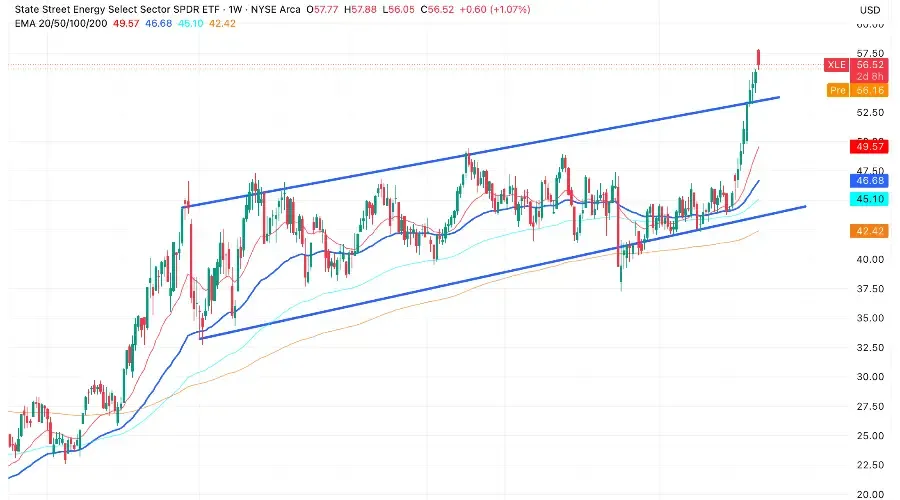
The chart structure currently shows a shooting star pattern at the upper boundary of an ascending channel, with the primary analysis timeframe on the daily chart.
The Technical Story - What This Chart Is Showing
XLE has been one of the strongest sector exchange-traded funds in the U.S. market during the past four months.
From a November 2025 low near $43, the ETF advanced to an intraday high of $57.72 on March 3. This represents approximately a 34 percent rally in roughly sixteen weeks.
The advance developed inside a clearly defined ascending channel. Two parallel rising trendlines have contained both the highs and lows of the trend since late 2025.
On March 3 the ETF opened at $57.39 and pushed to a fresh high of $57.72 during the session. Sellers then emerged aggressively, causing a reversal that produced a closing price of $56.52.
Pre-market activity on March 4 shows the ETF trading near $56.14, suggesting early continuation of the rejection from the upper channel boundary.
The Candlestick Signal
The candlestick printed on March 3 meets the criteria for a classic shooting star.
The opening price was $57.39 and the session reached an intraday high of $57.72 before reversing. The close occurred at $56.52.
The upper wick measures roughly $1.20, while the real body measures about $0.87.
This creates an upper wick approximately 1.4 times the size of the real body, which fits the textbook definition of a shooting star pattern.
More importantly, this candlestick occurs precisely at the upper boundary of the sixteen-week ascending channel.
This location produces two simultaneous signals:
A bearish intraday rejection from sellers.
Structural resistance defined by the channel ceiling.
A shooting star that appears in the middle of a trading range carries limited significance. However, a shooting star that forms at structural resistance following a strong multi-month rally has far greater analytical relevance.
Technical Criteria Validation
Candlestick Confirmation
Pattern classification: Shooting Star.
Location: Upper ascending channel boundary near $57.72.
Pre-market continuation: approximately $56.14, representing a decline of about -0.67 percent from the prior close.
The signal represents a bearish rejection inside an otherwise bullish trend. This implies a potential mean-reversion move rather than a confirmed trend reversal.
EMA Alignment - Trend Still Bullish
All four major exponential moving averages are rising and stacked in bullish order.
The 20 EMA sits at $54.19, placing it roughly $2.33 below the closing price.
The 50 EMA is at $51.16, approximately $5.36 below price.
The 100 EMA sits near $48.63.
The 200 EMA is positioned near $46.62.
This alignment confirms that the primary trend remains bullish across multiple time horizons.
However, the ETF is currently trading approximately 10.5 percent above its 50-day exponential moving average. Historically, such extensions often precede mean-reversion pullbacks toward intermediate support.
Pattern Structure - Ascending Channel
The current ascending channel began forming during November 2025.
Lower trendline anchor points include the November low near $43, subsequent December lows near $44 to $45, and additional lows during January and February near $44.50.
Upper trendline anchor points include the highs recorded in December, January, February, and the March 3 high of $57.72.
The structure has been developing for approximately sixteen weeks and has produced a price advance of roughly 34 percent.
Expected Mean-Reversion Levels
Within an intact ascending channel, pullbacks commonly occur toward internal support levels.
The first level of interest is the 20 EMA near $54.19. This level often acts as the first dynamic support zone during trend pullbacks.
The midpoint of the channel currently lies roughly between $50.50 and $51.50.
The 50 EMA near $51.16 aligns closely with this mid-channel region and represents a stronger confluence support zone.
The lower boundary of the channel lies near the $44 to $45 region. A move to this level would represent a full oscillation within the channel and would typically require a larger structural catalyst.
EMA Extension and Profit Taking
XLE trading 10.5 percent above its 50 EMA indicates that market participants who purchased during the previous fifty sessions are holding meaningful unrealized gains.
When a reversal candlestick appears at a known resistance zone, some of these participants reduce exposure to protect profits.
This behavior frequently produces short-term pullbacks while the broader trend remains intact.
Key Levels
Key resistance levels currently include the upper channel resistance near $57.50 to $58.00 and the March 3 shooting star high at $57.72.
Support levels include the March 3 session low at $56.05 and the rising 20 EMA near $54.19. Additional support exists near the 50 EMA at $51.16, followed by the 100 EMA at $48.63 and the 200 EMA near $46.62.
The lower boundary of the ascending channel remains near the $44 to $45 region.
The shooting star signal would be invalidated if price produces a daily close above $57.72 accompanied by strong trading volume.
Scenario Analysis
Scenario A - Mean Reversion Pullback
Trigger: Price breaks below the March 3 low of $56.05 on increasing volume.
Expected development: The ETF gradually retraces toward the 20 EMA near $54.19 over several sessions.
Professional focus: Analysts watch for bullish reversal candles forming at the 20 EMA. This would indicate that the pullback is functioning as a healthy retracement within the channel.
Scenario B - Shooting Star Negated
Trigger: Price closes above $57.72 with strong participation.
Implication: Buyers absorb supply at the channel ceiling.
Potential outcome: The ETF attempts a breakout above the ascending channel structure.
Scenario C - Consolidation Range
Trigger: Price holds between approximately $55.50 and $57.50 for multiple sessions.
Implication: The market pauses while the 20 EMA rises closer to price.
During this period, trading volume typically contracts and volatility declines.
Educational Takeaways
Candlestick Context Matters
A shooting star appearing in the middle of a trading range has limited analytical value.
However, a shooting star that appears after a 34 percent rally, at channel resistance, and while price is extended above key moving averages carries far greater significance.
The pattern itself does not change. The surrounding market context determines its importance.
EMA Ribbon as a Trend Health Indicator
The exponential moving averages on this chart act as a visual representation of trend health.
When the 20 EMA, 50 EMA, 100 EMA, and 200 EMA are all rising and stacked in bullish order, it indicates that buyers across multiple time horizons are holding profitable positions.
The greater the distance between price and these averages, the more extended the trend becomes.
Educational Disclaimer
This technical analysis teaches pattern recognition methodology rather than investment selection.
Chart patterns are probabilistic, not predictive.
All price levels and EMA values referenced in this article are sourced directly from the TradingView daily chart of XLE as of March 3-4, 2026.
Readers should independently verify all data before making financial decisions.
Historical pattern performance does not guarantee future results.
Consult licensed professionals for personalized financial advice.