
The current move in U.S. Treasury yields represents a meaningful development for cross-asset markets.
Several factors contribute to the significance of the move:
Yield move magnitude remains within the 5-10 basis point band that historically signals meaningful market repricing.
A geopolitical catalyst - specifically Iran-related tensions affecting oil markets - has introduced an inflation narrative.
The yield curve has shifted shape, with the 2s10s spread reaching its steepest level since early 2022.
The move is transmitting across asset classes, influencing equities, the dollar, commodities, and bonds simultaneously.
No Treasury auction occurred during this session, which removes one possible explanatory variable but does not diminish the market signal.
The Snapshot - Where Yields Stand
The U.S. Treasury curve moved notably during the session.
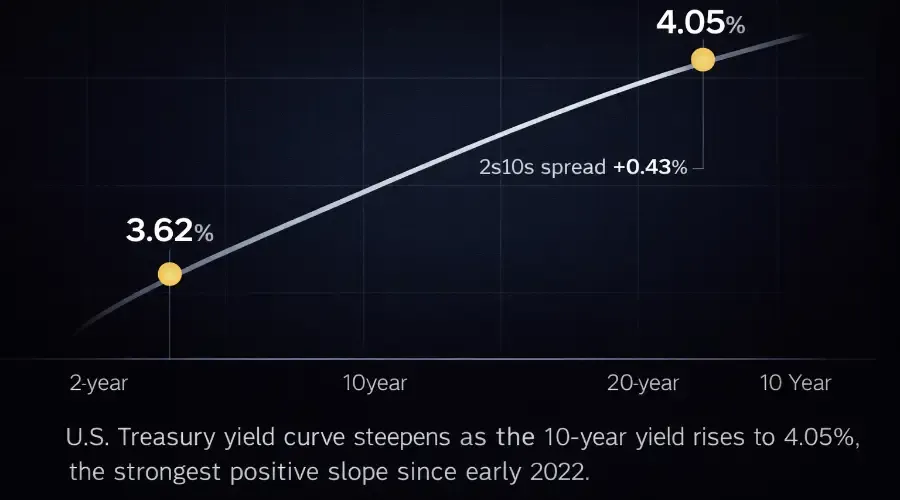
The 2-year Treasury yield now sits at 3.62 percent, rising 13 basis points over the past twenty-four hours.
The 10-year Treasury yield reached 4.05 percent, increasing 8 basis points during the same period.
The difference between the two - the 2s10s spread - currently stands at approximately +0.43 percent, producing a positively sloped curve for the first time since early 2022.
In practical terms, a 10-year yield of 4.05 percent means the U.S. government must pay investors roughly 4.05 percent annually to borrow money for a decade.
That rate becomes the baseline "risk-free" alternative used in financial valuation models. When this risk-free rate rises, the discount rate used to value corporate cash flows also rises. This changes the mathematical valuation of equities, particularly companies whose profits lie far in the future.
Historically, a 10-year yield around 4 percent would not appear extraordinary. During the 1990s and mid-2000s, such yields were common.
However, during the 2010-2021 decade, Treasury yields spent long periods below 2 percent and briefly fell near 0.5 percent during the pandemic.
Against that backdrop, a sustained yield above 4 percent represents a meaningful structural shift.
Why Yields Moved Today
The rise in Treasury yields is being driven by two distinct mechanisms operating at different points on the curve.
The 2-year yield, which is closely linked to Federal Reserve policy expectations, moved higher by 13 basis points.
This reflects the market reassessing near-term rate expectations. The geopolitical shock involving Iran has pushed oil prices higher, raising concerns that inflation could remain elevated. If inflation pressures persist, the Federal Reserve may maintain its current policy stance for longer than markets previously expected.
CME FedWatch data currently implies roughly 96 percent probability of a rate hold at the upcoming March meeting.
The 10-year yield, which reflects longer-term growth expectations and investor risk compensation, rose by 8 basis points.
This portion of the move reflects term premium expansion.
Term premium represents the additional compensation investors demand to hold long-term bonds rather than rolling over short-term securities. When geopolitical risk increases, particularly when it involves energy supply chains or potential fiscal expansion through defense spending, investors often demand a higher term premium for holding long-duration debt.
As a result, the long end of the curve can rise even if short-term policy expectations remain relatively stable.
Teaching Frame - Real Yields vs Inflation Expectations
Not all yield increases carry the same meaning.
A yield rise can occur because inflation expectations increase, or because investors demand higher real returns above inflation.
In the current environment, the catalyst appears to be influencing both channels simultaneously.
Short-term yields are reacting primarily to inflation concerns related to higher oil prices.
Long-term yields are reacting to rising term premium and geopolitical uncertainty.
Yield Curve Shape Analysis
The 2s10s spread, representing the difference between the 10-year and 2-year Treasury yield, is now approximately +0.43 percent.
This is significant because the yield curve spent much of 2022 through 2024 deeply inverted, with the 2-year yield above the 10-year yield.
Yield curve inversions historically signal economic slowdown risk.
The transition from inversion to a positively sloped curve therefore represents an important phase of the economic cycle.
Analysts typically interpret this shift through three possible frameworks.
One interpretation is late-cycle reacceleration. A curve that becomes positive while economic growth remains intact may signal that the economy is absorbing higher rates without entering recession.
A second interpretation is bear steepening. In this scenario both short and long yields rise, but long-term yields rise faster due to inflation concerns or increased term premium. This form of steepening tends to pressure equity valuations.
The third interpretation focuses on historical patterns. Recessions have often occurred not during the inversion itself but during the period when the curve begins to steepen again.
This observation does not predict recession but highlights a stage of the cycle that analysts monitor carefully.
Treasury Auction Context
No Treasury auction occurred during the current session.
However, auction schedules are not the only indicator of Treasury demand.
Secondary market trading - where existing Treasury securities are bought and sold - constantly reflects investor appetite for government bonds.
The rise in yields today indicates that bond prices are falling, meaning investors require higher compensation to hold long-duration Treasuries.
Equity Transmission Map
Treasury yields influence equities through several mechanisms.
One key transmission channel affects long-duration equities, particularly technology and growth companies.
Higher long-term yields raise the discount rate used to value future earnings. Companies whose valuations depend heavily on profits expected many years in the future are particularly sensitive to this effect.
The Nasdaq-heavy technology sector has shown relative weakness during this yield move.
Another transmission channel affects financial institutions.
Banks typically borrow at short-term rates and lend at longer-term rates. A wider difference between these rates can support bank profitability through improved net interest margins.
However, rising yields can also reduce the market value of bonds already held on bank balance sheets, creating unrealized losses.
A third channel affects energy and commodity producers.
Higher oil prices and stronger inflation expectations can improve revenue outlooks for energy companies. In this environment, the energy sector has shown relative strength while fixed income markets weaken.
Dollar and Global Context
The U.S. Dollar Index is currently trading near 104.20, representing roughly a 0.8 percent increase.
Rising U.S. yields tend to attract global capital flows toward dollar-denominated assets, strengthening the currency.
At the same time, European markets are facing inflation pressure driven by energy imports rather than domestic monetary policy shifts.
This divergence can widen the yield differential between U.S. and European bonds, reinforcing dollar strength.
Breakeven Inflation Expectations
Market-based inflation expectations can be inferred through Treasury Inflation-Protected Securities, commonly known as TIPS.
Current estimates place five-year breakeven inflation between 2.6 and 2.8 percent.
Ten-year breakeven inflation appears closer to 2.3 to 2.5 percent.
This structure suggests inflation expectations are currently front-loaded, with markets anticipating stronger inflation pressures in the near term that gradually moderate over longer horizons.
Key Takeaways for Equity Investors
Several important developments occurred during this session.
The 10-year Treasury yield moved above 4 percent, an important psychological and valuation threshold.
The 2s10s yield curve steepened to +0.43 percent, representing the steepest level since early 2022.
The primary catalyst was a geopolitical event that transmitted through energy markets into inflation expectations.
For different equity sectors, the implications vary.
Technology and growth stocks face pressure from higher discount rates.
Financials experience mixed effects from improved lending spreads but weaker bond valuations.
Energy companies benefit directly from higher oil prices.
Utilities and real estate sectors often struggle when long-term yields rise.
What to Watch Next
Several developments will help determine whether this yield move persists.
Oil price sustainability above $80 remains a key driver of inflation expectations.
Upcoming CPI data will provide confirmation of whether energy prices are transmitting into broader inflation.
Treasury auction demand will reveal investor appetite for government bonds at higher yields.
Federal Reserve commentary may clarify whether rising term premiums influence future policy decisions.
Fixed Income Education Path
Investors seeking deeper understanding of bond market mechanics often begin with the foundations of Treasury yields and yield curve interpretation.
Further study typically involves examining how bond markets influence equity valuations, how Treasury auctions reveal demand conditions, and how inflation expectations are measured through TIPS spreads.
Advanced analysis includes term premium modeling and understanding the Federal Reserve's reaction function within evolving macroeconomic conditions.
Educational Disclaimer
This fixed income analysis is published for educational purposes only.
All yield levels, spread data, and cross-asset observations are sourced from publicly available market data as of March 3, 2026.
Nothing in this article constitutes investment advice or a recommendation to buy or sell any security or financial instrument.
Fixed income markets involve risk, including interest rate risk, credit risk, and inflation risk. Past yield behavior does not guarantee future results.
Readers should conduct independent research and consult a qualified financial professional before making any investment decisions.
Complete legal disclaimers:
https://https://www.breakoutbulletin.com/terms-and-condition
This article is for informational and educational purposes only and does not constitute financial, investment, or trading advice. You are solely responsible for your own investment decisions and should consult a licensed financial professional before acting on any information in this post.