
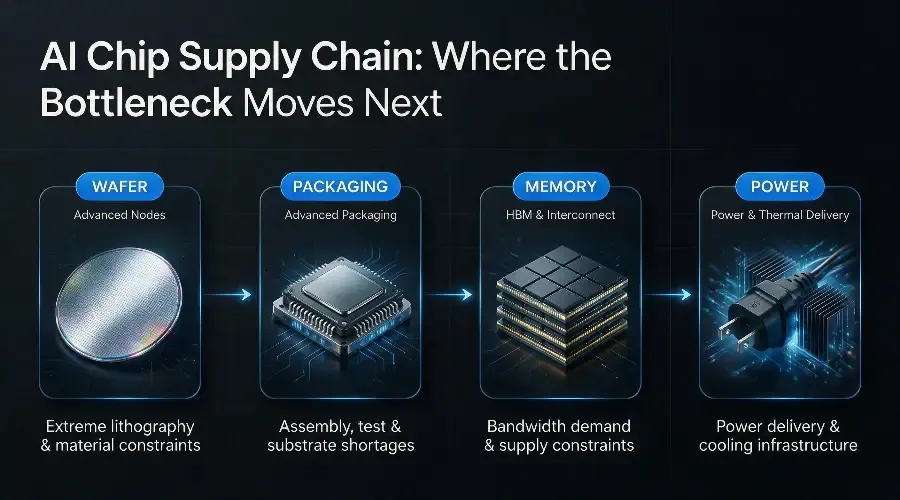
The foundries are fine. The bottleneck is the unglamorous, capital-intensive process of assembling the chip–and it’s creating a supply-chain logjam with no quick fix.
By Manish T. · BreakoutBulletin
Executive Summary :
The Core Disconnect: Silicon wafer fabrication yields (3nm/2nm) are healthy; the true AI bottleneck has shifted downstream to advanced packaging (TSMC CoWoS) and specialized substrates.
The Lead-Time Squeeze: CoWoS orders carry a 52-to-78 week lead time (delivering in 2028), with Nvidia holding ~60% of total global supply.
Pricing Power Migration: While wafer prices rise 3–5% annually, advanced packaging costs are escalating 10–20% per year, boosting margins for packaging equipment suppliers (BESI, ASMPT) and OSATs.
The Next Bottleneck: As packaging capacity ramps through 2027, the bottleneck will migrate to data center power delivery and thermal management (120kW+ per rack).
When people picture a chip shortage, they picture a fab–a multi-billion-dollar factory etching circuits onto silicon wafers, and a race to build more of them.
That mental model is now out of date.
The foundries can already make the advanced logic dies; TSMC is churning out 3-nanometer and 2-nanometer chips at healthy yields.
The thing actually deciding how many AI chips reach a data center this quarter isn't the wafer at all.
It's what happens after.
The bottleneck moved.
It slid downstream, into a step most people have never heard of–advanced packaging, the painstaking process of assembling a finished AI chip out of many smaller pieces.
And it slid upstream too, into the substrates, materials, and specialized tools that make packaging possible.
Front-end fabrication, the part everyone watches, is no longer the binding constraint.
The chokepoint is the unglamorous middle of the chain–and it's why the gap between AI demand and physical supply is wider than the headline factory announcements suggest.
What Actually Gates an AI Chip Now
Start with what a modern AI accelerator actually is, because the shortage makes no sense until you do.
Nvidia's Blackwell, AMD's MI-series, Google's and Amazon's custom chips–none of them is a single slab of silicon.
Each is an assembly: a logic die that does the computing, several stacks of high-bandwidth memory sitting right beside it, and a dense web of connections between them, all mounted on a substrate with almost unimaginable precision.
Fusing those pieces together is the job of advanced packaging, and for the highest-end chips that means TSMC's CoWoS process–"chip on wafer on substrate."
Here's the problem: CoWoS is sold out.
TSMC's own CEO called its packaging capacity "extremely tight and sold out through 2026," and a single customer–Nvidia–is estimated to hold roughly 60% of the world's supply.
Lead times for a CoWoS order run 52 to 78 weeks, which means a chip designer placing an order today may not see delivery until 2028.
TSMC is racing to nearly quadruple capacity, from about 35,000 wafers a month in late 2024 toward 130,000 by the end of 2026–and by its own math, that still falls short of demand.
Bottleneck by the Numbers
Here is the supply-demand snapshot that explains the entire crisis:
| Metric | Current State | Projected / Historical Context |
|---|---|---|
| TSMC CoWoS Monthly Capacity | ~70,000–80,000 wafers (mid-2026) | Target ~130,000 by end of 2026 |
| CoWoS Demand Growth | ~64% CAGR (2025–2027) | Demand consistently outstripping supply by 20–30% |
| CoWoS Lead Time | 52–78 weeks | Orders placed today deliver in 2028 |
| Nvidia's Share of CoWoS | ~60% | Leaves ~40% for AMD, Google, Amazon, Meta, and everyone else |
| Yield Impact (Blackwell) | Effectively halved output in early 2025 | Transition to CoWoS-L caused significant yield degradation |
| Packaging Price Increases | 10–20% annually | Vastly outpaces standard logic wafer price hikes (~3–5%) |
The capacity is rising fast, but "tightness easing" is not the same as "solved."
When demand is growing at 64% and capacity is growing at ~50%, the gap widens in absolute terms, even if the percentage shortfall shrinks.
Why "Just Build More" Doesn't Work Fast
The obvious response is "so build more packaging lines."
If only it were that quick.
The uncomfortable truth the industry has arrived at is that advanced packaging is now roughly as difficult and capital-intensive as making the chip in the first place.
The precision required to stack and connect these components is extreme, and the equipment that does it–thermal compression bonders, ultra-precise placement machines–carries its own 12-to-18-month lead times.
There's a bottleneck behind the bottleneck.
The yield trap made it worse.
In early 2025, the transition from CoWoS-S to the more advanced CoWoS-L architecture–required for Nvidia's Blackwell–created significant yield problems.
Technical hurdles effectively halved the expected output of Blackwell chips during the first three quarters of 2025.
The industry wasn't just short of capacity; it was short of usable output.
Then there are the materials.
The traditional organic substrates that used to sit under a chip can't handle the interconnect density that a giant AI logic die packed against memory stacks demands, so the industry leans on silicon interposers and specialized substrates made by a small handful of suppliers.
Swapping one supplier for another isn't a phone call–qualification cycles run long, and a part that fails validation can stall an entire line.
Geographic concentration magnifies every wobble.
Taiwan alone holds roughly 45% of global advanced-packaging capacity.
A single earthquake, power outage, or geopolitical flare-up in the Taiwan Strait would not just be a headline risk–it would directly constrict over 60% of the world's high-end AI chip supply.
TSMC is racing to expand packaging capacity in Japan and Arizona, but those fabs won't come online at scale until 2027 or later.
For the next 12–18 months, the supply chain is effectively running on a single island's infrastructure.
The New Players: It's Not Just CoWoS Anymore
CoWoS is the gold standard, but it's not the only game in town–and the emergence of alternatives is part of the story investors need to watch.
| Technology | Provider | Status |
|---|---|---|
| CoWoS | TSMC | Dominant; sold out through 2026 |
| EMIB / Foveros | Intel Foundry Services | Nvidia finalized a $5 billion partnership with Intel for packaging as a "Plan B" |
| CoWoP (Chip-on-Wafer-on-Panel) | ASE Group | OSAT providers scaling up as a cost-effective alternative |
| Panel-Level Packaging (PLP) | Multiple (including Samsung) | Moves from round wafers to square panels; increases usable area and lowers costs |
| Glass Substrates | Intel, Samsung | Next-gen materials that enable finer interconnects; still in early adoption |
The emergence of Intel and ASE as credible second sources is critical.
It won't solve the 2026 crunch, but it creates a more resilient supply base for 2027 and beyond.
Who Feels It and How (Stakeholder Impact)
The bottleneck redistributes leverage in a predictable way:
| Stakeholder | Position | Primary Impact |
|---|---|---|
| TSMC | The gatekeeper | Unprecedented pricing power; 10–20% annual price hikes; fully utilized capacity |
| Nvidia / AMD / Broadcom | The buyers | Fighting for CoWoS slots; forced to design around packaging constraints (e.g., using less HBM) |
| Hyperscalers (Google, Amazon, Meta) | The end customers | Longer GPU lead times; forced to pre-order years in advance; hoarding components while waiting |
| OSATs (ASE, Amkor) | The alternatives | Surge in demand for legacy and panel-level packaging as overflow from CoWoS |
| Packaging Equipment Suppliers (BESI, ASMPT) | The enablers | Extended order visibility; 12–18 month backlogs; direct beneficiaries of capacity expansion |
| Substrate Suppliers (Ibiden, Shinko) | The material providers | Premium pricing for high-density substrates; qualification bottlenecks |
| Automotive / Industrial | The losers | Crowded out by AI demand; longer lead times for any chip that touches advanced packaging |
The Pricing Power Reality
Advanced packaging services are not just tight–they are increasingly expensive.
Whereas standard logic wafer prices historically rise 3–5% annually, advanced packaging prices have been escalating 10% to 20% per year.
For a chip like Blackwell, packaging now represents a mid-to-high single-digit percentage of the total bill of materials–up from a rounding error a generation ago.
This is a structural margin shift for TSMC and a cost headwind for chip designers.
The "Golden Screw" Ripple
Here's where it stops being a Taiwan story and becomes an everyone story.
In hardware there's an old idea called the "golden screw": the one small part whose absence stops a finished product from shipping, no matter how ready everything else is.
In an AI server, the accelerator is the golden screw.
You cannot ship a $400,000 rack without it–so companies end up hoarding all the other components, from power chips to networking switches, while they wait for their packaging-constrained GPU allocation to arrive.
This Is the Same Story as the Memory Squeeze
If that last line sounds familiar, it should.
Advanced packaging is literally the step where the high-bandwidth memory from the ongoing memory shortage gets fused to the logic die.
The two constraints aren't separate stories–they're two gates on the same chip.
A finished AI accelerator has to clear the memory bottleneck and the packaging bottleneck, and right now both are tight at once.
Stack them together and you get the real shape of the AI supply problem: it isn't one factory that needs building.
It's a chain with several narrow points–and fixing one just moves the pressure to the next.
What to Watch Next
A few concrete signposts will tell you which way this is heading:
Watch the CoWoS capacity gap against demand. TSMC is ramping fast, but the absolute gap matters more than the percentage. If demand grows at 64% and capacity grows at 50%, the shortage widens in real terms.
Watch packaging equipment lead times. BESI and ASMPT order backlogs are the canary in the coal mine for capacity expansion timelines.
Watch Intel's EMIB ramp. The $5 billion Nvidia partnership is the first real test of whether CoWoS has a credible alternative at scale.
Watch Taiwan's weather and geopolitics. A single earthquake or major political event could instantly reduce global AI chip supply by 10–20%.
Watch the custom-ASIC crowd (Google, Amazon, Meta). They are competing for the same packaging slots as Nvidia–more bidders for a fixed resource keeps the bottleneck tight.
The Bigger Picture and Where the Pressure Moves Next
Step back and a pattern emerges that's bigger than any single component.
The AI buildout is increasingly bounded by physical reality, not by software demand–and the binding constraint keeps turning out to be something unglamorous and hard to scale.
Memory.
Packaging.
Power.
Each follows the same script: a finite, specialized input gets reallocated toward the highest-value AI use, lead times stretch, and the cost shows up somewhere less visible than the headline.
Which raises the natural sequel question:
If packaging capacity does catch up in 2027, what's the next bottleneck?
The early signals point to power delivery and thermal management.
An Nvidia GB200 NVL72 rack already consumes over 120kW of power and requires liquid cooling.
Scaling that to 200kW or 300kW per rack will strain data-center power grids, cooling infrastructure, and the electrical grid itself.
The "golden screw" is moving again–from the wafer, to the packaging, to the power plug on the wall.
For anyone trying to read this industry, the transferable habit is to stop watching the thing everyone else is watching–the fab, the capex number, the GPU launch–and trace the chain to the actual narrow point.
That is usually where the real story, and the real mispricing, hides.
Related Reading
The Memory Shortage Behind the AI Boom → https://www.breakoutbulletin.com/article/ai-memory-shortage-hbm-dram-spillover-analysis
The AI Build-Out's Deepest Bottleneck Isn't Chips or Memory (Power) → https://www.breakoutbulletin.com/article/ai-power-grid-bottleneck-transformers
The AI Boom Is Now Running on Debt (Credit) → https://www.breakoutbulletin.com/article/ai-boom-debt-bond-market-repricing
Disclaimer
BreakoutBulletin publishes educational and analytical content only. Nothing here is investment, financial, legal, or tax advice, or a recommendation or solicitation to buy, sell, or hold any security. Industry figures and supply-chain details reflect information available as of the publication date and are drawn from public sources (including company commentary and industry research); figures may be revised. Past performance does not indicate future results. Readers should conduct their own research and consult a qualified, registered financial adviser before making any decision.
Data Sources
TSMC Quarterly Earnings Calls & Investor Presentations (2025–2026)
UBS Research, "Semiconductor Packaging: The New Bottleneck" (April 2025)
TechInsights, "CoWoS-L Yield Analysis" (August 2025)
Intel Foundry Services, "Packaging Capacity Announcement" (January 2026)
Nikkei Asia, "Taiwan's Advanced Packaging Stranglehold" (February 2026)
BESI & ASMPT Annual Reports (2025)
\IDC, "AI Supply Chain Constraints" (March 2026)