
There's a version of every AI tool guide that front-loads the benefits, buries the limitations in a footnote, and leaves you to discover the failure modes yourself – usually at a cost.
This isn't that guide.
Understanding where AI falls short is not a reason to avoid using it. The traders who get the most consistent value from these tools are precisely the ones who know the limitations clearly and build their workflow around them. The ones who get hurt are the ones who didn't know what they were dealing with until a position went against them.
This post covers the failure modes honestly. Every single one of them.
These limitations make more sense once you understand how the underlying model works. What AI Actually Is for Traders covers the training data process, knowledge cutoffs, and why the model generates rather than retrieves – which explains most of what goes wrong.
No Live Price Data – And Why That Matters
This is the most fundamental limitation, and it catches more retail traders off guard than any other.
Claude, ChatGPT, and similar AI tools have no native connection to live market data feeds. They cannot see what a stock is trading at right now. They cannot access current bid-ask spreads, real-time order book depth, intraday price action, or live futures positioning.
They work entirely with what you provide – the text you paste, the numbers you include, the data you bring into the conversation.
If you ask Claude what the S&P 500 (SPY) is doing this morning without providing external context, it cannot answer accurately. It may generate a response that sounds convincing – drawing on historical patterns or general technical tendencies – but none of it reflects what is actually happening in the order flow right now.
The Workflow Core: AI is not a substitute for your charting platform, your live data feed, or your broker's quote screen. Those tools provide current market reality. AI processes information about market reality – but only the information you explicitly give it. AI sits downstream of your data sources, not upstream of them.
The fix for AI's lack of live data is bringing the data yourself. How to Feed Market Data into AI the Right Way covers exactly what to source, where to get it, and how to format it so the model works from accurate inputs rather than stale training data.
Cannot Execute Trades or Connect to Brokers
AI tools in their consumer form – Claude, ChatGPT, Perplexity – have no capability to interact with your brokerage account. They cannot place orders, modify active positions, trail stops, or manage capital allocation.
This sounds obvious when stated plainly, but it matters because the natural next step after a successful AI analysis is execution. That step happens entirely outside the AI window, through your trading platform, with your own hands.
A Warning to Beginners: Be extremely wary of any sketchy third-party browser extensions or unverified services claiming to "connect ChatGPT directly to your broker." These are not official tools, they frequently violate your platform's Terms of Service, and they present massive security risks to your actual funding.
For traders interested in automated algorithmic execution, that requires a completely different technical infrastructure: brokers with API access, Python script architecture, and dedicated institutional risk-management frameworks. That territory is covered separately in our Automation and Backtesting Hub. It is not what an AI chat interface does.
Knowledge Cutoff Risk: Financial Data Goes Stale Fast
Every large language model operates with a training cutoff – a fixed date beyond which it has no knowledge of historical events.
For trading, this creates an acute, expensive risk.
Markets are driven by highly volatile, evolving information variables. Earnings results, guidance revisions, FOMC interest rate decisions, management shakeups, and macro economic releases unfold continuously. A model relying on its internal memory simply does not know what happened after its cutoff point.
The risk isn't just that the model lacks recent data. The more dangerous scenario is when the model fills that void with outdated information presented with absolute authority.
It may reference a company's revenue guidance from three quarters ago as if it's current.
It may describe a CEO or fund manager who has since left the firm.
It may cite an analyst price target that was drastically revised downward months ago.
Financial data goes stale faster than almost any other domain. A legal precedent from three years ago may still be entirely valid. A company's free cash flow margin from three years ago may be completely unrecognizable relative to its current operational reality.
Hallucination in Financial Contexts: The Specific Risk
"Hallucination" is the specific term used when an AI model generates information that sounds completely plausible and is stated with absolute confidence, but is factually wrong. It is an inherent characteristic of how large language models function.
Because an LLM predicts word sequences based on mathematical probabilities rather than cross-referencing a static truth database, it will occasionally prioritize linguistic smoothness over factual reality. It will produce something that has the exact vocabulary of an institutional analyst report, but with completely fabricated metrics.
In a financial context, hallucination most commonly appears in these forms:
Incorrect financial figures: Generating an Earnings Per Share (EPS) or net income number that is close to the real figure, but completely wrong.
Outdated statistics presented as current: Sourcing short interest percentages, institutional ownership data, or gross margins from deep within its historical training data.
Invented details about micro-caps: Thinly covered stocks have very small data footprints in an LLM's training set. When pushed for data, the model will often stitch together fragmented data points to invent plausible corporate details.
The Short Interest Trap: An In-The-Trenches Example
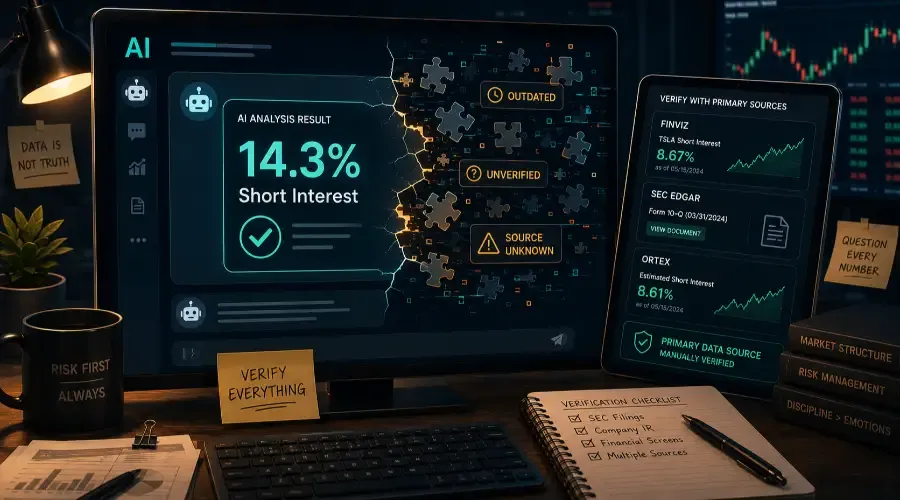
A trader is looking at a high-momentum small-cap stock and wants to evaluate the potential for a short squeeze. Rather than opening a dedicated short-tracking platform, they ask their AI tool for the current short interest percentage.
The AI responds instantly and confidently: "The current short interest is 14.3% of the float."
The trader notes it, trusts it, and frames their risk around it. Why? Because 14.3% sounds precise enough to be true. If the model had given a vague answer like "around ten or twenty percent," the trader would have instantly double-checked it. But the granular precision of a decimal place masks the fact that the number may be six months out of date, or completely fabricated to fit the grammatical rhythm of the prompt.
Short interest shifts continuously and is reported bi-weekly. A figure from a few months ago bears zero resemblance to the active float right now. Even if you use a live-search tool like Perplexity, it can easily misread an outdated web forum post or scramble a dynamic table layout, presenting a wrong figure as fact.
AI Reliability Matrix by Trading Task
| Trading Task | Reliability Rating | Primary Source of Truth |
|---|---|---|
| Summarizing Earnings Transcripts | 🟢 High (When data is pasted) | Investor Relations Page |
| Extracting 10-Q Risk Factors | 🟢 High (When data is pasted) | SEC EDGAR |
| Recalling Historical Macro Cycles | 🟡 Medium (Watch for Cutoffs) | Federal Reserve / St. Louis FRED |
| Tracking Live Short Interest | 🔴 Low (High Hallucination) | Ortex / Finviz Screener |
| Real-Time Market Sentiment / Flow | 🔴 Low (No Real-Time Streams) | Trade Alert / Options Flow Platforms |
Cannot Replace Screen Time and Market Intuition
AI can read an earnings transcript in seconds. It can map risk-language shifts, flag inventory build-ups, and structure a fundamental comparison across five competitor firms in minutes.
What it cannot do is tell you how that data feels in the context of a market that has been extended for nine months, where sector rotation is turning defensive, where volume is actively diverging from price, and where you have watched this exact institutional bull trap resolve painfully multiple times over your career.
That contextual judgment – built from years of screen time, managing real drawdowns, and cultivating localized pattern recognition – cannot be prompted. It lives exclusively within the trader, not the tool.
The Verification Rule – Non-Negotiable
Any specific number, financial figure, macro statistic, or factual claim that an AI tool generates must be verified against its primary source before you execute a trade. Every single time.
The cost of the verification habit is a few seconds. The cost of skipping it, when a hallucinated metric informs your position sizing, can wipe out weeks of discipline.
Your verification toolkit should remain simple:
SEC EDGAR: For any metric regarding official corporate filings (10-K, 10-Q, 8-K).
Company Investor Relations Pages: For official press releases and slide decks.
Dedicated Financial Screeners (Finviz, TradingView): For structural market data, short interest, and float metrics.
AI sits squarely between your data sources and your ultimate decision-making. It processes, structures, and synthesizes text at superhuman speed. But the structural data itself must always be anchored to a verified primary source.
Knowing the limitations is the foundation. The next step is learning how to work within them. How to Write Prompts That Get Useful Stock Analysis from AI covers the prompt structure that produces reliable output while keeping the model inside the scope of what you've provided.
Frequently Asked Questions
Q1: If Perplexity has live web search, is it immune to financial hallucinations?
A: Absolutely not. While live web browsing resolves the static knowledge cutoff issue, Perplexity is still powered by an underlying large language model. If a financial table is formatted uniquely on an investor relations page, or if a PDF report contains conflicting metrics, the model can easily misinterpret the layout, pull data from the wrong fiscal quarter, or cite an unreliable blog post confidently. Live data still requires manual verification.
Q2: Why does AI struggle so heavily with penny stocks and micro-caps?
A: Large language models rely on vast data density to build reliable linguistic probabilities. Large-cap stocks like Apple or Nvidia have millions of pages of analyst reports, news articles, and SEC commentary in an LLM’s training dataset. Micro-caps and penny stocks have incredibly thin information environments, leaving the model with minimal reference material, which drastically spikes the probability of hallucinated figures.
Q3: Can custom AI tools or custom GPTs execute automated trades for me?
A: Consumer chat interfaces cannot. To build automated execution systems, you must move outside standard chat spaces and build a dedicated programmatic workflow using your broker's official API keys via specialized algorithmic languages (like Python or Pine Script). Standard AI chat assistants are research-acceleration engines, not execution routers.
Q4: How do I know if a stock has enough coverage for an AI's internal knowledge to be reliable?
A: A good rule of thumb is index inclusion and institutional backing. If a stock is inside the S&P 500 or Nasdaq 100 and has heavy institutional ownership, its underlying training data footprint is vast and highly reliable. If it's a micro-cap with zero Wall Street analyst coverage, assume the AI knows nothing accurate about it internally, and switch entirely to a "Bring Your Own Data" model.
Q5: Can I use standard AI models to analyze complex daily options flow or dark pool data?
A: Not in real-time. Options flow and dark pool prints are highly dynamic, high-frequency data streams that change second by second. Because standard LLMs cannot tap into live raw exchange feeds, they cannot parse active order sweeps. For this data, you must rely on specialized premium streams (like Trade Alert or Cheddar Flow). You can, however, copy the end-of-day block summaries from those platforms and paste them into Claude to look for historic structural anomalies.
Disclaimer: For educational and informational purposes only. This content does not constitute financial, investment, or trading advice. Trading stocks and options involves significant risk of loss. Always do your own research or consult a licensed professional before making any financial decisions.