
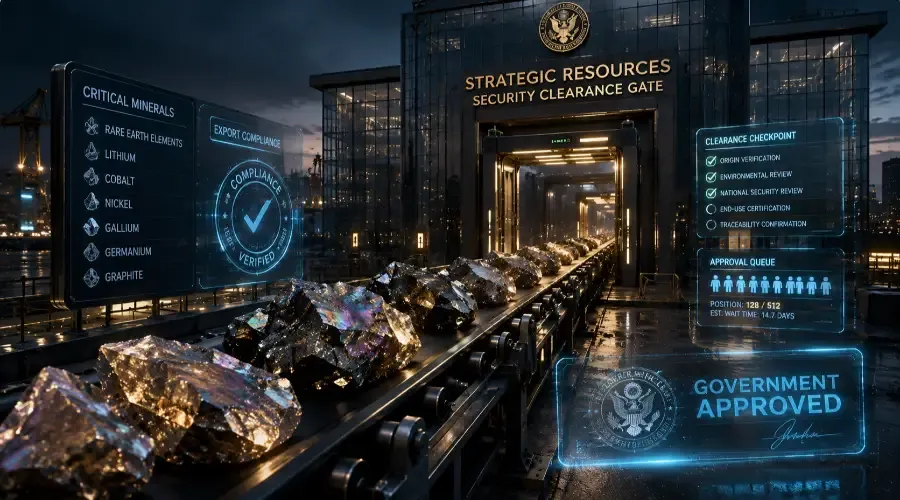
The most important shift in critical-mineral controls isn’t dramatic embargoes. It’s the quiet administrative machinery – licenses, approval rates, extraterritorial rules – that does the same work without the headline.
By Manish T. · August 16, 2026 · 8 min read
Editor’s note: This is educational analysis, not investment or trade advice. Figures are as reported by official ministry notices, customs data, and specialist trade press as of August 2026. Private and aggregate approval-rate data may be revised and vary by country, end use, and mineral. Nothing here is a recommendation to buy, sell, or transact in any commodity or security.
When people picture a country weaponizing its resources, they picture an export ban – a dramatic, headline-making cutoff. The actual mechanism reshaping the critical-minerals supply chain is subtler, more durable, and far easier to miss: critical minerals export licensing, mineral export controls approval rates, end-use declarations, whistleblower enforcement, and extraterritorial origin rules.
Control has migrated from the ban to the bureaucracy. And the bureaucracy is, in important ways, more effective.
What Changed: The In-Force Licensing Regime
China’s controls across rare earths, gallium, germanium, antimony, and tungsten have shifted from suspended bans to an in-force licensing regime. That sounds technical. It is the whole point.
Among the key developments reported in official notices and specialist trade press:
-
Gallium and germanium export controls remain in force, with licensing approvals tied to end-use and end-user screening.
-
Antimony and tungsten export restrictions have moved from temporary suspensions into durable licensing frameworks.
-
Dysprosium and terbium licensing – the elements most critical to high-temperature rare earth permanent magnets supply chain – remains fully active.
-
The commerce ministry has formalized a reporting-and-whistleblower regime for export violations and has begun its first criminal enforcement actions against mislabeled shipments.
-
Two suspended tracks carry hard snap-back dates in November 2026.
The headline may read “truce.” The machinery reads “tightening.”
This is why investors need to look beyond individual announcements and understand the broader architecture of China's critical-minerals export controls. The important question is not simply whether an export is banned, but which minerals, processing stages, end uses and downstream products are brought inside the control regime.
The China rare earth licensing queue is no longer a single event. It is the standing architecture of the market.
The Signal Most People Miss: Approval Rates, Not Prices
Under a licensing regime, the price of a mineral tells you less than the approval rate does.
A licence that technically exists but takes months to obtain and clears a fraction of the time creates supply-chain uncertainty without any formal shortage. Spot prices can look calm while physical availability quietly tightens. This is the spot price vs physical availability disconnect, and it is one of the most misread signals in the current critical-minerals market.
For European buyers, reported mineral export controls approval rates in recent quarters have run below 25%, according to specialist trade press and customs data. That headline number needs context.
Where baseline data are available, pre-regime approval rates for routine end-use categories were materially higher – often cited in the 60–70% range for standard industrial applications before the in-force licensing shift. The current sub-25% figure is not evenly distributed:
-
Defense, optics, and magnet-grade applications face the longest critical mineral approval lead times.
-
Commodity-grade gallium and germanium for non-sensitive uses can clear more readily.
-
European and Japanese buyers appear to face tighter screening than some Southeast Asian intermediaries.
The aggregate number is a signal, not a uniform cutoff. But direction matters more than level: approval times are lengthening, and rejection risk is rising, even as spot prices fail to reflect that friction.
If you want to read this market, watch approval times and rejection rates, not just the quoted price. They move first.
The Extraterritorial Trap: Substantial Transformation Origin Rules
The second mechanism is less visible than licensing but just as powerful.
Extraterritorial rules critical minerals now hinge on substantial transformation origin rules. In practice, a product manufactured in a third country using controlled inputs can still fall under the regime if the processing in that third country is not considered substantial enough to change the product’s origin.
That turns rerouting – through Belgium, Germany, or Southeast Asia – into a compliance minefield.
A buyer who reroutes through a third country may still be subject to:
-
End-use declarations rare earths and downstream audits.
-
Substantial transformation origin rules challenges at the point of import.
-
Legal exposure for intermediaries that cannot prove the origin of controlled inputs.
The result is a transshipment premium vs shortage price. Buyers end up paying for legal review, origin documentation, physical verification, and longer working capital cycles – not for a visible shortage.
That premium is a real, rising cost that price-only models never capture. Early reported data suggests:
-
Low single-digit percentage premium for simple, compliant rerouting through a third country.
-
Double-digit premium when origin documentation, legal review, and physical verification are required.
This is not a spike on a chart. It is a tax on trade that quietly raises landed costs.
The Control Point Matters: Raw Material vs Metal vs Magnet
Not all licensing is equal. The compliance burden and economic impact depend heavily on where the control sits.
-
Raw oxide controls affect the earliest stage but leave room for downstream processing outside China.
-
Metal controls catch refined product and raise secondary processing export risk for non-Chinese processors.
-
Magnet and component controls are the most restrictive, because they capture the highest-value step in the rare earth permanent magnets supply chain.
China’s move toward controls on dysprosium, terbium, and the magnets that contain them is significant precisely because it shifts the chokepoint downstream. That is where the value and the switching costs are highest.
The lesson: when reading a new control, ask not whether a mineral is covered, but at what stage. The later the control, the stronger the leverage.
Enforcement: How the Whistleblower Regime Works
The new whistleblower export compliance commerce ministry mechanism is not just a reporting hotline.
According to ministry notices, it establishes:
-
Reporting channels for employees, logistics providers, customs brokers, and even competitors.
-
Liability for exporters and intermediaries that mislabel shipments, falsify end-use declarations, or route through non-compliant third countries.
-
Penalties that can include export privilege suspension, fines, and referral for criminal prosecution in clear mislabeling cases.
The first criminal enforcement action – reportedly against a shipment in which controlled gallium was mislabeled as a non-controlled compound – signals that the regime is operational, not decorative.
This matters because enforcement risk is the multiplier that makes licensing queues effective. A queue without enforcement is an inconvenience. A queue with enforcement is a weapon.
Why Administrative Resource Weaponization Is More Durable Than a Ban
A ban is a blunt, contestable instrument. It invites retaliation, formal trade disputes, and a visible political cost.
Administrative resource weaponization is different:
-
Deniable: there is no embargo to challenge at the WTO.
-
Granular: it can be tuned firm-by-firm, end-use-by-end-use, and mineral-by-mineral.
-
Reversible: it is a lever, not a wall.
The strategic importance extends beyond rare earths. The AI buildout is increasing demand for tin, tungsten and other specialized industrial metals, creating another layer of exposure between technology expansion and physical resource availability. As these supply chains become more important, administrative controls can affect technology investment without ever producing a conventional commodity shortage.
That is precisely why it is a structural, multi-year feature rather than a news event. The resource nationalism bureaucracy delivers leverage without the costs of a headline cutoff.
Why This May Not Tighten Indefinitely
The blog’s framework is only useful if it can also explain erosion.
There are at least four countervailing forces that could weaken administrative control over time:
-
Diplomacy: Licensing regimes can be adjusted through trade negotiations, firm-level lobbying, or bilateral deals with downstream partners.
-
Substitution and recycling: High prices and long lead times accelerate substitution, urban mining, and recycling, reducing the leverage of primary control.
-
Ex-China project acceleration: The longer approval queues run, the more economic ex-China projects become. The blog’s own winners – MP Materials, Lynas, and reshored antimony/tungsten – are the mechanism’s long-term weakening.
-
Smuggling and gray markets: Administrative control creates incentives for mislabeling, smuggling, and gray-market flows. The enforcement regime may lag, fail at scale, or generate corruption.
Substitution is also constrained by the physical economics of mining and processing. Even when alternative sources of a mineral exist, the broader supply chain can remain dependent on processing inputs such as sulphuric acid, creating bottlenecks that cannot be solved simply by opening another mine.
The question is not whether these forces exist. It is whether they work fast enough to offset the tightening queue.
What Outcome Does Beijing Want?
Effectiveness should be measured by strategic goals, not just process.
Beijing’s likely goals include:
-
Forcing downstream processing onshore, especially for magnets and advanced materials.
-
Raising partner-country dependence on Chinese licensing decisions, creating leverage in technology and trade negotiations.
-
Supporting domestic industrial policy by giving Chinese buyers preferential or expedited access.
The queue appears to be achieving the first two goals even if it does not produce visible headline shortages. The fact that spot prices remain calm is not evidence that the regime is failing. It is evidence that the regime is working through lead times and compliance costs rather than through open scarcity.
Failure Scenario
Administrative control erodes when:
-
Substitution moves faster than expected: new magnet designs or alternative materials reduce demand for controlled elements.
-
Enforcement becomes selective or corrupted: whistleblower reports go unresolved, and the queue becomes a rent-seeking tool rather than a strategic lever.
-
Ex-China capacity reaches critical mass: at that point, the licensing queue stops being a supply-chain threat and becomes a cost disadvantage for Chinese processors.
-
A formal trade challenge succeeds: if a WTO panel rules that the licensing regime is a disguised export restriction, the deniability advantage weakens.
This is not the base case, but it is the path through which the queue loses power.
Winners and Losers
Winners
-
Ex-China developers and processors – MP Materials, Lynas, and reshored antimony and tungsten operations – whose economics improve as the queue lengthens.
-
Compliant intermediaries that can document origin and end use, and that capture the transshipment premium.
Pressured
-
EV, defense, optics, and industrial buyers facing approval delays and transshipment premiums.
-
Commodity traders and price-only models that miss the spot price vs physical availability disconnect.That disconnect is a broader commodity-market lesson: physical-market plumbing often moves before the headline price. Treatment charges, inventories, processing economics and supply-chain flows can reveal tightening conditions well before the commodity chart confirms them.
-
Non-Chinese magnet producers dependent on Chinese dysprosium and terbium.
Why This Matters
In plain terms: you don’t need to ban something to control it.
You make everyone ask permission, approve slowly, and check where every downstream product truly came from. The shortage never arrives as a headline. It arrives as lead times, paperwork, and quietly higher landed costs.
This is the real critical raw materials chokepoint: not a wall, but a queue.
Catalysts to Watch
-
The two November 2026 snap-back dates on the suspended tracks.
-
Approval-rate and rejection data by country, end use, and mineral – the real-time tightness gauge.
-
Enforcement actions and detentions under the whistleblower regime.
-
Ex-China project timelines – the variable that could eventually ease the pressure.
-
Substitution and recycling announcements from downstream users seeking to break the queue.
The Bottom Line
The era of the dramatic export ban is giving way to something quieter and harder to fight: the licensing queue.
This is administrative resource weaponization at scale. The signal is not the embargo headline. It is the approval rate, the origin rule, the end-use declaration, and the enforcement action.
Watch those. Not the tape.
BreakoutBulletin publishes analytical research and education for informed investors. Nothing here is a buy or sell recommendation or personalized investment advice; the author is not a registered investment adviser. Figures are as publicly reported and may be revised; private and aggregate approval-rate data are self-reported or specialist press estimates. Do your own research.