
BREAKOUTBULLETIN · COMMODITIES / SECOND-ORDER SIGNAL
By Manish T. · August 12, 2026
The metal is piling up in the U.S. while smelters struggle to secure concentrate.
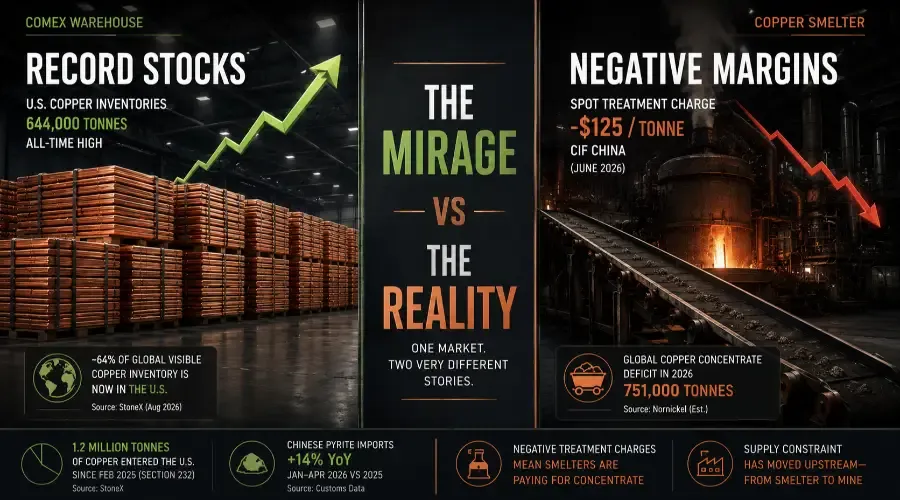
For the 2026 contract year, the benchmark copper concentrate treatment charge settled at zero for the first time in history. On the spot market, it went even further. S&P Global Platts assessed spot treatment charges at -$125 per tonne CIF China in late June, confirming the depth of the squeeze.
In simple terms, copper smelters are now effectively paying miners for the privilege of processing their ore. That is more than a pricing anomaly; it is evidence that the market constraint has moved upstream – from the smelter to the mine.
Negative Copper Spot Treatment Charges Signal Supply Scarcity
Treatment charges are effectively the price smelters receive for converting copper concentrate into refined metal. When concentrate is plentiful, miners compete for smelter capacity and treatment charges rise. When concentrate becomes scarce, the balance reverses: smelters compete for feedstock.
That is where the market is now. Chinese smelting capacity expanded for years on the assumption that mine supply would keep pace. It didn't. Concentrate growth stalled while outages at major mines tightened the raw-material pipeline further. Nornickel estimates the global copper concentrate deficit at 751,000 metric tons in 2026 – a shortfall large enough to keep smelter margins under sustained pressure.
The result is an increasingly uncomfortable equation: More furnaces + insufficient concentrate = collapsing treatment charges
Once charges move below zero, the economics become particularly revealing. Smelters are effectively subsidizing the processing of scarce concentrate simply to keep capacity operating.
The Pyrite Signal Is More Important Than It Looks
The most interesting evidence may be hiding in customs data. Chinese pyrite imports rose approximately 14% year-on-year during the first four months of 2026, reaching nearly 392,000 tonnes - the highest volume for that timeframe since 2014.
That is not simply a routine change in feedstock. It shows smelters searching for alternative sulphur-bearing inputs as conventional concentrate becomes harder to secure.
Smelters are also leaning more heavily on by-product credits from:
- Gold
- Silver
- Sulphuric acid
These secondary revenues can help offset deteriorating core processing economics. But there is a huge difference between maximizing by-products and searching for substitute feed because the normal concentrate pipeline is failing. When an industrial system begins using inputs it previously did not need, it is a sign that the system is approaching a physical constraint.
The COMEX Inventory Number May Be Misleading
Now consider the headline most investors are watching. COMEX copper inventories have reached roughly 644,000 tonnes – a record level. At first glance, that looks bearish: more inventory should mean more supply.
Location matters. StoneX estimates that at least 1.2 million metric tons of copper have entered the United States since the Section 232 investigation was ordered in February 2025. As of August 2026, roughly 64% of global visible copper inventory is located in the United States.
That is an extraordinary concentration driven by tariff front-running rather than genuine global abundance. The metal didn't suddenly appear because the world produced substantially more copper; it moved because market participants anticipated that copper inside the United States could become more valuable under Section 232.
This is the broader lesson of commodity market plumbing: inventory numbers only become meaningful when you know where the metal is, why it moved, and what part of the physical supply chain is actually constrained. A record warehouse balance can therefore coexist with a tightening market if the inventory is concentrated in the wrong location.
The COMEX vs LME copper inventory divergence highlights how metal is displaced, not surplus.
London and Shanghai provide a more useful perspective on underlying physical tightness. While U.S. stocks are elevated, ex-U.S. inventories remain lean. The copper isn't surplus – it's in the wrong place.
Refined Supply Isn't Responding Like a Surplus Market
Despite substantial global smelting capacity, the International Copper Study Group expects refined copper production to grow only around 0.4% for the full year.
Capacity exists, but usable concentrate does not. When treatment charges collapse, smelters eventually have to respond through: Run cuts → Maintenance → Curtailments → Lower refined output
The market's constraint has migrated from "Can the world smelt enough copper?" to "Can the world produce enough concentrate to keep the smelters supplied?"
AI and Grid Demand Are Waiting on the Other Side
This supply problem is arriving just as structural demand becomes harder to ignore. AI data centres and global grid expansions require massive amounts of physical copper infrastructure.
Copper is therefore one part of a much larger physical constraint on AI expansion. Power, memory, advanced packaging, cooling and critical inputs can each become bottlenecks, meaning the speed of AI deployment ultimately depends on far more than the availability of GPUs.
If smelter curtailments reduce refined supply into that demand wall, the market could move from a processing-margin problem to a physical metal problem.
The Second-Order Effect: Copper Also Needs Acid
Copper isn't only a producer of sulphuric acid through smelting. Roughly 21% of global copper mine output comes from SX-EW (Solvent Extraction-Electrowinning) operations, which consume acid as a leaching reagent.
SX-EW copper operations account for 21% of mine output and drive significant sulphuric acid demand.
That means higher sulphuric-acid prices raise production costs for a significant portion of global copper supply, creating a double squeeze:
- Smelter cuts → less by-product acid supply
- Higher acid prices → higher SX-EW production costs
The same acid dependency extends beyond copper. Sulphuric acid is a critical processing input for uranium, nickel and other mining operations, so a reduction in by-product acid from copper smelters can transmit the supply shock into completely different commodity markets.
Copper Shortage → Smelter Cuts → Less By-Product Acid → Higher Uranium & Nickel Production Costs
What to Watch Next
Three signals matter far more than the headline COMEX number:
- U.S. Section 232 policy decision: The central catalyst for determining whether the U.S. inventory build represents temporary tariff positioning or genuine end-user demand.
- Chinese smelter curtailments & CSPT floor prices: Watch actual run-rate reductions and CSPT (China Smelters Purchase Team – the buying consortium that sets joint floor guidance for 16 major Chinese smelters) moves. Negative spot treatment charges cannot persist indefinitely without forcing capacity adjustments.
- Ex-U.S. inventory draws: LME and SHFE inventory movements provide a much cleaner read on true physical tightness than the record COMEX stockpile.
The Bottom Line
The copper market is telling two completely different stories: COMEX says abundance, but treatment charges say scarcity. Pyrite imports show smelters improvising, while the concentrate deficit confirms the underlying feedstock problem is real. If smelters cannot secure enough concentrate, production eventually has to adjust – and when it does, the constraint will ripple across the entire commodity ecosystem.
BreakoutBulletin publishes analytical research and education for informed investors. Nothing here is a buy or sell recommendation or personalized investment advice; the author is not a registered investment adviser. Figures are based on information available at publication and may be revised. Readers should conduct their own research and verify material claims against primary sources.