
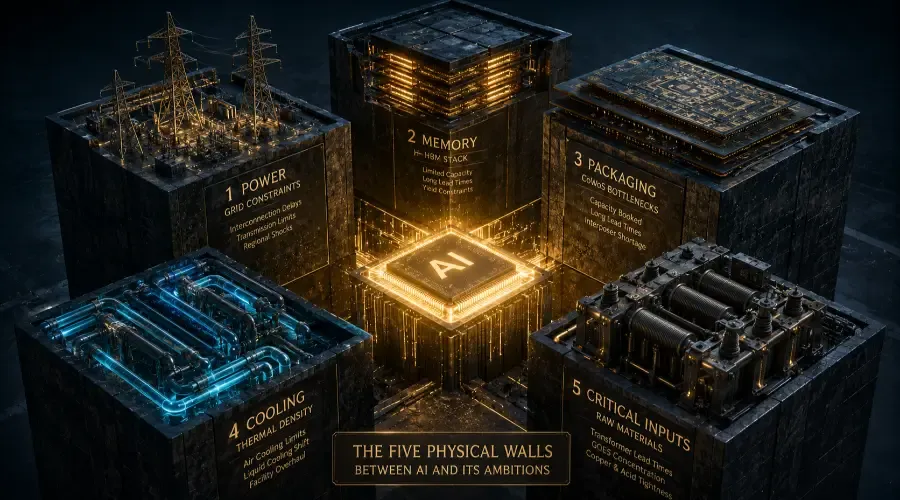
The AI story is told as software and demand. The binding constraints are physical – power, memory, packaging, cooling, and a handful of raw inputs – and each one caps how fast the build-out can actually go.
By Manish T. · August 16, 2026 · 10 min read
Editor’s note: This is educational analysis, not investment advice. Figures are as reported in company earnings calls, grid operator filings, specialist trade press, and supply-chain data providers as of August 2026. Capacity, lead times, and yield figures may be revised. Nothing here is a recommendation to buy or sell any security.
Markets price AI as a demand story: insatiable appetite for intelligence, priced into the companies that sell it.
The companies actually building it keep saying something different. AMD called supply-chain capacity – not demand – its main near-term constraint. The real ceiling on AI is physical, and it has five walls.
Understanding them is the difference between pricing the ambition and pricing what can actually be delivered.
Wall 1 – Power: The Grid Is the First Gate
A single large AI data center can draw as much electricity as a small city, and the grid can’t keep up.
AI data center power grid constraints are no longer a future risk. They are a present bottleneck.
The problem is increasingly moving from generation to the physical equipment required to deliver electricity where it is needed. Transformers, transmission connections and grid infrastructure can take years to secure, turning power availability into a much more immediate constraint on AI deployment.
-
Interconnection Queues: Transmission queues stretch years in multiple US regions.
-
Grid Shocks: A transmission fault in Northern Virginia dropped more than 3 GW of data-center load onto backup in seconds.
-
Regional Moratoriums: Texas paused new data-center grid approvals to audit an interconnection queue that dwarfs its record peak demand – an ERCOT-level signal that the queue itself has become the constraint.
You can have the capital and the chips and still wait years for the power to run them.
Wall 2 – Memory: HBM Is the Binding Input
High-bandwidth memory is the quiet chokepoint. The high-bandwidth memory (HBM) shortage is no longer a demand problem; it is an allocation problem.
-
HBM is reported sold out through 2026, with 2027 capacity fully booked across all three major makers.
-
Samsung’s HBM4 yield rates only recently reached an ~80% level, with SK Hynix and Micron also working through complex manufacturing yields.
-
Buyers like NVIDIA and AMD are redesigning accelerators around the memory they can get rather than the performance they want.
When the buyer bends the product to the constraint, the constraint has become structural. These are increasingly memory-bound AI accelerators, not just compute-bound ones.
The significance goes beyond a temporary HBM shortage. As AI accelerators become increasingly dependent on high-bandwidth memory, HBM and DRAM availability can become the next semiconductor constraint, affecting the entire computing stack rather than simply the memory suppliers themselves.
Wall 3 – Packaging: The Bottleneck Has Moved Downstream of the Fab
Even with chips fabricated, they can’t ship without advanced packaging. TSMC CoWoS packaging bottlenecks and extended lead times are now among the most critical hardware constraints in AI.
-
CoWoS capacity is booked into 2027, with lead times running 50 to 78 weeks.
-
The silicon interposer capacity shortage remains acute, because each AI accelerator requires a large silicon interposer that is non-trivial to manufacture at scale.
-
A chip can be designed, taped out, and fabbed and still sit unshippable for lack of a packaging slot.
The bottleneck has migrated downstream of the fab, to a step most investors never evaluate.
That shift makes advanced packaging almost as strategically important as semiconductor fabrication itself. CoWoS capacity, silicon interposers and packaging lead times can determine whether a completed AI chip can actually become a shippable accelerator.
Wall 4 – Cooling: Thermal Density Has Broken Air Cooling
As accelerators grow denser, air cooling stops working.
Legacy air-cooled data centers were designed for roughly 10–15 kW per rack. Modern AI clusters routinely operate at 40–100+ kW per rack, and next-generation liquid-cooled deployments push even higher.
-
Mandatory Architecture: Liquid and immersion cooling shift from optional to mandatory.
-
Facility Overhaul: The data center’s physical plant – plumbing, heat rejection, water sourcing – becomes a binding constraint alongside the silicon.
-
Retrofit Friction: A facility designed for yesterday’s thermal density cannot simply be filled with today’s chips. The thermal density per rack mismatch is the wall.
Wall 5 – Critical Inputs: The Quiet Upstream Chokepoints
Upstream of the data center sit unglamorous but essential material constraints.
Grain-Oriented Electrical Steel (GOES) & Transformers
-
Domestic US production of Grain-Oriented Electrical Steel is effectively concentrated in one primary producer.
-
High-voltage transformers – which require GOES for their cores – face multi-year delivery lead times.
-
A data center can be fully built and equipped, but it cannot be energized without a transformer and a grid connection.
Copper & Sulphuric Acid
-
Copper: Infrastructure pulls massive copper volumes across the grid, the substation, and power distribution within the facility. Treatment charges and scrap spreads serve as early indicators of physical tightening.
-
Sulphuric Acid: Acid is an indispensable processing reagent across the metals (copper, nickel, cobalt) that feed the build. Merchant acid pricing provides a quiet signal of upstream processing friction.
The material bottleneck extends beyond copper and sulphuric acid. AI infrastructure also creates demand for specialized metals used across the computing and electrical supply chain, making tin and tungsten potential physical constraints in the AI buildout if supply cannot scale alongside demand.
The Unifying Insight: Liebig’s Law of the Minimum
In every one of these walls, announced capacity overstates deliverable capacity because the binding constraint sits upstream of the visible bottleneck.
This is Liebig’s Law of the Minimum – the principle from agricultural chemistry and systems engineering that growth is dictated not by total resources available, but by the scarcest resource.
-
You can build the winding line but not wind transformer cores you cannot source.
-
You can build a data center shell but not energize it without a substation connection.
-
You can design a faster chip but not ship it without an HBM allocation and a packaging slot.
Deliverable compute is capped by whichever wall is shortest at any moment.
Severity & Solvability Ranking
| Wall | Severity | Expected Duration | Solvability |
|---|---|---|---|
| Power / Grid | Highest | Multi-year | Hard – Heavy infrastructure, complex permitting, and transmission lead times. |
| Memory (HBM) | High near-term | 12–24 months | Moderate – All three major memory makers adding capital and cleanroom capacity. |
| Packaging (CoWoS) | High near-term | 12–30 months | Moderate – New TSMC lines and alternative packaging ecosystems scaling up. |
| Cooling | Medium | Transitional | Easier – Engineering and facilities migration, not an absolute raw material limit. |
| Critical Inputs | Cyclical | 18-36 months | Market-Driven – Elevated prices incentivize new supply lines and substitution. |
The Case for Relief: Walls Can Move
These walls do not form a permanent ceiling. Each is dynamic, and capital is actively working to dismantle constraints:
-
Power: Interconnection queue reforms, on-site dedicated generation, utility-scale battery storage, and small modular reactors (SMRs) are expanding options over time.
-
Memory: Aggressive cleanroom expansion from Samsung, SK Hynix, and Micron is projected to ease HBM allocation pressure into late 2027.
-
Packaging: Advanced packaging lines and alternative panel-level packaging technologies are coming online.
-
Cooling: Standardized direct-to-chip liquid cooling manifolds are shortening facility commissioning timelines.
-
Critical Inputs: High prices for GOES, copper, and reagents are incentivizing capacity restarts and domestic supply chain reshoring.
Sulphuric acid is particularly important because it connects the AI infrastructure story to a much wider mining system. A disruption in copper smelting can reduce merchant acid availability, raising input costs for uranium, nickel and other metals that depend on acid-intensive processing.
The right frame is not that the walls are unbreakable. It is that the walls move on physical timelines, not financial markets' schedules.
Geopolitical Concentration: The Overlay Risk
Two of the five walls carry an acute geopolitical overlay:
-
Advanced Packaging remains heavily concentrated in Taiwan, centered around TSMC’s domestic foundries.
-
High-Bandwidth Memory (HBM) is concentrated in South Korea across Samsung and SK Hynix.
While power and transformer steel are largely domestic infrastructure challenges, HBM and advanced packaging sit in regions with heightened geopolitical sensitivity. Supply-chain concentration magnifies the physical constraints into tail risks.
Diagnostic Tracking Framework
| Wall | Key Metrics & Leading Indicators to Watch |
|---|---|
| Power | Interconnection queue backlog data, ISO/RTO approval timelines, regional transmission fault rates. |
| Memory | HBM yield progression rates, vendor allocation disclosures, lead times for HBM4/HBM4E. |
| Packaging | TSMC CoWoS capacity expansion timelines, packaging lead-time changes, silicon interposer availability. |
| Cooling | Liquid and immersion cooling adoption percentages, rack density milestones ($\text{kW/rack}$), municipal water permit restrictions. |
| Critical Inputs | GOES domestic output, high-voltage transformer delivery lead times, copper treatment charges (TC/RCs), merchant sulphuric acid pricing. |
Catalysts to Watch
-
HBM4E & CoWoS Additions: Progress on advanced-packaging yield and memory delivery curves.
-
Grid Interconnection Reform: Federal and regional regulatory overhauls for large-load data center approvals.
-
Thermal Architecture Shifts: Speed of data center retrofits from legacy air handling to direct-to-chip liquid loops.
-
Upstream Material Signals: GOES production volumes, transformer lead times, and global copper treatment charges.
-
Geopolitical Events: Policy and trade actions impacting Taiwan and South Korea semiconductor supply chains.
The Bottom Line
The AI ceiling isn’t imagination or capital – it’s physics.
Power, memory, packaging, cooling, and raw inputs each cap the build-out. Announced capacity overstates what can actually be delivered.
Value migrates to whoever controls the scarce wall: the memory oligopoly, the packaging leaders, and the power and electrical equipment chokepoints.
There is also a reflexive twist: an efficiency gain that relieves one wall often deepens another. Cheaper inference accelerates broad adoption, which pulls more aggregate power.
Price deliverable compute, not demand. Follow the value to whoever owns the shortest wall.
BreakoutBulletin publishes analytical research and education for informed investors. Nothing here is a buy or sell recommendation or personalized investment advice; the author is not a registered investment adviser. Figures are as publicly reported and may be revised; private valuations are self-reported or specialist press estimates. Do your own research.