
Most traders do not lose because they misread direction; they lose because they misread structure, entering too early in what appears to be a breakout or too late when the move is already exhausted. In Elliott Wave theory, timing is inseparable from structure, and structure is what defines opportunity.
The real edge lies in identifying a Motive Wave early, particularly Wave 3, which is the phase where price no longer hesitates, participation expands across the market, and momentum begins to align with structure in a way that produces sustained directional movement.
This guide approaches the Motive Wave not as a theoretical construct, but as a decision framework, allowing you to move from subjective labeling to structured execution grounded in observable price behavior.
This article is part of the complete framework: Elliott Wave Trading: Complete Guide from Basics to Strategy
What is an Elliott Wave Motive Wave
A Motive Wave is a five-wave price sequence that progresses in the direction of the dominant trend, forming the structural backbone of all sustained market moves. Within this sequence, Waves 1, 3, and 5 represent directional advances, while Waves 2 and 4 serve as corrective interruptions that reset positioning without breaking the trend itself.
What makes this structure particularly powerful is its fractal nature, meaning the same five-wave pattern replicates across timeframes, allowing a trader to analyze a daily trend and an intraday move using the same structural logic without inconsistency.
Most Common Mistake
The most frequent error is not misunderstanding the theory, but misidentifying the starting point. Traders often label any five-bar advance as Wave 1, assuming the beginning of a new trend, when in reality the move lacks internal structure.
A valid Wave 1 must subdivide into five smaller waves on a lower timeframe, reflecting genuine directional intent. If the move resolves into three waves (A–B–C), it is corrective in nature, not impulsive, and treating it as a motive wave introduces structural risk from the outset.
To understand how these misreads happen inside corrections, read: Corrective Waves: Zigzag vs Flat Explained
The 5-3-5-3-5 Structure
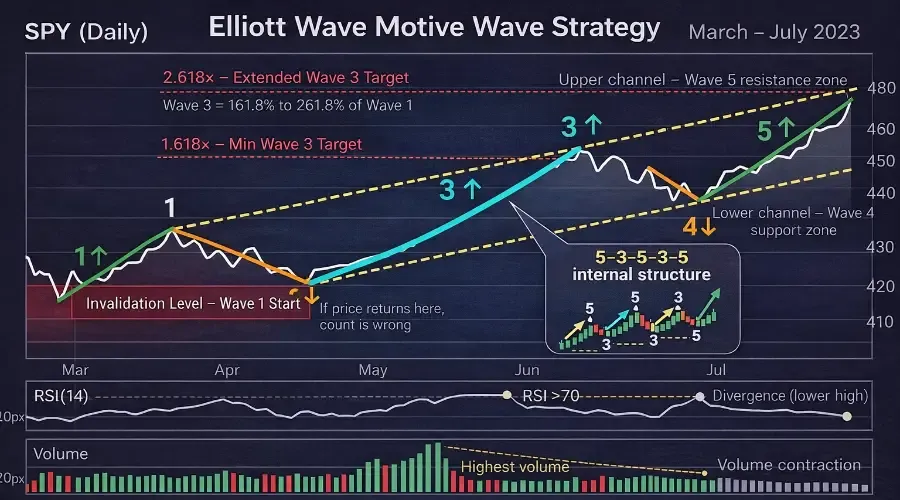
The internal architecture of a motive wave follows a precise and repeatable sequence: Wave 1 advances in five sub-waves, Wave 2 corrects in three, Wave 3 expands again in five, Wave 4 consolidates in three, and Wave 5 completes the structure with a final five-wave advance.
This 5-3-5-3-5 formation is not merely descriptive; it is diagnostic. It allows you to validate whether a move belongs to a trend or a correction, and more importantly, whether the market is transitioning from uncertainty to expansion, which is where opportunity emerges.
Elliott Wave Channeling Technique
Channeling translates structure into spatial context, providing a framework for anticipating where price is likely to react within a developing trend. By connecting the end of Wave 1 to Wave 3 and projecting a parallel line from Wave 2, you create a channel that often contains the full impulse.
Within this framework, Wave 4 tends to respect the lower boundary, reflecting controlled retracement, while Wave 5 approaches the upper boundary, where momentum begins to decelerate as the trend matures.
CHART: SPY daily chart showing a five-wave impulse with channel boundaries, highlighting Wave 3 expansion and Wave 5 interaction with upper resistance
Wave 3: The Most Tradeable Opportunity
Among all five waves, Wave 3 represents the point where structure and participation converge, producing the most reliable and scalable trading opportunity. Unlike Wave 1, which often forms under conditions of uncertainty, Wave 3 emerges after the market has corrected, absorbed opposing positions, and aligned participants in the direction of the trend.
This is the phase where momentum accelerates, volume expands, and breadth improves, creating a feedback loop that sustains the move far beyond initial expectations.
To understand how momentum confirms or invalidates this phase: Wave 3 vs Wave 5 Divergence Strategy
How to Identify Wave 3 Early
Identifying Wave 3 early requires more than pattern recognition; it requires the alignment of structure with measurable momentum. Structurally, you must confirm that Wave 1 has completed with a clear five-wave subdivision and that Wave 2 has corrected in three waves without retracing the entirety of Wave 1.
From a momentum perspective, the transition into Wave 3 is typically accompanied by RSI moving above 60 with continuation, an expanding MACD histogram, and increasing volume relative to recent averages, all of which indicate that participation is no longer isolated but broad-based.
When these elements align, the probability that the market is entering a genuine Wave 3 increases materially.
Wave 3 Extension Targets
Wave 3 is rarely symmetrical with Wave 1; instead, it tends to extend, and these extensions provide a measurable framework for projecting targets. The most common relationships are 1.618 times the length of Wave 1, which serves as a minimum expectation, and 2.618 times Wave 1, which reflects strong trend conditions.
For example, if Wave 1 advances from 400 to 420 and Wave 2 retraces to 410, the 1.618 projection implies a move toward approximately 442, while the 2.618 projection extends toward 462. A failure to approach the 1.618 level often indicates that the structure is not a true motive wave but part of a corrective sequence.
Learn how to calculate these levels precisely: Fibonacci Targets for Wave 3, 4 & 5
Trade Decision Logic
Structure provides the framework, but execution requires decision rules. If price reaches the 1.618 extension with expanding volume, the structure is behaving as expected, and holding for a potential move toward 2.618 becomes justified. If, however, price struggles to sustain movement beyond the 1.0 extension, the implication is that the move lacks impulsive strength, and exiting becomes the prudent decision.
When price reaches 1.618 but momentum begins to contract, partial profit-taking allows you to reduce exposure while remaining aligned with the broader structure. Finally, if price retraces to the origin of Wave 1, the entire count is invalidated, and the position should be exited without hesitation.
Elliott Wave Non-Negotiable Rules
These rules define the structural integrity of a motive wave and are not open to interpretation. Wave 2 must not retrace more than 100 percent of Wave 1, as doing so negates the existence of a trend. Wave 3 cannot be the shortest among Waves 1, 3, and 5, ensuring that the central impulse retains its defining strength. Wave 4 must not overlap the price territory of Wave 1, preserving the separation between impulse and correction. Wave 5 should exceed the high of Wave 3, unless a truncation occurs, which itself carries specific implications.
For complete validation framework: Elliott Wave Rules vs Guidelines
Wave 2 Retracement Behavior
While Wave 2 is bounded by a single rule, its behavior tends to cluster within identifiable ranges. Retracements between 50 and 61.8 percent are the most common and reflect a balanced reset of positioning. Deeper retracements toward 78.6 percent indicate stronger counter-trend pressure, while shallow retracements below 38.2 percent often signal that the underlying trend is exceptionally strong and unlikely to pause for long.
Impulse vs Motive Wave
Although often used interchangeably, the distinction matters. All impulse waves qualify as motive waves, but not all motive waves meet the stricter criteria required of impulses. Motive waves encompass a broader category, including diagonal structures, whereas impulse waves adhere to more rigid rules. Understanding this distinction prevents structural misclassification.
What is Truncation
A truncation occurs when Wave 5 fails to exceed the high of Wave 3, indicating that the trend has reached a point where participation no longer supports continuation. Although relatively rare, truncations are significant because they often precede sharp reversals driven by exhaustion rather than gradual transition.
Market Regime and Wave Behavior
The behavior of motive waves is not constant; it varies with the broader market environment. In expansionary regimes characterized by abundant liquidity and risk appetite, Wave 3 extensions frequently reach or exceed 2.618, and trends tend to persist. In contractionary regimes, where liquidity tightens and uncertainty increases, extensions are shorter, and failure rates rise. Aligning your expectations with the prevailing regime improves both accuracy and risk management.
Wave 3 Trade Checklist
- Wave 1 displays a clear five-wave internal structure
- Wave 2 forms a three-wave correction
- Wave 2 does not retrace 100 percent of Wave 1
- RSI is above 60 and rising
- MACD histogram is expanding in the direction of the trend
- Volume is increasing relative to recent averages
- The 1.618 extension level is defined
- The invalidation level at the start of Wave 1 is clearly marked
Risk Management
The primary risk in Elliott Wave analysis is not volatility but structural misinterpretation. Entering a trade without confirming internal subdivisions introduces ambiguity that cannot be managed through position sizing alone. A disciplined approach requires multi-timeframe validation, structural clarity, and predefined invalidation levels before capital is committed.
Frequently Asked Questions
What is the Elliott Wave Motive Wave strategy
It is a structured method of trading trends by identifying five-wave price sequences and focusing on high-probability phases such as Wave 3.
How do I confirm a Wave 3 breakout
By aligning structural completion of Wave 2 with expanding momentum indicators such as RSI, MACD, and volume.
Can Wave 3 be shorter than Wave 1
Yes, but it cannot be the shortest among Waves 1, 3, and 5, as this would violate core structural rules.
Key Takeaways
- Motive waves follow a 5-3-5-3-5 structure that defines trend behavior
- Wave 3 represents the highest-probability and most scalable opportunity
- Fibonacci extensions provide objective target frameworks
- Structural rules are absolute and must not be violated
- Momentum confirmation separates valid breakouts from corrective moves
Internal Links
Learn how corrective structures develop in the guide on Corrective Waves (ABC Patterns).
Understand the full framework in Elliott Wave Rules Explained.
Call to Action
This article is part of the Elliott Wave Mastery Series. Start from the beginning or continue to the next step to build a complete trading framework.
Next Step in the Framework:
Now that you understand how trends form, the next step is to understand how they pause and trap traders.
Read Next: Corrective Waves (Zigzag vs Flat)