
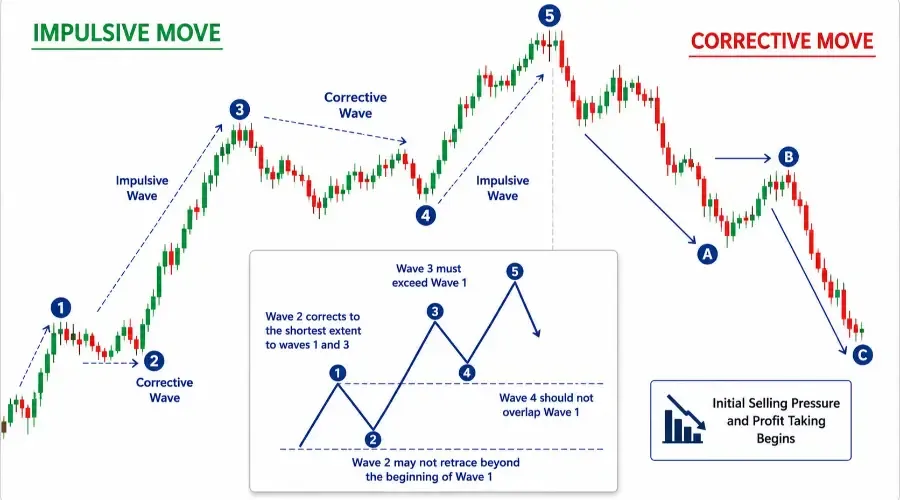
Most Elliott Wave content teaches labeling. Very little teaches execution.
This distinction is where most traders fail.
A wave count can be technically correct and still be completely useless if it does not translate into a tradeable framework. Elliott Wave becomes powerful only when it answers four questions before the trade begins:
Where to enter
Where to exit if wrong
Where to take profit
What conditions validate the setup
Professional traders do not rely on interpretation. They rely on structure, rules, and predefined outcomes.
This guide is designed to move from theory to execution - from identifying waves to building a complete trading framework.
What Is Elliott Wave and Why It Works
Markets move in cycles, not in straight lines. These cycles are driven by collective human behavior — expansion, participation, hesitation, and reversal.
Elliott Wave captures this behavior through repeating structures of trend and correction. These structures are fractal, meaning the same patterns appear across all timeframes.
However, the goal is not to label every wave. The goal is to identify phases where probability is asymmetric.
The edge does not come from prediction. It comes from positioning within the structure.
Motive Waves: The Engine of Trend
Motive waves define directional movement. They consist of a five-wave sequence, but the count itself is not the edge - the behavior inside the sequence is.
Wave 1 begins with early participation. It is often hesitant and overlaps with prior structure.
Wave 2 retraces Wave 1 and tests conviction. It should unfold in three waves.
Wave 3 is where participation expands. Momentum increases, corrections become shallow, and volume typically confirms strength. This is the most important wave for trading.
Wave 4 introduces hesitation but should remain shallow and structured.
Wave 5 completes the move, often with weakening momentum and divergence.
The critical insight is this:
A valid impulse must subdivide into five smaller waves. If internal structure does not confirm, the pattern is not impulsive - regardless of appearance.
To understand how to actually trade Wave 3 setups, read: Elliott Wave Motive Wave Strategy: Identify Wave 3 & Targets
Corrective Waves: Where Most Traders Fail
Corrections are not random pullbacks. They follow defined structures that reflect profit-taking and counter-trend positioning.
The most common forms are:
Zigzag — sharp and directional (5-3-5)
Flat — sideways and complex (3-3-5)
Triangle — contracting and indecisive
The mistake most traders make is treating corrections as trends.
A three-wave move is not the start of a new trend. It is a pause within the existing structure.
This is where traps occur - particularly during B-waves, which often resemble breakouts but lack impulsive structure.
The key rule is simple but non-negotiable:
Three waves indicate correction. Five waves indicate trend.
To avoid common traps in corrections, read: Corrective Waves: Zigzag vs Flat Explained
Complex Corrections: When Structure Extends
Markets do not always correct cleanly. When a simple correction fails to resolve, it extends into combinations such as W-X-Y structures.
These formations are not random. They represent continuation of correction when the market has not yet completed its rebalancing phase.
The X-wave acts as a connector, often misleading traders into thinking a new trend has begun.
This is where most incorrect wave counts originate - misinterpreting continuation of correction as initiation of trend.
Understanding complex corrections is not optional. It is necessary to avoid false signals.
For deeper understanding of extended corrections: X-Wave Trap: Double Three (WXY) Strategy
The Four Rules: Structural Integrity
Elliott Wave is not flexible. It is governed by rules.
Wave 2 cannot retrace 100% of Wave 1
Wave 3 cannot be the shortest
Wave 4 cannot overlap Wave 1
Wave 5 typically exceeds Wave 3
These are not guidelines. They are conditions of validity.
The moment a rule is violated, the count is invalid.
There is no interpretation at this stage. There is only acceptance and reset.
This is where discipline replaces bias.
Study full validation framework: Elliott Wave Rules vs Guidelines
Fibonacci: Measuring Probability
Fibonacci ratios provide the measurement framework for Elliott Wave. They define where waves are likely to terminate, not where they must terminate.
Wave 2 typically retraces 50% to 61.8% of Wave 1
Wave 3 commonly extends to 161.8% or beyond
Wave 4 tends to retrace 23.6% to 38.2%
Wave 5 often mirrors Wave 1
The edge does not come from a single level. It comes from confluence - where multiple projections align.
Fibonacci is not predictive. It is probabilistic.
Used correctly, it allows traders to define targets before price reaches them.
Learn how to project exact targets: Fibonacci Targets for Wave 3, 4 & 5
Common Mistakes That Invalidate Analysis
Most failures in Elliott Wave come from avoidable errors:
Ignoring rules
Misidentifying wave degree
Trading corrections as impulses
Forcing counts to fit price
The most important principle is this:
The market is not wrong. The count is wrong.
A valid trader does not defend a count. They abandon it when invalidated.
Avoid the most dangerous trap: B-Wave Trap: False Breakout Explained
The Trading System: Converting Structure into Execution
Analysis without execution has no value.
A tradeable system must define:
Entry
Stop
Target
Exit
The most reliable setup is the Wave 3 breakout:
Entry occurs on a break above Wave 2 high
Stop is placed at the start of Wave 1
Target is projected using Fibonacci expansion (161.8%)
This structure creates asymmetric trades with defined risk and expandable reward.
The system removes interpretation at the point of execution.
Apply this in real trading: Wave 3 Entry Strategy (Entry, Stop, Target)
How the Framework Connects
This is not a collection of concepts. It is a sequence.
Structure identifies opportunity
Rules validate structure
Fibonacci defines targets
Mistakes refine understanding
System executes the trade
Skipping any step weakens the entire framework.
Key Takeaways
Elliott Wave is effective only when rule-based
Wave 3 provides the highest-probability trading opportunity
Fibonacci defines probability, not certainty
Most errors come from misidentifying structure
Execution determines outcome more than analysis
Frequently Asked Questions -
Is Elliott Wave reliable for trading?
It is reliable when applied with rules, structure, and predefined execution. Without discipline, it becomes subjective.
Which wave is best for trading?
Wave 3 offers the strongest combination of momentum and clarity of invalidation.
Why do most traders fail with Elliott Wave?
They treat it as a labeling exercise instead of a rule-based system.
Can Elliott Wave be used without indicators?
Yes, but combining it with momentum and volume improves confirmation.
Is backtesting necessary?
Backtesting provides statistical validation, but it does not eliminate uncertainty.
Final Statement
Elliott Wave is not a prediction tool. It is a framework for identifying structure, managing risk, and executing high-probability trades.
When applied with discipline, it transitions from theory to a complete trading system.