
The Part of the Market Most Traders Never Learn
Most traders understand the surface-level idea of sector rotation. They know institutions move from growth to value when rates rise, shift into defensives before recessions, and reduce exposure when volatility increases.
But very few understand how those moves actually happen.
The real edge does not come from knowing what institutions do. It comes from understanding how they execute those decisions, because execution leaves patterns in the market. These patterns are subtle, slow, and often invisible to traders who only focus on price.
Institutional behavior is not hidden. It is simply misunderstood.
The Size Constraint: Why Institutions Move Slowly
Scale Changes Everything
One of the biggest misconceptions in trading is that institutions are faster than retail participants. In reality, the opposite is true.
A retail trader can enter or exit a position in seconds. An institutional fund managing billions cannot. If a large fund attempts to buy aggressively, it pushes the price against itself, increasing its own cost of entry.
This creates a structural constraint. Institutions must accumulate positions gradually, often over weeks or even months. They break large orders into smaller pieces and distribute them across time to minimize market impact.
This slowness is not a weakness. It is a footprint.
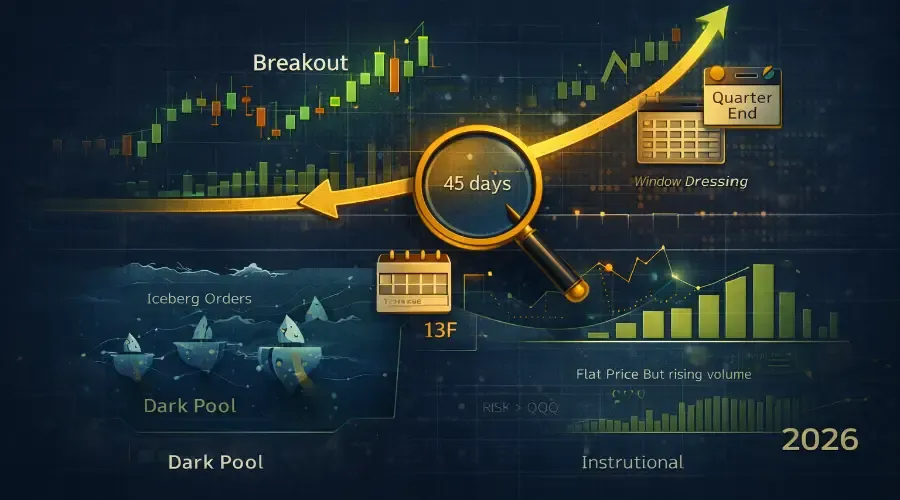
When you see sustained volume without a clear catalyst, it is often not random activity. It is institutional accumulation unfolding quietly.
This is the same process that creates early signals of hidden strength before price breakout becomes visible.
Dark Pools and VWAP: Where Real Accumulation Happens
Why Price Doesn’t Always Move With Volume
A large portion of institutional trading does not occur on visible exchanges. It happens in dark pools, where orders are hidden to prevent price disruption.
At the same time, institutions use execution strategies like VWAP, which aim to match the average price of the day. This allows them to build positions without signaling intent to the broader market.
The result is a unique pattern. Price may remain relatively stable while volume increases steadily. To an untrained eye, nothing is happening. But in reality, large-scale accumulation is already in progress.
By the time price begins to trend strongly, institutions are often well into their positions.
This explains why you often see stocks holding steady or rising even when the broader market is weak.
The 13F Illusion: Why Most Traders Are Already Late
Understanding the Delay in Institutional Data
Many traders look at 13F filings to track institutional activity. While these filings provide valuable insight, they come with a critical limitation.
There is a delay.
By the time a filing becomes public, the data can be several weeks old. Institutions may have already adjusted or exited those positions. This makes 13F data unreliable as an entry signal.
However, it still serves an important purpose. It confirms whether a move has institutional backing. It validates what the market has already been signaling through price and volume.
These patterns align closely with broader sector rotation dynamics currently shaping market leadership.
Index Rebalancing: The Predictable Flow Nobody Talks About
When Rules Drive the Market
Not all institutional flows are discretionary. A significant portion of capital follows rules, particularly in index funds and ETFs.
When a company is added to a major index, funds tracking that index are forced to buy. When it is removed, they must sell. These events are announced in advance, creating predictable demand and supply shifts.
This is one of the few areas in markets where timing is partially knowable.
Quarter-end adjustments add another layer. Funds often reposition their holdings to reflect recent winners, creating short-term distortions that reverse shortly after.
Understanding these patterns allows traders to anticipate movement rather than react to it.
Risk Parity Flows: When Volatility Controls Capital
The Mechanical Side of Market Moves
Some institutional strategies are driven not by opinion, but by formulas. Risk parity funds adjust exposure based on volatility levels.
When volatility rises sharply, these funds reduce equity exposure automatically. This creates additional selling pressure, often amplifying market declines.
When volatility falls, the process reverses. Capital flows back into equities, supporting recovery.
These flows are mechanical, not emotional. And that makes them predictable.
What the 2026 Market Is Revealing Right Now
The current market environment reflects these mechanics clearly. With the yield curve normalizing and inflation remaining elevated, institutions are rotating toward energy and financials.
But this rotation is not happening in a single move. It is unfolding gradually, visible through sustained volume patterns rather than sudden price spikes.
This is where most retail traders misinterpret the market. They wait for confirmation through price, while institutions are already positioned through execution.
Q&A: Understanding Institutional Behavior
Why does it feel like institutions always enter trades before everyone else?
Because they begin positioning before price confirms the move. Institutions anticipate macro shifts and start accumulating early using execution strategies that minimize visibility. By the time price trends clearly, much of their positioning is already complete.
Can traders use 13F filings to follow institutional moves?
Not for timing entries. The delay in reporting means the information is already outdated by the time it becomes public. However, it can be used to confirm whether a trend has strong institutional support.
What is the significance of flat price combined with rising volume?
This pattern often signals accumulation. Large players are absorbing supply without pushing price higher, typically using algorithmic execution. It is one of the clearest signs of institutional activity before a breakout.
The Real Edge: Reading What Others Ignore
Most traders focus on price because it is visible and immediate. But price is often the final stage of a process that begins much earlier.
Volume patterns, execution behavior, and institutional constraints provide signals before price moves. These signals require patience and interpretation, but they offer a significant advantage.
Markets do not move randomly. They move through structured behavior that can be observed and understood.
Final Thought: Execution Is the Hidden Layer of the Market
Understanding macro trends tells you where the market might go. Understanding institutional execution tells you when that move is actually happening.
The combination of both is what creates true edge. All of this fits into a larger framework of how markets actually function beneath the surface.
If you can see how capital is being deployed, you are no longer reacting to the market. You are moving with it.