
The 20 minutes before you sit down to trade are worth more than almost any other 20 minutes in your trading day.
Not because anything dramatic happens in that window. Because what you do in that window determines whether you arrive at the session with a clear picture of what matters today – or whether you're reacting to whatever the market throws at you first.
Most traders underinvest in pre-market preparation. They scan a few headlines, check their watchlist from yesterday, maybe glance at futures. They show up with a partial picture and fill in the gaps in real time, under pressure, while the market is moving.
That's not a process. That's improvisation with money.
An AI-assisted pre-market briefing changes this. Not by predicting what the market will do – nothing does that reliably – but by compressing the information-gathering and synthesis work that a thorough preparation requires into a repeatable 20-minute process you can run every single day.
Whether you use Claude, ChatGPT, or any other capable Large Language Model (LLM), this template and system will work seamlessly. This post covers exactly how to build that process.
The pre-market briefing is Stage 1 of the five-stage daily workflow. Daily Trading Workflow with AI covers how all five stages connect and what AI does and doesn't do at each one.
What a Pre-Market Briefing Should Cover
Before covering how to build the briefing, it's worth being precise about what it needs to contain. A complete pre-market briefing addresses five key areas:
Futures positioning
Where are S&P 500, Nasdaq, and Dow futures sitting relative to the prior close? Are they indicating a gap up or gap down at the open, and what's the approximate magnitude? This sets the overall market tone before anything else.
Macro news and economic events
What economic data is being released today? Are there any Fed speaker appearances, Treasury auctions, or geopolitical developments that could move markets? What happened overnight in Europe and Asia that's relevant to US market sentiment?
When the briefing involves a Fed decision or CPI release, the analytical approach changes. How to Interpret Fed Statements and Macro News with AI covers how to extract rate path signals from FOMC language and translate them into the sector implications that shape the session.
Earnings movers
Which companies reported earnings after yesterday's close or before today's open? Are any of them on your watchlist, or are they large enough to move their sector? What were the headline numbers – beat, miss, guidance direction?
Sector leaders and laggards
Which sectors are showing momentum coming into today's session? Which are under pressure? The sector picture tells you where institutional money is flowing before you start looking at individual stocks.
Stocks gapping pre-market
Which individual stocks are showing significant pre-market movement? Stocks gapping more than 2% pre-market on meaningful volume are typically worth noting – they often set the tone for their sector and can create sympathy moves in related names.
None of these five areas requires a deep analytical session to cover. Each requires a specific data source and a few minutes of focused attention. The AI briefing synthesizes all five into a structured summary that would otherwise take 45 minutes to build manually. Think of your AI tool as an algorithmic research assistant – it handles the repetitive synthesis so you can focus on judgment.
Where to Collect the Data
This represents the data-gathering phase (which we cover across our core workflow series)–the physical collection that happens before you open an AI tool. To harvest this data efficiently, you don't need complex formatting; simply highlight and copy the raw text directly from the pages. AI reads unstructured data tables perfectly.
Here is exactly where each data type comes from:
Futures – CME Group, Finviz, or your broker's pre-market screen
CME Group's website shows live futures prices for the major US indices. Finviz's futures page provides a clean pre-market snapshot. Most broker platforms display current futures positioning on their dashboard or market overview screen. Copy the current levels and the implied open change for S&P 500, Nasdaq, and Dow.
Macro news and economic events – Reuters, economic calendar
Reuters and Bloomberg provide overnight news summaries that cover the key macro developments. For the economic calendar – which events are scheduled today and what are the consensus estimates – sites like Investing.com, Econoday, and the Federal Reserve's own release schedule provide clean, structured data. Copy the relevant events and consensus figures. This data forms the foundation of your macro trading system.
Earnings movers – Finviz earnings calendar, company IR pages
Finviz's earnings calendar shows which companies are reporting today and whether they report before or after the bell. For companies that have already reported, the headline EPS and revenue figures are typically available on Finviz, Yahoo Finance, or directly from the company's investor relations page within minutes of the release. Copy the headline figures for any name relevant to your watchlist or sector focus.
Sector leaders and laggards – Finviz ETF performance table
Finviz's ETF section shows the performance of the 11 SPDR sector ETFs across multiple timeframes – 1 day, 1 week, 1 month. The 5-day view is particularly useful for the pre-market briefing because it captures recent momentum rather than just yesterday's move. This table is a key input for your top-down sector analysis. Click and drag your mouse to highlight and copy the entire table–ticker, sector name, 5-day return–directly from the page.
Pre-market movers – Finviz pre-market screener
Finviz's pre-market tab shows stocks with significant pre-market price movement alongside the volume driving that movement. Filter for stocks moving more than 2% with meaningful pre-market volume. Copy the top names, their move percentage, and the reason for the move where it's visible.
Total data collection time on a standard morning: 7 to 10 minutes. On an earnings-heavy day or a scheduled macro event day, allow 12 to 15 minutes to gather the additional material.
How to Structure the AI Prompt for a Pre-Market Brief
With your data gathered, open your AI interface. The prompt structure follows an optimized framework–assigning a role, context, data placeholders, specific tasks, and tight constraints.
Here's your master template:
"Act as a market analyst preparing a pre-market briefing for a swing trader focused on [your sector focus] stocks with a [your holding period] holding period.
I've provided the following data:
– Current futures positioning: [paste]
– Today's economic calendar: [paste]
– Pre-market earnings movers: [paste]
– 5-day sector ETF performance table: [paste]
– Pre-market stock movers above 2%: [paste]
Based only on the data I've provided:
(1) Summarise the overnight market tone and what it suggests about today's open.
(2) Identify the two sectors showing the strongest and weakest momentum from the sector ETF data.
(3) Flag any scheduled events or pre-market movers today that could significantly impact [your sector focus].
(4) List the top 3 stocks worth watching today based on the pre-market data, with a one-sentence reason for each.
Keep to four clearly labelled sections. Do not introduce information not present in the data I've provided."
The variable fields in this pre-market preparation AI template–such as your sector focus and holding period–are where you personalize this template to your strategy. A semiconductor swing trader fills those in differently from a broad-market day trader. The structural engine stays the same.
The constraint at the end – "do not introduce information not present in the data I've provided" – is critical. Without it, the model may pull from its training data to fill gaps, introducing figures or context that are outdated or inaccurate. With it, the briefing stays grounded in what you've verified.
How to Iterate Your Prompts
The value of this system depends heavily on well-constructed prompts. Do not settle for basic, default outputs. If the AI gives you generic commentary, you must optimize the instructions you give it.
The Lazy Prompt (Low-Value Output)
"Look at these pre-market numbers and tell me what's moving today."
The Result
A boring repetition of public data you just pasted, adding zero synthesis.
The Systematic Prompt (High-Value Architecture)
"Act as a risk manager. Compare today's economic calendar items against my tech sector focus. Identify if any upcoming data releases create a structural mismatch with a 5-day swing holding period."
The Result
A prioritized risk matrix highlighting which positions must be protected or avoided ahead of specific hours.
What to Do With the Output
The AI trading briefing is a starting point, not a finished product. When the output comes back, three steps follow before you're ready to trade.
Read it critically, not passively
The briefing is structured and clear, which can create the impression that it's authoritative. It isn't – it's a synthesis of the data you provided, framed by the model's analytical patterns. Read it the way you'd read a research note from a junior analyst: useful for structure and organization, requiring your judgment to evaluate.
Use follow-up questions to drill deeper
If the briefing surfaces something worth understanding better – a sector rotation signal, an unusual pre-market mover, a macro event with complex sector implications – run a follow-up prompt:
"The sector rotation you identified between XLK and XLE – based on the data I've provided, what does that suggest about the risk environment for semiconductor names today?"
One or two targeted follow-ups often produce the most useful insights from a briefing session.
Run the Mandatory Verification Pass
Any specific figure in the output must be traceable to the data you pasted. A quick scan of the briefing against your source material takes 2 to 3 minutes and confirms the model worked from your accurate data.
Specifically check that critical numbers–such as ensuring a company's reported EPS number matches what Finviz showed, or checking that a pre-market gap percentage hasn't been rounded up incorrectly–are exactly accurate. Never trade off unverified AI text.
The briefing output feeds directly into watchlist building. How to Build a Daily Watchlist Using AI Sector Analysis covers the top-down process for moving from a sector rotation picture to a ranked list of individual stock candidates with specific volume and relative strength thresholds.
What to Never Skip Even When Time Is Short
Some mornings the pre-market window is compressed. A meeting runs long, the alarm didn't go off, something came up. When you're running short on time, the temptation is to skip parts of the process. Here's what to protect regardless of time pressure:
The economic calendar check
The single most dangerous thing you can do in a pre-market session is enter a trade without knowing what macro events are scheduled that day. A CPI release, a Fed decision, a non-farm payrolls number – any of these can override every technical setup on your watchlist within minutes of their release. Knowing what's on the calendar today takes 90 seconds and is never the right thing to skip.
The earnings mover check
If a large-cap in your sector reported overnight and you don't know about it, you're trading blind on the most important catalyst that stock and its sector peers will trade on all day. Two minutes on Finviz's earnings calendar is not optional.
The futures read
You don't need a 10-minute analysis of futures positioning. But knowing whether the market is set to open up 0.8% or down 1.4% changes the entire context of your watchlist and your entry criteria. 60 seconds. Never skip it.
The sector ETF table and the pre-market movers list can be abbreviated when time is genuinely short. The three items above cannot.
A Real Pre-Market Briefing – Fed Decision Day
To make this concrete rather than theoretical, here's what a complete pre-market briefing session looked like on a Fed rate decision day, walked through in full to show how the process handles a high-stakes macro event for a trader executing a top-down strategy on US markets using Eastern Time (ET).
The Date
November 7, 2024 – FOMC decision day.
The Context
The Fed was expected to cut rates by 25 basis points. The decision was due at 2:00 PM ET, with Chair Powell's press conference to follow. Markets had largely priced in the cut, but the language around future cuts – the pace and magnitude of the easing cycle – was the variable that would move markets.
Data gathered (8:00 AM–8:12 AM ET)
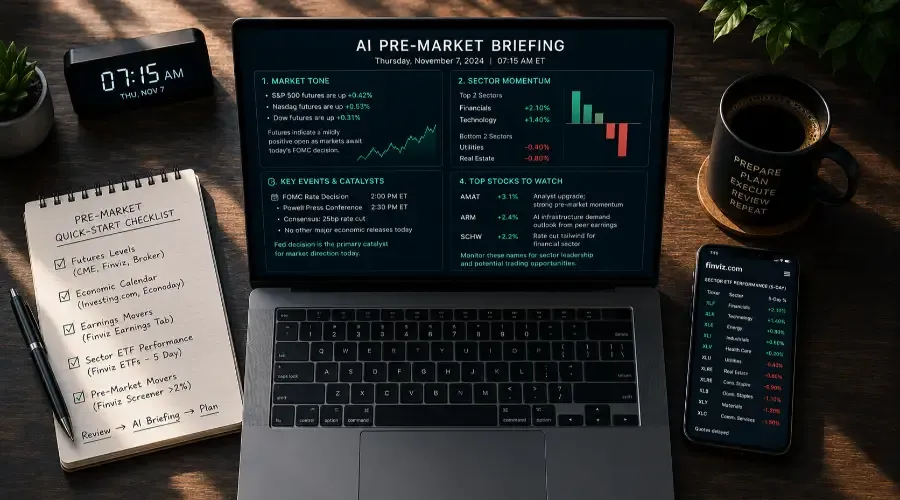
Futures: S&P 500 futures up 0.4% ahead of the open. Nasdaq futures up 0.5%. Market tone: mildly risk-on into the decision, consistent with a cut being fully priced.
Economic calendar: FOMC rate decision at 2:00 PM ET. Consensus: 25bp cut. No other major releases scheduled today. Powell press conference begins approximately 2:30 PM ET.
Earnings: No major earnings relevant to the watchlist reported overnight.
Sector ETF 5-day performance: Financials (+2.1%), Technology (+1.4%), Energy (+0.8%), Industrials (+0.6%), Healthcare (+0.2%), Utilities (-0.4%), Real Estate (-0.8%).
Pre-market movers above 2%: AMAT +3.1% (analyst upgrade), ARM +2.4% (AI infrastructure commentary in peer earnings), SCHW +2.2% (pre-positioning ahead of rate cut).
Claude Prompt applied
"Act as a market analyst preparing a pre-market briefing for a swing trader focused on tech and semiconductor stocks with a 5-to-15 day holding period.
I've provided: (1) futures positioning, (2) today's economic calendar with the FOMC decision at 2:00pm ET, (3) 5-day sector ETF performance table, (4) pre-market movers.
Based only on the data I've provided:
(1) Summarise the overnight market tone and what the futures positioning suggests about market sentiment ahead of the Fed decision.
(2) Identify the sector momentum picture from the ETF data – which sectors are positioned constructively and which are under pressure going into the decision.
(3) Flag how a 25bp cut, if accompanied by hawkish language on the pace of future cuts, could affect tech and semiconductor stocks specifically – based on what rate-sensitive sector behaviour the ETF data suggests.
(4) From the pre-market movers, identify which name or names are worth watching today and why.
Four clearly labelled sections. Use only the data I've provided."
What the output surfaced
The briefing identified financials as the strongest sector into the decision – consistent with rate-cut positioning benefiting net interest margin expectations. Tech was constructive but not leading.
Utilities and real estate were under pressure, which the model framed as the market still pricing some residual rate uncertainty despite the expected cut.
On the event risk: the model flagged specifically that hawkish language on future cuts – fewer cuts expected than the prior dot plot implied – would likely pressure long-duration tech valuations despite the cut itself being bullish. This was the nuance a headline reader would have missed: the cut was priced, the language was not.
The 20-Minute Target
A complete AI-assisted pre-market briefing – data gathering, AI session, follow-up questions, verification pass – should take 20 minutes or under on a standard trading day.
| Step | Time Allocated | Core Activity |
|---|---|---|
| Extract | 7–10 Minutes | Copy raw text from CME, Finviz, and macro calendars. |
| Synthesize | 3 Minutes | Feed master prompt into the LLM; execute targeted follow-ups. |
| Verify | 3 Minutes | Cross-check core figures (EPS, percentages) against primary sources. |
| Map | 5 Minutes | Finalize watchlists and set hard risk alerts on your charting platform. |
The 20-minute target matters because pre-market preparation competes with everything else that happens before the session opens. A process that reliably fits in 20 minutes gets done consistently. One that expands to fill whatever time is available gets abbreviated or skipped on the days when time is short. Those are often the days when preparation matters most.
Summary: Quick-Start Sourcing Checklist
Print or screenshot this compact market preparation checklist to run through your data gathering before your morning coffee:
[ ] Futures Levels: Implied open changes for SPY/QQQ/DIA via CME or Finviz.
[ ] Economic Calendar: Today's macro events and consensus figures via Investing.com (tracked in ET).
[ ] Earnings Movers: Overnight/Before-the-bell catalysts via Finviz Earnings Tab.
[ ] Sector ETF Performance: Highlight and copy the 5-day return table via Finviz ETFs.
[ ] Pre-Market Movers: Filter for stocks moving >2% on volume via Finviz Screeners.
A single pre-market briefing changes very little. Fifty consecutive pre-market briefings – run with the same structure, the same data sources, the same prompt template – changes how you approach every session. You arrive with context instead of questions.
FAQ
Q: Can I use standard, free AI models for this if I don't have paid accounts with live web access?
A: Absolutely. Because this entire system relies on you gathering the fresh data from the checklist and pasting it directly into the context window as raw text, you do not need active web browsing plugins. In fact, pasting your own curated data ensures significantly higher accuracy and prevents the AI from pulling random, unverified internet noise.
Q: What should I do if my AI briefing gives a conflicting macro signal to my favorite technical chart setup?
A: The technical chart rule always wins when it comes to trade execution. The AI briefing does not generate trade signals; it sets the broad structural risk boundary for the day. If your technical setup says "Long" but the AI briefing notes that the broader sector is experiencing massive institutional distribution over a 5-day lookback, that conflict tells you to lower your position size or demand a tighter execution pattern.
Q: How do I handle days when multiple data sources are reporting contradictory information?
A: This is exactly why the human layer of judgment is non-negotiable. If one financial portal lists an earnings move as a beat and another lists it as a miss due to adjusted vs. unadjusted EPS, look at the asset's pre-market price reaction itself. Note the discrepancy, paste both sets of data into the AI, and ask it to explicitly outline the two scenarios so you can map out clear "if-then" execution rules for both directions.
Integrating a structured pre-market preparation AI process into your daily routine builds a repeatable edge. Your AI trading briefing, top-down sector analysis, macro trading system, and market preparation checklist all work together to turn an overwhelming flood of information into a clear, focused 20-minute ritual. Over time, that consistency compounds – and your algorithmic research assistant becomes an extension of your own disciplined process.