
The traders who get the most from AI are not the ones who use it most. They’re the ones who use it most consistently.
There’s a meaningful difference between those two things. A trader who opens Claude whenever something catches their eye – a stock that’s moving, a headline that looks interesting, a setup that feels right – is using AI reactively.
They’re getting individual outputs that may be useful in isolation but don’t build into anything systematic. Each session starts from scratch. Nothing compounds.
The Hybrid Approach
This isn’t to say reactive AI use is entirely useless. Ad-hoc deep dives and casual brainstorming sessions are excellent for serendipitous pattern spotting and fresh idea generation. However, those raw insights must eventually feed back into a structured system to have any lasting value.
A trader who runs the same structured AI-assisted process every day – pre-market, during the session, post-close, end of week – is building something different.
The process gets sharper over time. The prompts improve. The pattern recognition deepens. The research that used to take 90 minutes gets done in under 30, and it gets done better.
That’s what this hub is about. Not one-off AI tricks. A repeatable daily system. It’s a complete AI trading workflow that turns sporadic use into a systematic trading process you can rely on, session after session.
This hub is part of the broader How to Use AI for US Stock Market Trading series. If you're new to the series, the pillar post gives you the complete map – six hubs, what each one covers, and the right reading order based on where you're starting from.
Why Consistency Beats Intensity
Most traders underestimate how much of their edge comes from process rather than insight. A trader with a mediocre strategy and an excellent process – consistent research, disciplined execution, systematic review – will typically outperform a trader with sharper instincts and a chaotic workflow over any meaningful timeframe.
AI amplifies this dynamic. Used reactively, it adds some speed but no structure. Used systematically, it compresses the research phase, improves the quality of preparation, and creates a feedback loop where each week’s review informs the next week’s process.
The consistency layer also helps when your attention isn’t at its best. On a Monday morning after a good weekend, your manual research might be thorough and focused. On a Thursday evening after a difficult session, the same research might be rushed and incomplete. A structured AI workflow produces more consistent output than a trader’s attention alone – because the process runs the same way regardless of how you feel.
That consistency compounds. Not dramatically in any single session. Significantly over months.
The Five Workflow Stages
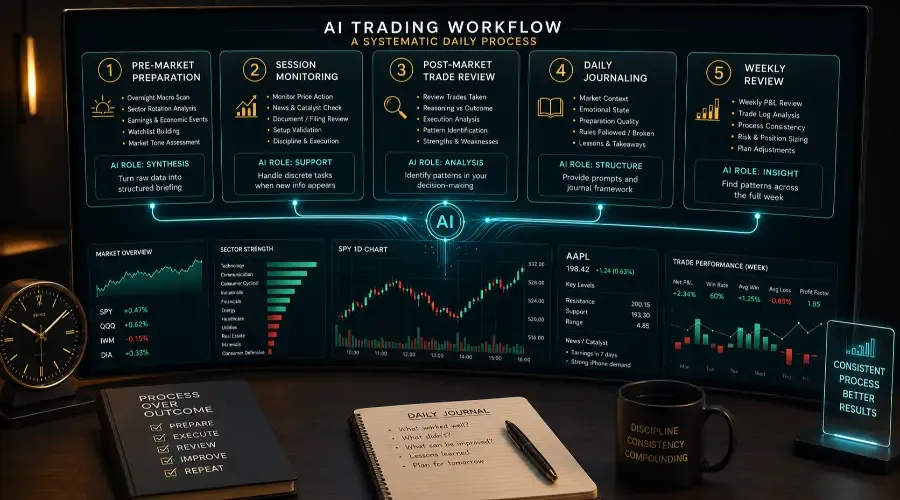
A complete daily AI trading workflow has five distinct stages. Each stage has a different purpose, a different set of AI tasks, and a different relationship between the tool and your judgment.
Stage 1 – Pre-Market Preparation
This is where the day’s trading context gets built. Before the market opens, you want to understand the overnight macro environment, the sector rotation picture, any earnings or economic events that could move your watchlist, and the overall market tone.
AI’s role in this stage is synthesis. You gather the data – futures positioning, sector ETF performance, economic calendar, earnings schedule – and AI organises it into a structured brief that would otherwise take 45 minutes to build manually. The goal is to arrive at market open with a clear picture of what’s likely to matter today, which sectors have momentum, and which stocks are worth watching.
The pre-market stage is covered in full in How to Build a Pre-Market Briefing with AI – data sourcing, the exact prompt structure, what to never skip when time is short, and a complete walkthrough of a Fed decision morning.
The post-market review is where most traders improve – or don't. How to Use AI for Post-Market Review and Trade Journaling covers the journaling prompt structure, how AI identifies patterns in your decision-making, and what an honest debrief actually looks like.
Watchlist building is the output of pre-market preparation, not a separate exercise. How to Build a Daily Watchlist Using AI Sector Analysis covers the top-down process – macro to sector to individual stock – with the specific thresholds that distinguish stocks worth watching from stocks worth trading.
Stage 2 – Session Monitoring
During the trading session itself, AI plays a more limited role. Markets move in real time and AI has no live data access – so the session is primarily where your preparation meets live price action, and where your trading rules govern your decisions.
Where AI can help during the session: processing a document or filing that drops mid-session, quickly framing a news item’s sector implications when something breaks, or running a fast check on a setup you’re considering against your pre-defined criteria.
These are discrete tasks with specific inputs – not open-ended analysis sessions.
On earnings days, the most time-sensitive mid-session task is processing a report the moment it drops. How to Analyze Earnings Reports with AI covers what to collect, how to structure the prompt, and what to look for beyond the headline numbers.
Fed decision days require a different analytical approach. How to Interpret Fed Statements and Macro News with AI walks through how to extract rate path signals from FOMC language, translate them into sector implications, and frame the hawkish-dovish spectrum accurately.
When an 8-K drops mid-session, the traders who extract the key information fastest have the biggest information advantage. How to Read SEC Filings with AI covers the 8-K catalyst prompt that gets from filing to structured analysis in under 12 minutes.
The discipline point is important here: AI use during the session should be bounded and purposeful, not a distraction from execution. If you find yourself opening Claude while a trade is live and asking it what to do, that’s a sign the pre-market preparation wasn’t thorough enough – not a sign that mid-session AI use is the answer.
Stage 3 – Post-Market Trade Review
After the session closes, you review what happened. What trades did you take, what was the reasoning, what was the outcome, and did your execution match your plan? This is where most traders improve – or fail to – depending on whether the review is honest and systematic or cursory and self-serving.
AI accelerates and sharpens this process in a specific way: it can identify patterns in your decision-making that you cannot see yourself, because the same cognitive biases that influenced your trades also influence your post-trade assessment of them.
Describe your trades, your reasoning, and the outcome to Claude – including the market conditions and what you were thinking – and ask it to identify patterns. The output won’t always be comfortable, but it will often be accurate.
Stage 4 – Daily Journaling
The trade review and the journal are related but distinct. The review identifies patterns. The journal records them – along with the market context, your emotional state, the quality of your preparation, and any rules you followed or broke.
AI can help structure and prompt the journaling process, but the journal itself is yours. The act of writing, specifically in your own words, is part of what makes journaling useful. AI can give you the structure and the questions. You provide the honest answers.
The journal entry from each session feeds into the weekly review. Over time, it becomes the most accurate record of what your actual trading behaviour looks like – not what you intend it to look like, but what it actually is.
Stage 5 – Weekly Review
The Friday review is the highest-leverage habit in a trading workflow. It’s where a week of individual sessions gets evaluated as a whole – win rate, average win vs average loss, position sizing consistency, emotional decision markers, setup quality across the week’s trades.
AI’s role in the weekly review is pattern identification at scale. You bring the trade log, the P&L summary, and the key market context from the week. AI helps you identify what the numbers actually say about your process – not just whether you made or lost money, but whether the underlying decision-making was consistent with your rules.
A positive week with inconsistent process is a warning sign. A negative week with solid process may simply reflect market conditions. AI helps you see the difference, which is information that’s easy to miss when you’re looking at the bottom line alone.
The weekly review is where individual session patterns become visible. [How to Use AI for End-of-Week Portfolio Review] covers the expectancy formula, the position sizing inconsistency that most weekly reviews miss, and how to produce a single specific process adjustment for the following week.
The weekly review is where individual session patterns become visible. How to Use AI for End-of-Week Portfolio Review covers the expectancy formula, the position sizing inconsistency that most weekly reviews miss, and how to produce a single specific process adjustment for the following week.
How AI Slots Into Each Stage
To be specific about the division of labour across the five stages:
Pre-market: AI does the synthesis work – turning raw data inputs into a structured brief. You do the data gathering and the final judgment about what to watch and why.
Session monitoring: AI handles discrete, specific tasks when new information appears. You handle execution, discipline, and real-time decision-making.
Post-market review: AI identifies patterns in the data you provide about your trading. You provide honest inputs and apply the output to your rules.
Journaling: AI provides structure and prompts. You provide the substance.
Weekly review: AI analyses the aggregate data you’ve accumulated across the week. You draw conclusions and adjust next week’s plan.
In every stage, the pattern is the same: AI processes and structures, you judge and decide. The tool never crosses into the decision itself. The moment you find yourself acting on AI output without applying your own judgment, the workflow has broken down.
The Discipline Layer
Workflow structures create accountability in a way that ad-hoc AI use never can.
When you have a defined pre-market process, you either ran it or you didn’t. When you have a post-market journaling template, you either completed it or you didn’t. When you have a weekly review framework, the data is either there or it isn’t.
This matters because trading discipline is not just about following rules during a trade. It’s about maintaining process quality across every phase of the trading day, consistently, in conditions both favourable and difficult. A workflow makes that consistency visible – you can see when you’re maintaining it and when you’re not.
AI speeds up the analytical parts of the workflow. It does not enforce the discipline parts. That remains yours. But a workflow that’s structured and repeatable is significantly easier to maintain consistently than one that’s ad-hoc and variable. The structure itself supports the discipline.
A Real Week – What the System Looks Like in Practice
Here’s what a full Tuesday workflow looks like during an active earnings week – to make this concrete rather than theoretical.
Pre-market (8:00am–8:25am IST)
Perplexity scan for overnight news and futures. Finviz sector ETF table copied.
Two earnings reports dropped after yesterday’s close – one in tech, one in financials. The tech name is on the watchlist.
Claude session: paste futures summary, sector table, and the earnings headline figures from the tech company. Pre-market briefing prompt produces a structured brief covering market tone, sector picture, and the earnings mover’s key numbers.
One follow-up question drills into the guidance language from the earnings release. Verification pass on the figures takes 3 minutes. Watchlist confirmed: four names, one earnings mover elevated to primary watch.
Total: 25 minutes. Done before pre-market opens.
Mid-session (approx. 9:30pm IST)
The tech earnings mover has gapped up and is holding. A sector peer is moving in sympathy. No new AI use needed – the setup was pre-identified and the trading plan is in place. Execution follows the plan.
A Fed speaker comment hits the wires mid-session. It’s relevant to the rate-sensitive names in the portfolio. Quick Claude task: paste the two-paragraph quote, ask for sector implications relative to current positioning. Output takes 4 minutes. No trade changes – confirms the existing view. Back to the session.
Post-close (approx. 5:30am IST next morning, or same evening depending on schedule)
Two trades taken. One winner, one stopped out.
Post-market journal prompt: paste both trades with entry reasoning, outcome, market conditions, and emotional notes.
Claude identifies a pattern – the stopped-out trade was entered 12 minutes before a scheduled macro event, which is inconsistent with the stated rule to avoid entries within 30 minutes of major events. Output is specific and uncomfortable in the way useful feedback typically is.
Journal entry written. Rule violation noted. Plan adjustment for tomorrow documented.
Total post-market session: 18 minutes.
Friday – Weekly review
Full trade log for the week pasted into Claude alongside the week’s P&L. Three wins, two losses. Net positive week.
But the position sizing review reveals that both losses were sized at 1.8x the standard 2% risk rule – a creep that had happened gradually over the week without being consciously noticed.
AI output frames this clearly: the week was profitable despite the sizing inconsistency, not because of it. The wins happened to be large enough to absorb the oversized losses. That’s not a repeatable pattern – it’s luck operating in a direction that made a problem invisible.
That insight – which a manual review might have glossed over because the week was green – is the kind of thing a systematic AI-assisted review surfaces consistently.
What This Hub Covers
Seven posts cover each component of the daily workflow in depth.
Blog 9: How to Build a Pre-Market Briefing with AI
Complete pre-market data sourcing and briefing process, including the 20-minute target and a full prompt walkthrough for a Fed decision day.
Blog 10: How to Use AI for Post-Market Review and Trade Journaling
The journaling framework, the post-market prompt structure, and how AI identifies patterns in trading behaviour that self-assessment consistently misses.
Blog 11: How to Analyze Earnings Reports with AI
What to collect, how to structure the prompt, what to look for beyond the headline numbers, and the verification steps specific to earnings analysis.
Blog 12: How to Interpret Fed Statements and Macro News with AI
How to turn deliberately ambiguous Fed language into sector-level implications using a structured AI process.
Blog 13: How to Read SEC Filings with AI
The three filings that matter most, which sections to copy for each, and how to extract actionable insight from dense regulatory documents quickly.
Blog 14: How to Build a Daily Watchlist Using AI Sector Analysis
The top-down process from macro to sector to individual stock, with the relative strength and volume thresholds worth tracking.
Blog 15: How to Use AI for End-of-Week Portfolio Review
The weekly review framework, what the numbers actually reveal about process quality, and how to use the output to adjust next week’s plan.
Where to Start Based on Your Routine
If you’re building a daily workflow from scratch, start with Blog 9. The pre-market briefing is the highest-leverage single habit in the system – it shapes every session that follows, and getting it right from the beginning pays off immediately.
If you already have a pre-market routine but no structured review process, Blog 10 and Blog 15 are the priority. The review is where most process improvement happens, and most traders underinvest in it significantly.
If you’re active during earnings season and want to process reports faster and more accurately, Blog 11 and Blog 24 – the earnings transcript post in Hub 4 – should be your next reads.
Start with the stage of the workflow that will have the most immediate impact on your current process. Add the others over time. The system works best as a whole, but each component delivers value independently.
Once the daily workflow is in place, the next layer is using AI within your technical analysis process specifically. Technical Analysis with AI covers how to describe chart structure in text, how to feed indicator readings into AI, and how the model adds a verification layer to setups you've already identified.
For traders who combine technical setups with fundamental context, Fundamental Research with AI covers how to compress the research phase – transcript extraction, filing review, ratio analysis, peer comparison – from hours into a focused 35-minute session
For traders who combine technical setups with fundamental context, Fundamental Research with AI covers how to compress the research phase – transcript extraction, filing review, ratio analysis, peer comparison – from hours into a focused 35-minute session.
Frequently Asked Questions
What is an AI trading workflow?
An AI trading workflow is a structured, repeatable process that uses AI tools like Claude at specific times – pre-market preparation, session monitoring, post-market trade review, daily journaling, and weekly review. Instead of using AI randomly, you follow the same steps every day so your research, analysis, and journaling compound into a systematic trading process.
Do I need to use a particular AI tool?
The examples in this hub reference Claude, but the workflows can be adapted to any capable large language model. The key is consistency, not the brand of the tool. The same principles apply whether you use ChatGPT, Gemini, or another AI assistant.
How does AI trade journaling work?
AI trade journaling means you feed your trade details, reasoning, market conditions, and emotional notes into the AI after the session. The AI helps structure the entry and can spot patterns you might miss – for example, rule violations, sizing creep, or emotional decision triggers. The substance of the journal is still yours; the AI provides the framework and the second set of eyes.
Is this system only for day traders?
No. The five-stage workflow adapts to any trading style that involves preparation, execution, and review. Swing traders, position traders, and even longer-term investors can run a similar daily or weekly rhythm, just with different timeframes and data inputs.
How do I stop AI from making my decisions?
The workflow is built so AI processes and structures information, but you always judge and decide. If you ever catch yourself acting on AI output without applying your own analysis, that’s a signal to pause and reconnect with your process. The tool supports your discipline; it doesn’t replace it.
Building an AI trading workflow and sticking to a systematic trading process turns ad-hoc research into a repeatable edge. Whether you’re refining pre-market preparation AI, strengthening your AI trade journaling, or leaning on trading discipline tools like the weekly review, consistency is what makes it all work. Over weeks and months, that structure becomes the backbone of your trading – not a clever trick, but a real system.