
When you buy a stock through an app, the transaction doesn't happen inside that app. It routes through an exchange – a regulated marketplace where buyers and sellers are matched. Understanding what that means takes the mystery out of the process and helps you read financial data more accurately.
What an Exchange Does
A stock exchange provides the infrastructure for trading: listing standards that companies must meet, systems that match buy and sell orders, and rules that govern pricing and disclosure. The exchange doesn't set stock prices. It creates the environment where prices emerge from the interaction of supply and demand.
Two exchanges handle the majority of U.S. stock trading.
NYSE
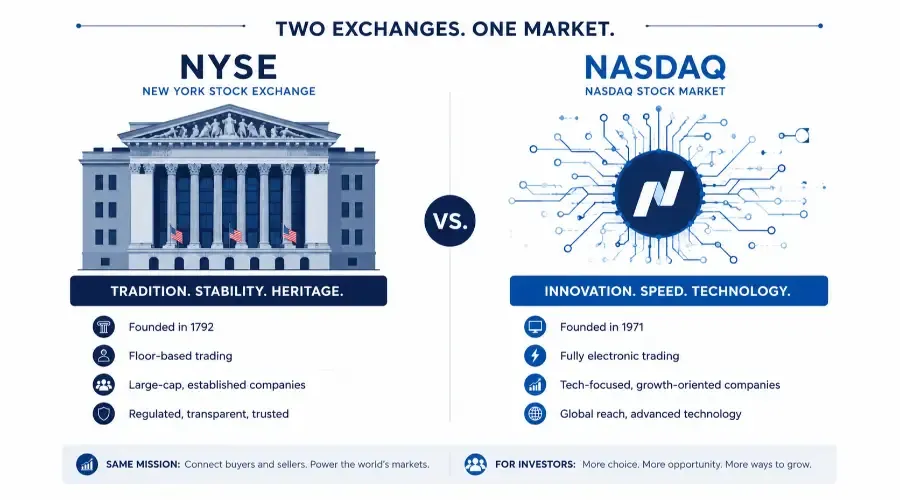
The New York Stock Exchange, founded in 1792, is the world's largest stock exchange by market capitalization of listed companies. It maintains a physical trading floor in lower Manhattan – the one you've seen in news footage – though most transactions are now electronic. NYSE lists roughly 2,800 companies, including many large, established names: Walmart, Coca-Cola, JPMorgan Chase, Disney.
Listing on the NYSE requires meeting specific financial and governance standards. Companies that qualify tend to be profitable, well-established, and subject to higher disclosure requirements.
NASDAQ
NASDAQ launched in 1971 as the world's first fully electronic exchange – no physical floor. It lists approximately 3,300 companies, with a significant concentration in technology and growth-oriented businesses: Apple, Microsoft, Amazon, Tesla, Nvidia.
The NASDAQ's electronic infrastructure handles extremely high trading volumes at low latency, which makes it the preferred exchange for many technology companies. Listing standards differ slightly from the NYSE, with NASDAQ historically more accommodating to earlier-stage growth companies.
How Your Trade Routes
You don't choose which exchange your order goes to. Your broker handles routing, typically sending orders to the exchange where the stock is listed or to a market maker that offers the best available price. The routing happens in milliseconds and is invisible to the user.
The exchange charges the broker a small fee – fractions of a penny per share – which the broker absorbs. Commission-free trading on most major retail platforms means you pay only the share price for standard stock trades.
OTC Markets
Some stocks don't meet the listing requirements for NYSE or NASDAQ and instead trade on over-the-counter (OTC) markets. These are less regulated, have lower disclosure requirements, and carry meaningfully higher risk. OTC stocks (sometimes called penny stocks) are generally unsuitable for new investors – the lack of oversight creates conditions for price manipulation and poor liquidity.
If the ticker you're looking at isn't listed on NYSE or NASDAQ, that's a signal to research carefully before proceeding.
What the Exchange Label Tells You
The exchange a stock lists on provides a rough signal about the company type. NYSE listings tend to be older, established businesses. NASDAQ listings skew toward technology and growth. Neither is inherently better – the quality of the underlying business matters more than its exchange address.
When you look up a stock on any financial platform, you'll see the exchange label next to the ticker: "NASDAQ: AAPL" or "NYSE: DIS." That tells you where the shares trade and which regulatory framework governs the listing.
The Practical Takeaway
For most investors, the exchange is invisible infrastructure – like the road network behind a delivery. Your broker handles the connection. You select the stock, place the order, and the system routes it appropriately. The exchange ensures the transaction is matched, recorded, and settled within regulatory standards.
Where it becomes relevant: OTC-listed stocks lack the protections that exchange listings provide. Sticking to NYSE and NASDAQ-listed securities is a reasonable default for anyone building an early portfolio.
This content is for educational purposes only and does not constitute investment, legal, or tax advice. Investing in securities involves risk, including possible loss of principal. Always conduct your own research and consult a licensed financial professional before making investment decisions.
Exchanges are where your trades route - but most investors never see this layer directly. The next step is understanding the participants who operate on those exchanges and how your order actually gets filled.
→ How Markets Function → The complete picture of exchanges, market makers, and liquidity - www.breakoutbulletin.com/article/how-stock-market-works-behind-the-app
→ How the Stock Market Actually Works → The path of a trade from your app to the exchange - www.breakoutbulletin.com/article/how-the-stock-market-works-for-teens-a-simple-guide-to-buying-and-selling-stocks
→ Understanding Stock Ticker Symbols → The identification system that tells you where each stock lists - www.breakoutbulletin.com/article/stock-ticker-symbols-for-beginners