
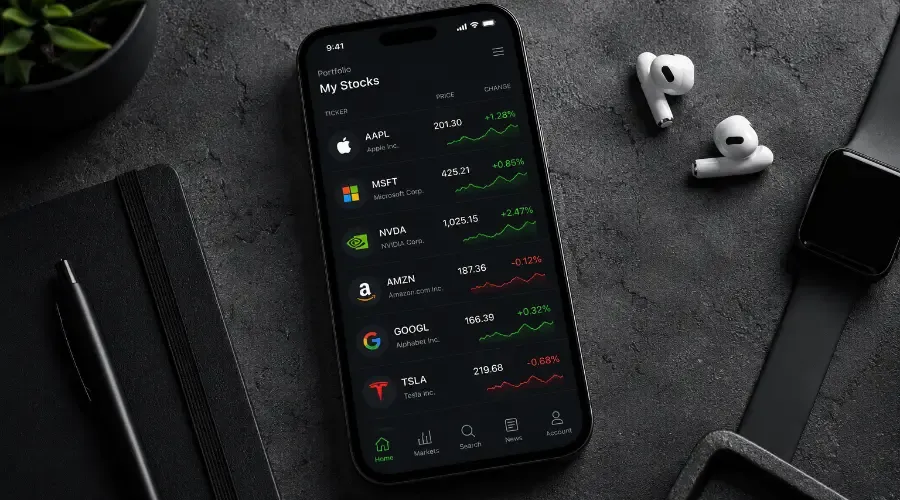
Every publicly traded company has a ticker symbol – a short, unique abbreviation that identifies it on a stock exchange. Before placing any trade, understanding how tickers work prevents one of the most avoidable beginner mistakes: buying the wrong company.
What a Ticker Symbol Is
A ticker is an exchange-assigned code that functions as a stock's permanent ID. When a company lists on an exchange, it receives a unique symbol. That symbol is then used across every brokerage, financial platform, and news source globally. Apple is always AAPL. Nike is always NKE.
Tickers range from one to five characters depending on the exchange and the company's choice at listing.
Exchange Patterns
NYSE-listed companies typically use one to three letters: F (Ford), V (Visa), DIS (Disney), NKE (Nike). Shorter tickers on NYSE often belong to older, more established companies that listed when the exchange was smaller.
NASDAQ-listed companies typically use four to five letters: AAPL (Apple), MSFT (Microsoft), TSLA (Tesla), GOOGL (Alphabet). Many tech companies list on NASDAQ, so four-letter tech tickers are common.
OTC-listed stocks often have five-letter tickers with unusual endings. If you encounter a ticker that looks irregular – multiple consonants, a trailing F or Y, or formatting like "ABCDF" – it's likely an OTC name or a foreign company trading in the U.S. Both warrant extra research before investing.
Tickers Are Not Always Intuitive
Many tickers match the company name closely: AMZN (Amazon), NFLX (Netflix), SBUX (Starbucks), WMT (Walmart). Others require memorization: NKE (Nike), TGT (Target), COST (Costco). Some are deliberately unexpected: RACE (Ferrari), LUV (Southwest Airlines), CAKE (Cheesecake Factory), HOG (Harley-Davidson).
When tickers were assigned, companies sometimes chose symbols based on branding preferences rather than abbreviation logic. Always verify before trading rather than guessing.
The Wrong-Company Risk
Similar company names can produce easily confused tickers. Disney (DIS) and Warner Bros. Discovery (WBD) are entirely different businesses. Alphabet has two tickers – GOOGL (Class A shares, voting rights) and GOOG (Class C shares, no voting rights) – with slightly different prices.
The practical solution: before placing any order, search the company name on Google Finance or Yahoo Finance, confirm the ticker that appears, and verify the exchange label matches (NYSE or NASDAQ). This takes 30 seconds and eliminates a category of mistake that's difficult to undo.
Share Classes and Multiple Tickers
Some companies issue multiple classes of shares with different voting rights or economic terms. Alphabet's GOOGL and GOOG are the most commonly encountered example. Berkshire Hathaway has BRK.A (Class A, trading above $600,000 per share as of 2024) and BRK.B (Class B, a fractional version accessible to most investors).
Both tickers represent ownership in the same underlying business, but the share structure differs. In most cases for new investors, the lower-priced share class is the practical choice – BRK.B over BRK.A, for example – though the economic exposure is equivalent on a per-dollar basis.
Tickers Change
Companies rebrand. Facebook became Meta and its ticker changed from FB to META. Formerly known as Google, Alphabet retained the GOOGL symbol from before the corporate restructure. After mergers, the surviving entity typically retains its original ticker or adopts a new one.
If you search for a company and can't find the expected ticker, check whether there was a recent rebrand, merger, or delisting. Financial news from the past 12 months usually clarifies the situation quickly.
Building a Working Vocabulary
Learning 15 to 20 common tickers – for companies you follow, use, or own – creates a working framework. From there, the rest fill in naturally. Reading financial headlines becomes faster when AAPL, TSLA, and MSFT are already familiar; the story registers without a lookup step.
Starting list for reference: AAPL (Apple), MSFT (Microsoft), GOOGL (Alphabet), AMZN (Amazon), NVDA (Nvidia), META (Meta), TSLA (Tesla), NFLX (Netflix), SBUX (Starbucks), NKE (Nike), WMT (Walmart), DIS (Disney), JPM (JPMorgan Chase), V (Visa), MA (Mastercard).
This content is for educational purposes only and does not constitute investment, legal, or tax advice. Investing in securities involves risk, including possible loss of principal. Always conduct your own research and consult a licensed financial professional before making investment decisions.
Tickers are the identification system. Once you can read them confidently, the next step is understanding how the exchanges those tickers list on affect the regulatory framework and investor protections around those shares.
→ What Stocks Actually Are → The full picture of ownership, share classes, and how stocks enter public markets - www.breakoutbulletin.com/article/what-is-a-stock-ownership-explained
→ What Is a Stock? → What the ticker actually represents - ownership in a real business - www.breakoutbulletin.com/article/what-is-a-stock-a-simple-teen-guide-to-owning-a-piece-of-real-companies
→ Stock Exchanges Explained → How NYSE and NASDAQ differ and why OTC-listed stocks carry more risk - www.breakoutbulletin.com/article/stock-exchanges-for-teens-nyse-vs-nasdaq