
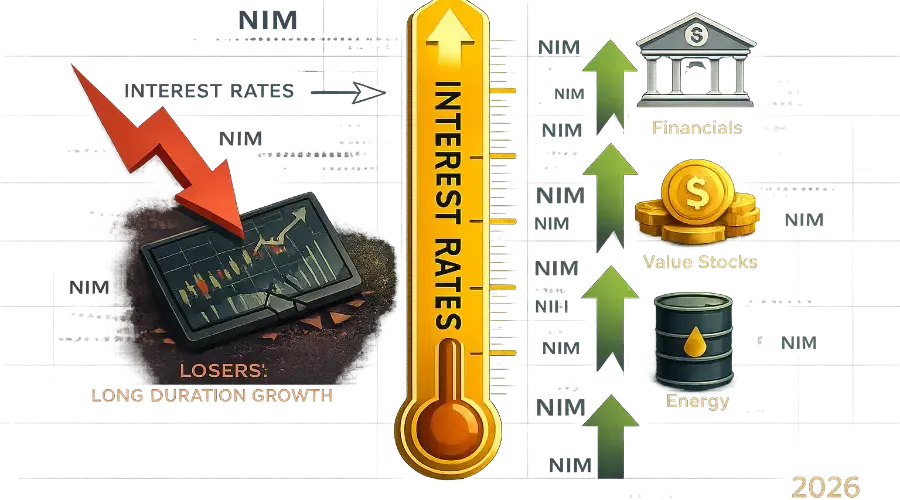
The Rate Narrative Most Traders Get Half Right
When interest rates rise, most traders instinctively assume that equities will struggle across the board. The usual reaction is to exit growth stocks and move to cash, treating the environment as uniformly negative for risk assets.
That view is not entirely wrong, but it is incomplete. Rising rates do not destroy opportunity; they redistribute it.
Markets do not fall in a straight line during tightening cycles. They split. Some sectors face valuation pressure, while others quietly benefit from the same macro force. In 2022, while the broader market declined, financials and energy held up far better. The same pattern is emerging again in 2026, where Financials are outperforming while Technology is lagging, reflecting a classic rate-driven divergence.
Understanding this divergence is what separates reactive trading from strategic positioning.
The Yield Sensitivity Framework: How Rates Actually Impact Stocks
The real impact of rising interest rates depends on how a business generates its income and how its cash flows are structured. Every company sits somewhere along a spectrum where higher rates either improve profitability, reduce valuation, or have a limited effect.
This is where the concept of a yield sensitivity framework becomes useful. Instead of looking at sectors broadly, it helps to think in terms of underlying business mechanics. Some companies directly benefit from higher rates, others benefit relatively, and some only benefit under specific macro conditions. The impact of rates becomes clearer when viewed alongside bond yields.
Financials: The Direct Beneficiaries of Higher Rates
How Net Interest Margin Drives Profitability
Banks are the most direct winners in a rising rate environment. As interest rates increase, lending rates adjust faster than deposit rates. This gap expands what is known as Net Interest Margin, which directly improves profitability.
In 2026, this dynamic is already visible. Financial institutions are seeing improved spreads, and regional banks in particular tend to benefit faster due to their exposure to floating-rate lending. This is not sentiment-driven performance; it is mechanical revenue expansion.
Insurance companies also participate in this trend. As they reinvest premiums at higher yields, their long-term return profile improves. Similarly, brokerages benefit from higher returns on idle client cash, which enhances revenue per account. This also aligns with broader sector rotation trends in the market.
Value Stocks: The Relative Winners in a High-Rate World
Why Present Cash Flow Matters More Than Future Growth
Value stocks do not gain from rising rates in a direct sense. Their advantage comes from how markets reprice future earnings.
When interest rates rise, the discount rate applied to future cash flows increases. This disproportionately affects growth stocks, whose valuations rely heavily on earnings expected years into the future. As a result, long-duration assets face compression.
Value stocks, on the other hand, generate earnings in the present. Their valuation is anchored in current cash flow rather than distant projections. This makes them relatively more attractive when rates rise.
The outcome is not always that value stocks surge, but that they decline less and stabilize faster, which in a relative performance framework is a meaningful advantage.
Energy and Commodities: The Conditional Beneficiaries
When Inflation Supports Commodity Strength
Energy stocks occupy a more nuanced position. They do not benefit from rising rates directly, but they tend to perform well when rate hikes are driven by strong economic activity and inflation.
In such environments, demand for commodities remains elevated, allowing producers to generate higher revenues even as broader markets adjust. This dynamic was evident in previous cycles and continues to be relevant in 2026.
However, if rates rise in a slowing economy, the benefit becomes less reliable. Energy performance depends not just on rates, but on the reason rates are rising.
The Other Side of the Trade: What Struggles in Rising Rate Cycles
Rising rates create clear pressure points in the market. Growth stocks, particularly those with earnings far in the future, tend to see the sharpest valuation compression.
Utilities and real estate investment trusts also face challenges. Their business models rely heavily on borrowing, and as financing costs rise, profitability can come under pressure. Additionally, their dividend yields become less attractive compared to safer fixed-income alternatives.
This is where understanding duration becomes critical. The further out the earnings, the greater the sensitivity to interest rates.
In contrast, investors often shift toward defensive stocks during uncertainty.
Q&A: Mastering the Rate Cycle
Why are rising interest rates described as a market bifurcation rather than a broad negative event?
Because the market is not a single entity but a collection of different business models. Rising rates reduce the present value of future earnings, which impacts growth stocks heavily. At the same time, they increase profitability for financial institutions through mechanisms like Net Interest Margin expansion. This creates a clear split between winners and losers rather than a uniform decline.
How can investors distinguish between direct and relative beneficiaries in a rising rate environment?
A direct beneficiary is a company whose core business improves mathematically as rates rise, such as banks earning higher spreads on loans. A relative beneficiary, like a value stock, does not necessarily earn more because of rates but becomes more attractive compared to growth stocks due to its stable and immediate cash flow.
Are utilities always negatively impacted when interest rates rise?
In most cases, yes. Utilities rely heavily on debt to finance infrastructure, so higher interest rates increase their cost of capital. Additionally, their dividend yields become less competitive when government bond yields rise, which reduces investor demand.
Reading the Phase of the Rate Cycle
Not every stage of a rate cycle behaves the same way. Early rate hikes tend to favor financials as margin expansion begins. As rates approach their peak, that benefit starts to stabilize, and growth sectors begin to find a bottom.
When the market senses a pause in rate hikes, leadership often shifts again. This is where positioning becomes dynamic rather than static.
Understanding where the economy stands within the rate cycle allows investors to anticipate rotation rather than react to it.
Risk Still Matters in a Rising Rate Environment
Even sectors that benefit from rising rates are not without risk. Banks, for example, can face pressure if the yield curve inverts, compressing margins instead of expanding them.
This highlights an important point. Macro trends create opportunities, but they do not eliminate uncertainty.Diversification and disciplined position sizing remain essential.
Final Thought: Follow the Flow, Not the Fear
Rising interest rates do not simplify the market; they make it more selective. The opportunity lies not in predicting whether markets will rise or fall, but in identifying where capital is moving within that environment.
The traders who adapt to that flow position themselves ahead of the curve, while others remain stuck reacting to headlines.