
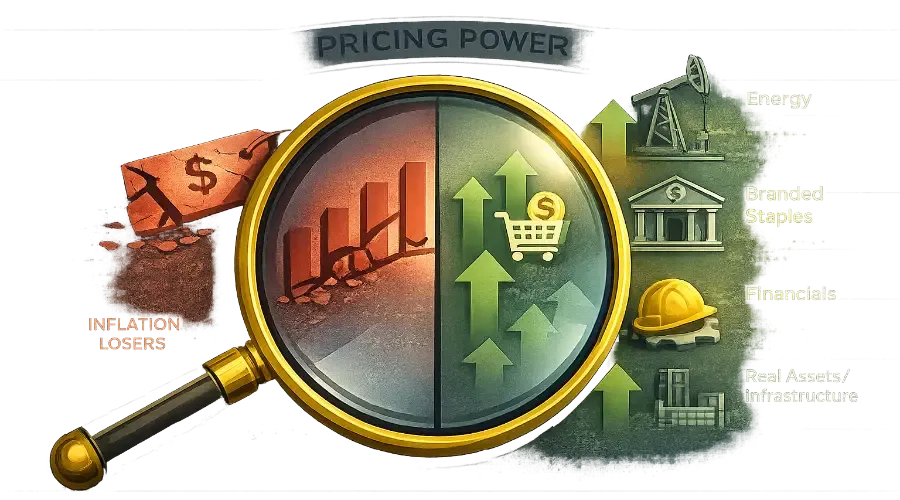
Inflation Doesn’t Hurt All Companies - It Separates Them
The instinct during inflation is to assume that rising prices create a universal problem for businesses. Costs go up, margins shrink, and stocks fall. That is how inflation feels on the surface, especially to retail participants watching prices rise across the board.
But markets do not think in averages. They differentiate.
Inflation acts less like a blanket headwind and more like a sorting mechanism. It divides companies into two clear groups: those that can pass rising costs onto customers without losing demand, and those that cannot. That single trait, pricing power, becomes the defining factor of performance during inflationary periods.
The evidence is already visible. Even in recent cycles, while broader indices struggled, energy companies surged, materials held firm, and select consumer staples outperformed. At the same time, growth-heavy sectors corrected sharply. The market did not fall evenly. It reorganized around pricing power. This is a key driver behind sector rotation during inflationary cycles.
The Materiality Lens: How Inflation Impacts Earnings
To truly understand inflation, you have to move beyond sector labels and focus on business mechanics. The key question is simple but powerful: does this company’s revenue naturally rise with inflation, or does it have to fight for every price increase?
This is where the idea of a materiality lens becomes essential. Some companies experience inflation as a tailwind because their revenue scales with rising prices. Others experience it as a margin squeeze because their costs increase faster than their ability to adjust pricing.
Businesses that can pass through costs efficiently often see margins remain stable or even expand. Those that cannot absorb rising input costs without losing customers tend to see earnings pressure build over time.
Inflation does not just raise prices; it reveals business strength.
Energy and Commodities: The Most Direct Beneficiaries
When Revenue Moves With Prices
Energy and commodity producers are the clearest beneficiaries in inflationary environments. When inflation is driven by demand, the price of oil, metals, and raw materials rises, and producers directly benefit from higher selling prices.
This creates a powerful dynamic where revenue increases quickly while production costs move more slowly. The result is expanding margins and strong earnings performance.
However, the nature of inflation matters. If inflation is driven by supply shocks rather than demand, the benefit becomes less predictable. In such cases, high prices can eventually slow consumption and cap upside.
Even then, low-cost producers tend to remain resilient, as their profitability survives even when prices stabilize. This is a classic example of sector rotation driven by inflationary pressure.
Consumer Staples: Where Pricing Power Becomes Visible
Not All Defensive Stocks Are Equal
Consumer staples are often labeled as defensive, but during inflation, their real strength lies in brand power. Companies with strong brand equity can raise prices without losing significant volume, allowing them to protect margins.
This is where differentiation becomes critical. A company competing purely on price has limited flexibility. But a dominant brand with customer loyalty can increase prices gradually without damaging demand.
In inflation, brand strength converts directly into financial strength.
This is why certain consumer staples outperform consistently, not because they are safe, but because they have built the ability to control pricing over time.
Financials: Benefiting Through the Rate Channel
When Inflation Triggers Policy Response
Financial stocks benefit indirectly from inflation when central banks respond by increasing interest rates. As rates rise, lending margins expand, improving profitability for banks and financial institutions.
This creates a conditional advantage. The benefit exists only when inflation leads to tightening monetary policy. Without that response, the mechanism weakens.
In 2026, this connection remains relevant. With interest rates elevated, financials continue to benefit from improved spreads, reinforcing their position as inflation-linked performers. Financials also benefit in rising interest rate environments.
Real Assets: The Structural Inflation Hedge
Physical Assets That Adjust With Price Levels
Real assets provide a slower but more durable response to inflation. Infrastructure, logistics networks, and certain real estate assets often have pricing structures that adjust with inflation over time.
This makes them less volatile than commodities but more consistent across a full cycle. Their value is tied not just to market pricing, but to underlying physical demand. In an inflationary world, tangible assets regain importance.
Why Some Stocks Struggle in Inflation
Not all sectors can adapt equally. Growth stocks, particularly those dependent on future earnings, face valuation pressure as interest rates rise. Higher discount rates reduce the present value of long-term cash flows, leading to sharp repricing.
Consumer discretionary companies face a different challenge. As households spend more on essentials, discretionary spending declines. This creates real demand pressure, not just valuation changes.
The most vulnerable businesses are those with thin margins and limited pricing flexibility. Rising costs combined with weak pricing power create a squeeze that is difficult to escape. These valuation pressures are largely influenced by bond yields.
Inflation does not punish weakness - it exposes it.
Q&A: Identifying Inflation Winners
Why is pricing power more important than sector classification during inflation?
Because sector labels often hide critical differences between companies. Two businesses may operate in the same sector, but only one may have the ability to raise prices without losing customers. Pricing power determines whether inflation becomes an opportunity or a threat, making it far more important than broad categorization.
How can investors use a materiality approach to evaluate stocks?
The focus should be on whether revenue adjusts naturally with inflation. Companies whose pricing moves with market conditions tend to maintain margins, while those locked into fixed pricing structures face pressure. This approach shifts analysis from labels to underlying business strength.
Does energy always benefit during inflation?
Energy performs best when inflation is driven by strong demand. In supply-driven inflation, prices may rise sharply, but demand can weaken over time. This creates a more complex environment where only efficient, low-cost producers maintain consistent performance.
Reading the Inflation Cycle Before Taking Positions
Inflation moves through phases, and each phase creates different leadership patterns in the market. Early stages often favor commodities and materials. As inflation peaks, pricing power businesses such as consumer staples and real assets gain prominence.
When inflation begins to decline, the market narrative shifts again. Growth stocks often stage a recovery as rate pressure eases, and capital rotates back toward future earnings.
Understanding this cycle is critical because timing matters as much as selection.
Final Thought: Inflation Rewards Strength, Not Size
Inflation is not just a macro event; it is a filter that reshapes market leadership. The companies that succeed are not necessarily the largest or fastest-growing, but those with the strongest control over their pricing and cost structures.
The real edge lies in identifying businesses that can adapt, not just survive.