
US Earnings Analysis | July 24, 2026 | By Manish T., BreakoutBulletin
We argued in The $700 Billion AI Capex Reality Check, published ahead of this earnings season, that investors had stopped rewarding AI announcements and started pricing return on capital, and that cash flow rather than revenue would decide how these stocks traded. Two sessions later, Tesla beat revenue by $2.5 billion and fell more than 7%. The shift is no longer theoretical.
Market Summary
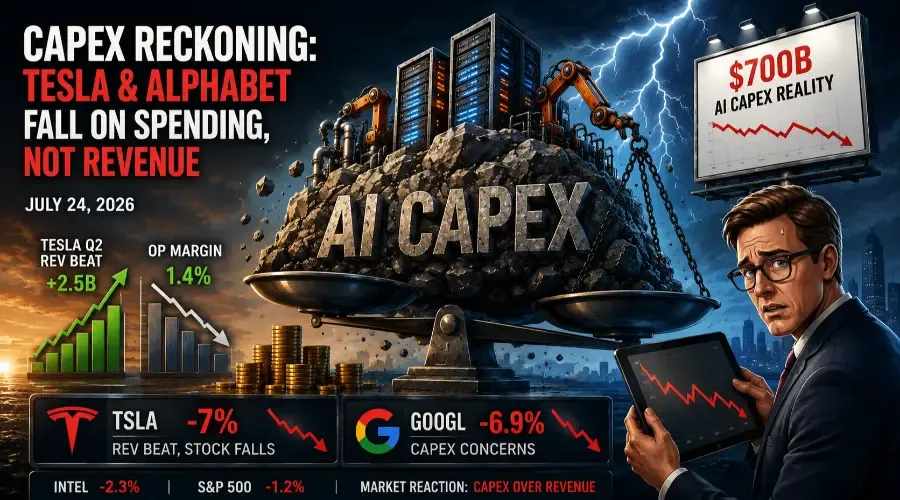
Two mega-cap prints in two sessions delivered the same message. Tesla reported Q2 revenue of $28.24 billion against a $25.71 billion estimate, a clear beat, and the stock fell more than 7% by Thursday’s pre-market. Alphabet followed a day later and closed down 6.89%, with coverage highlighting capital expenditure as a primary concern. Neither company missed on demand. Both were marked down on what they are spending to chase it.
Key Takeaways
Tesla beat revenue and still fell. $28.24B versus $25.71B expected, with adjusted EPS of $0.33 against roughly $0.51 estimated.
The margin is the story. Operating income fell 57% to $398 million. Operating margin dropped to 1.4% from 4.1% a year earlier.
Spending, not sales, caused it. Operating expenses rose 47% to $4.35 billion on AI and R&D, against 2026 capex guided above $25 billion.
Alphabet fell 6.89% the following session, with capex cited as a key factor. Intel dropped 2.33% and the S&P 500 fell 1.21% the same day.
The transparency problem is now explicit. CFRA flagged a lack of visibility on expected returns from Tesla’s escalating capital programme.
What Actually Happened at Tesla
The delivery number was never in doubt. Tesla shipped 480,126 vehicles in Q2, up 25% year over year and roughly 74,000 above consensus – its strongest second quarter on record and its first annual delivery growth in two years. Revenue followed, beating estimates by more than $2.5 billion.
Everything below the revenue line went the other way. Adjusted EPS came in at $0.33 against expectations near $0.51. Operating income fell 57% to $398 million. The operating margin compressed to 1.4%, down from 4.1% in the year-ago quarter.
The cause sits in the expense line. Operating costs climbed 47% to $4.35 billion as the company funded AI compute, robotics, and other development programmes. Management guided 2026 capital expenditure above $25 billion and noted capacity to borrow up to $30 billion to fund further expansion. Tesla’s own earnings materials described capacity buildout underway across AI compute, solar, battery materials, and semiconductor manufacturing.
Record volume, record revenue, and a 1.4% operating margin. That combination is what a company looks like when it is spending its growth away faster than it earns it.
The Same Verdict at Alphabet
Alphabet reported the following session and closed down 6.89%. While the decline likely reflects multiple factors, analysts flagged capital expenditure commitments as a central concern. Intel, reporting in the same window, fell 2.33%, and the S&P 500 dropped 1.21%. The common thread across these prints was unease over the scale of AI infrastructure spending and the uncertain timeline for returns.
Why This Was Predictable
The prior analysis made a structural argument, not a short-term prediction about any single stock’s exact price move. It observed that hyperscaler capital expenditure was running near $700 billion in 2026, up roughly 77% from about $410 billion in 2025, and that the spending had grown heavy enough to push free cash flow at Amazon toward negative territory. Q1 earnings had already shown the market repricing on cash flow rather than revenue – Amazon fell despite a revenue beat, and Microsoft dropped 17%.
The thesis was that escalating capex would make revenue beats insufficient because it directly erodes the conversion of sales into free cash flow. Tesla’s Q2 report is a textbook case. Revenue handily topped estimates, but operating income cratered 57% as AI-driven opex surged. The market looked past the beat and focused on the margin compression – exactly the mechanism described. The revenue beat became the least useful number in the report.
Alphabet’s decline extended the pattern. Investors saw rising capex without a clear near-term path to returns and marked the stock down. CFRA’s transparency criticism is the same question stated plainly by an analyst rather than implied by a price move.
One honest note on what was and was not predicted. Nobody called Tesla’s specific numbers or Alphabet’s 6.89% decline. The structural claim was that heavy capex would cost these names their multiple regardless of top-line performance. That framework held. The individual prints were always going to be whatever they were.
What It Means for the Rest of the Season
Three things carry more information than the headline number in the reports still to come.
Sequential capex guidance.
Whether management holds or raises full-year capital spending without a matching improvement in operating margin. Rising spend against flat margins is the combination that produced this week’s reaction.
Operating margin direction.
Tesla’s compression from 4.1% to 1.4% is the extreme case, but the direction is what matters across the group. Growth arriving with margin erosion is lower-quality growth than the top line implies.
Capital return commentary.
Any pause or reduction in buybacks signals where the cash is being redirected. That is management telling you the priority without needing to be asked.
The Bottom Line
Tesla beat on revenue by more than $2.5 billion and fell over 7%. That single fact captures the current regime: investors spent two years rewarding AI ambition, and they are now pricing AI arithmetic instead, asking what the capital returns rather than what it promises. For the remaining reports this season, the operating margin line and the capex guidance carry the information. The revenue beat is now the least useful number on the page.
None of this is to say the spending is wasteful. If the AI infrastructure being built today eventually delivers outsized returns, today’s skepticism could prove to be a buying opportunity. But for now, the burden of proof has shifted, and the market is demanding evidence before it awards premium multiples.
Internal link anchors:
How to Analyze Earnings Reports with AI – https://www.breakoutbulletin.com/article/how-to-analyze-earnings-reports-ai
How to Evaluate Valuation and Financial Ratios Using AI – https://www.breakoutbulletin.com/article/how-to-evaluate-valuation-and-financial-ratios-with-ai
How to Analyze Growth, Margins, and Cash Flow Using AI – https://www.breakoutbulletin.com/article/how-to-analyze-growth-margins-cash-flow-ai
Sources: CNBC, Yahoo Finance, Electrek, Teslarati, MarketBeat, July 22–23, 2026. Educational content only. Not investment advice. Verify all figures against company filings before acting. Markets involve risk.