
By Manish T. · July 25, 2026
Before $100 crude reset Treasury yields and stock valuations on Thursday, a currency squeeze in Lagos revealed the shock in raw form. Here is why frontier FX is the ultimate leading indicator for Wall Street.
For nearly two weeks, the U.S. market did something that should make every trader uncomfortable: it stared at a widening war and a climbing oil price and decided none of it mattered. Then, on Thursday, it changed its mind all at once. That delayed reaction – not the oil price itself – is the real lesson here, and frontier markets are the clearest window into why $100 crude is not a headline you get to ignore.
The shock, in plain terms
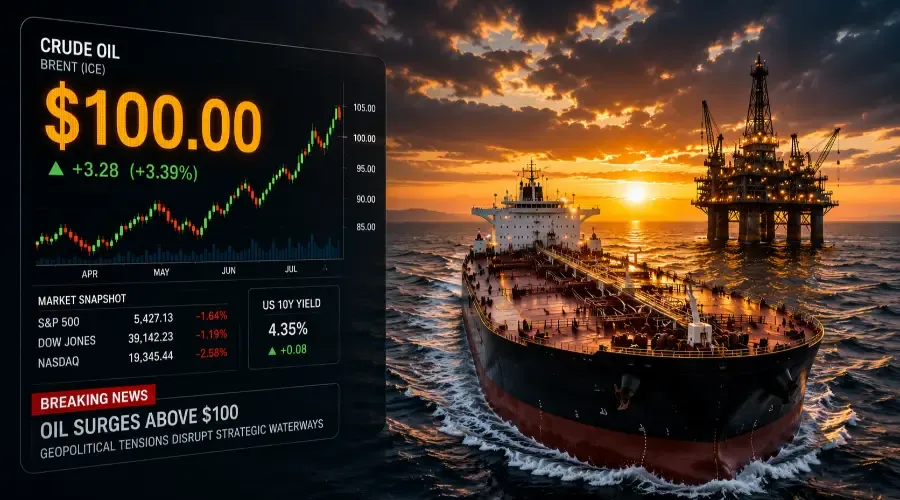
Brent crude pushed back above $100 a barrel this week and now sits near the high-$90s to $100, up roughly 30% over the past month. This isn't a vague "supply tensions" story. It's a specific, physical one: the U.S. has struck Iran on consecutive nights, Iran-aligned Houthi forces have attacked Saudi oil tankers in the Red Sea, traffic through the Strait of Hormuz has been disrupted, and the Caspian Pipeline Consortium suspended loadings that carry a large share of Kazakhstan's exports. Hormuz alone is the transit route for something like a fifth to a third of the world's seaborne crude. When a chokepoint that size is in question, oil doesn't drift – it gaps.
The move isn't one-directional, which is its own warning. Brent slid about 4% on Friday – its biggest single-day drop in weeks – on reports about the direction of U.S.–Iran talks. That's the tell of a war-premium market: it's not trading fundamentals, it's trading the next headline. Two-way, violent, and impossible to position around with confidence.
The "brush off, then break" pattern
Here's the part worth studying. For days, U.S. equities stayed roughly flat while oil rose and Treasury yields marched higher. Investors treated the conflict as background noise – a repeat of an earlier flare-up that had faded. Then Thursday arrived and the major indexes tumbled as traders finally priced in the possibility of a prolonged conflict rather than a quick off-ramp.
This lag is common, and it's instructive. Markets are efficient at pricing earnings and rates, and clumsy at pricing geopolitics, because geopolitics resists a spreadsheet. So risk builds quietly in oil and bonds – the markets that feel it first – while equities hold, until a round number like $100 forces the repricing. If you only watch the S&P, you miss the warning. If you watch crude and yields, you get a head start. That's the transferable skill in this episode, independent of how the war resolves.
Related reading: How to Read Institutional Positioning Signals
https://www.breakoutbulletin.com/article/how-to-read-institutional-positioning-signals
How it lands on U.S. stocks
Treat the following as observations on how the transmission works, not as calls.
Energy is the obvious beneficiary. Oil and gas names have been bucking the broader selloff, rising while the index falls – the one corner of the market where a supply shock reads as revenue rather than cost.
The offsets sit on the other side of the fuel bill. Airlines and transports absorb higher jet fuel and diesel directly. The broader consumer story is subtler but larger: higher pump prices act like a tax on household spending, which is why strategists have started flagging both an inflation problem and a consumer-demand problem from the same shock. To be clear, the U.S. economy is far less oil-intensive than it was during past oil shocks – energy costs now represent a smaller share of GDP – which should, in theory, soften the blow. But the psychological punch of $100 headlines and the potency of the rates channel both have a way of overwhelming that structural improvement.
Then there's the rates channel, which is where this stops being an energy story and becomes a whole-market one. Treasury yields have climbed alongside oil because a crude spike is an inflation impulse. The June CPI print had been expected to show cooling as energy prices eased – but higher-for-longer oil complicates that disinflation path and, with it, the timeline for rate cuts. There's an active debate about whether the Fed would look through a supply-driven oil spike and focus on core inflation. For now, the market isn't betting on that patience – and a prolonged conflict would only weaken the case for a dovish pivot. An oil shock doesn't just move XLE; it can quietly reset the Fed narrative that the entire equity market is leaning on.
Related reading: The $700 Billion AI Capex Reality Check
https://www.breakoutbulletin.com/article/700-billion-ai-capex-reality-check-megacap-earnings-2026
Nigeria: what $100 oil looks like at ground level
To see the shock stripped of abstraction, look at how it's tearing through one import-dependent economy in real time.
Reuters' latest survey of currency traders projects the Nigerian naira to weaken over the coming week, driven by fuel importers front-loading dollar purchases to build inventories. What makes it a compelling case is the timing: the naira had just rallied for seven straight sessions to around ₦1,368 on the official market before this fresh pressure appeared. A recovery meeting a renewed headwind – the same "brush off, then break" rhythm, playing out in a currency instead of an index. The parallel market already sits near ₦1,420, and that widening gap between official and street rates is exactly what FX desks watch as a tell for building stress.
Now the paradox that makes it click. Nigeria is home to Africa's largest refinery, yet fuel importers are still scrambling for dollars. The Dangote refinery briefly flipped to dollar-denominated fuel sales in mid-July after crude-sourcing problems, then reverted to naira on July 22 – but at a new ex-depot price of ₦1,215 per litre, a 13% jump, explicitly linked to the global crude rally. Domestic refining capacity, it turns out, doesn't insulate you from a dollar-priced commodity when you still have to source crude and imports in dollars.
And here's the twist a surface read misses: Nigeria is an oil exporter, so the same $100 crude that's inflating its fuel-import bill is also padding its export receipts – reserves have actually climbed past $50 billion. The shock hits both sides of the ledger at once. That two-sided squeeze is the honest version of the story, and it's more useful than "oil up, naira down."
Why a U.S. trader should care about a Nigerian pump price
Because it's the same force, observed at a different point in the pipe. The crude spike that shows up in Lagos as a 13% jump in fuel and a wobbling currency shows up in the U.S. as a hotter CPI print and a jumpier bond market. One economy feels it at the pump and the FX window; the other feels it in the inflation data and the rate-cut odds. The common driver – a contested strait half a world away – is the single variable worth tracking in both.
That's the entire case for reading emerging-market stress as a leading indicator rather than foreign news. Frontier economies are the market's exposed nerve endings; with thinner buffers and faster pass-through, they register a supply shock in raw, unmistakable form days or weeks before it filters into the smoothed macro data that moves U.S. equities.
Related reading: Sector Rotation Strategy (2026)
https://www.breakoutbulletin.com/article/sector-rotation-strategy-2026
What to watch next
The near-term tape belongs to headlines, not fundamentals: any concrete movement on U.S.–Iran talks, the status of Hormuz and Red Sea shipping, and whether Friday's pullback in crude extends or reverses. On the U.S. side, the next inflation print is the one to circle – it's where an oil shock becomes a Fed problem. And the market-internals question is whether energy leadership persists and whether the broad index keeps discounting the war or finishes repricing it. And here's the built-in stabilizer: sustained $100 crude begins to destroy demand, which can cap the spike and relieve pressure even if geopolitics don't improve. If oil can't hold $100, much of that pressure eases on its own. If it can, the repricing that started Thursday likely isn't finished.
Bottom line
The oil price is the story, but the market's reaction time is the lesson. Crude and yields flagged the risk early; equities took almost two weeks to listen. Nigeria's currency is simply that same shock made visible – a real-time readout of what $100 oil does when it hits an economy with nowhere to hide. Watch the strait, watch crude, watch the next CPI. The rest is downstream.
Further reading: How to Use AI for US Stock Market Trading – Complete Guide
https://www.breakoutbulletin.com/article/ai-for-stock-market-trading
This article is for educational purposes and reflects observations on publicly reported information. It is not investment advice or a recommendation to buy or sell any security. Do your own research and consider your own risk tolerance.