
Key Takeaways
The March oil shock didn't just move commodity prices - it fundamentally shifted market expectations about Federal Reserve policy.
Brent crude crossed and held above $100 following the Strait of Hormuz closure, with 20% of global crude flows disrupted.
Oil transmits to inflation in two stages: direct (2-6 weeks) and indirect (2-9 months), with second-round effects posing the greater policy risk.
The Fed cannot cut rates into an energy-driven inflation spike - rate cut expectations for 2026 have been repriced accordingly.
Sector rotation is the visible effect: energy outperforms, rate-sensitive tech faces valuation pressure, and consumer stocks contend with margin headwinds.
The Policy Trap Logic - How Oil Flows Through to Fed Constraints
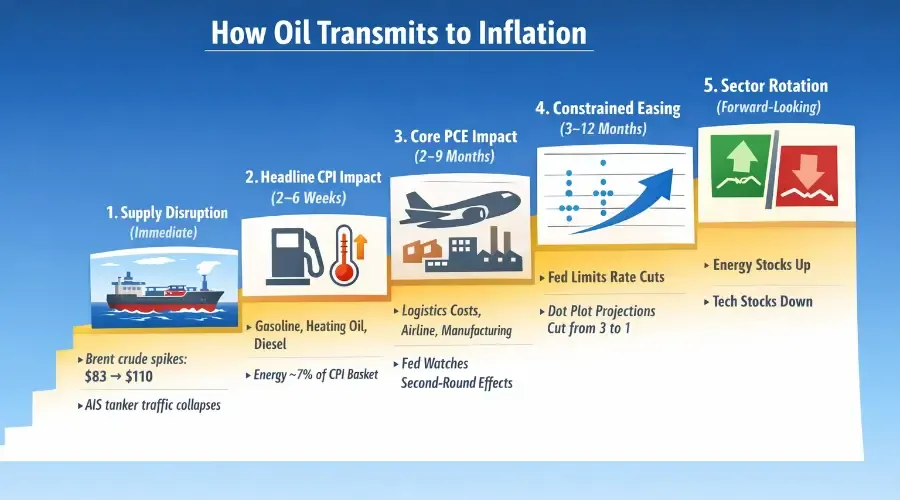
To understand why the March oil shock matters, you have to visualize the transmission mechanism. Oil doesn't move markets in a straight line—it flows through the economy in stages, each with its own timing and policy implications.
Related Reading — BreakoutBulletin
Oil Rally Persists as Geopolitical Premium Overrides Supply Data
The $100 Oil Reality: Hormuz Tanker Traffic Collapse
Hour Zero: What Happens When the Strait of Hormuz Closes
What Happens If the Strait of Hormuz Closes Tomorrow: Hour by Hour
text
Crude Oil Price Spike ($100+ Brent)
↓
Direct Effects (2–6 weeks)
↓
• Gasoline prices ↑
• Diesel/Jet fuel ↑
• Home heating costs ↑
↓
Headline CPI Rises (April–May prints)
↓
Indirect Effects (2–9 months)
↓
• Transportation/logistics costs ↑
• Manufacturing inputs ↑
• Airline margins ↓
• Consumer wallet share shifts
↓
Core PCE / Core CPI Rises (Q3–Q4 2026)
↓
Fed Policy Response
↓
• Cannot cut into supply-driven inflation
• Rate cuts delayed or reduced
• Restrictive stance maintained
↓
Market Repricing
↓
• Bond yields elevated
• Growth multiples compressed
• Sector rotation accelerates
This is the chain markets are now watching. The March shock is not about oil alone—it's about whether the second-round effects become embedded in core inflation.
→ Hormuz Tanker Traffic Collapses: Energy Stocks Traders Are Watching
→ Oil Shock Series Post 3: Why the Fed Cannot Cut When Oil Is at $90
What Actually Changed in March 2026
The March oil shock traces directly to geopolitical disruption in the Strait of Hormuz. Following weekend military strikes on Iranian infrastructure, commercial tanker traffic through the strait declined approximately 90–94%, according to AIS tracking data. Ships either idled offshore, diverted around Africa (adding two weeks of transit time), or sailed dark with transponders off to reduce targeting risk.
Brent crude responded immediately, crossing $100 on March 16 and sustaining above that level through the FOMC meeting. WTI followed at a slight discount, reflecting the Brent-WTI basis differential-Brent more directly captures Middle East supply disruption because it reflects delivered crude costs to European refiners.
The market's response, however, extended far beyond energy prices. Rate cut expectations for 2026, which had priced in as many as three cuts before the shock, were rapidly repriced. The CME FedWatch tool showed the probability of a June cut falling from 68% to 42% within five trading days.
Lines in the Sand - Key Levels Traders Are Watching
Brent Crude - $105.00: Sustained break above confirms market views this as a structural inflation shift, not a transient shock.
Brent Crude - $95.00: Move below would suggest supply concerns are easing and the shock may prove temporary.
10-Year Yield - 4.40%: Resistance level; sustained break above signals markets are pricing permanent inflation shift.
10-Year Yield - 4.20%: Support; holding below indicates markets still expect Fed cuts eventually.
QQQ (Nasdaq) - $450.00: Critical support; break below opens next downside zone at $430 and signals intensifying valuation pressure.
QQQ (Nasdaq) - $470.00: Resistance; reclaiming would suggest tech has absorbed the rate shock.
XLE (Energy) - $95.00: Support level; holding confirms sector rotation durability.
XLE (Energy) - $100.00: Psychological resistance; break above would signal continued energy leadership.
The G.E.O.F.E.D. Scoreboard - March 2026 Assessment
For readers following the G.E.O.F.E.D. framework introduced in our earlier macro series, here is the current configuration:
Growth — Moderating but positive — 2/3
Employment — Stable — 3/3
Oil — Sustained above $100 — 3/3
Fed — Restrictive, cuts delayed — 2/3
Earnings — Mixed—energy up, tech pressured — 2/3
Dollar — Range-bound, modestly higher — 1/3
Total G.E.O.F.E.D. Score: 13 / 18
This configuration (Oil = 3, Fed = 2, Growth = 2) places markets in a Stagflation Watch posture-not full stagflation, but the early signals are present. Both equities and bonds face simultaneous pressure, which explains the elevated volatility and sector rotation.
→ The G.E.O.F.E.D. Framework - A Complete Guide to Macro Regimes
How Oil Transmits to Inflation - The Two-Stage Process
Understanding oil's impact on inflation requires looking beyond the headline CPI print. The transmission happens in two distinct stages, each with different implications for Fed policy.
Stage 1: Direct Impact (2-6 weeks)
Higher crude prices flow quickly into:
Gasoline prices at the pump
Home heating and energy bills
Diesel costs for transportation
These components feed directly into headline CPI within one to two months. The March oil shock, therefore, will begin appearing in inflation data starting in April and May.
Stage 2: Indirect Impact (2–9 months)
The second-round effects take longer to materialize but pose the greater policy risk:
Transportation costs rise across supply chains
Manufacturing input costs increase
Airlines and logistics companies face margin pressure
Businesses eventually pass higher costs to consumers
These effects flow into core inflation-the measure the Fed watches most closely-with a lag of two to nine months. A sustained oil shock in March could therefore keep core inflation elevated well into the fourth quarter of 2026.
Historical context: In the 2022 oil shock following Russia's invasion of Ukraine, headline CPI peaked within three months, but core inflation remained elevated for more than a year. The Fed continued hiking into September 2023-18 months after the initial shock.
Why Energy Inflation Creates a Policy Trap
The Federal Reserve's mandate is price stability and maximum employment. Oil inflation creates a unique problem because it lies outside the Fed's control.
The Fed cannot:
Increase global oil supply
Resolve geopolitical conflicts
Reopen the Strait of Hormuz
What the Fed can do is avoid making inflation worse by maintaining restrictive policy. When oil rises:
Inflation expectations risk becoming unanchored
The Fed delays or reduces planned rate cuts
Markets reprice the entire rate path
Financial conditions tighten even without a rate hike
This is why the March FOMC meeting shifted in tone. The committee acknowledged that energy-driven inflation persistence now poses a risk to the 2026 easing cycle. The statement language changed from "gradual progress on inflation" to "inflation remains elevated, with energy prices introducing uncertainty."
Key insight: The Fed is not reacting to oil directly. It is reacting to the inflation persistence that oil creates.
What the March FOMC Actually Signaled
The March 2026 FOMC meeting revealed a subtle but powerful shift. No policy changes were announced—rates remained at 4.25–4.50%. But the forward guidance changed.
Before March:
Markets priced 2–3 rate cuts in 2026
First cut expected in June
Inflation seen as gradually moderating
After March:
0–1 cuts now priced for 2026
First cut pushed to September or later
Energy now cited as an inflation risk factor
The dot plot, released with the statement, showed committee members revising their 2026 rate expectations higher by an average of 25 basis points. Three members who previously expected two cuts now expect only one.
"Markets move on expectations, not decisions." The March meeting changed expectations—and that was enough to move every asset class.
Sector-Level Impact - Winners and Losers
Oil shocks don't move markets in one direction. They create rotation as capital flows from exposed sectors to beneficiaries.
Energy - Direct Beneficiary
Higher crude prices expand upstream revenue per barrel, widen refining margins, and create pricing power for pipeline operators.
XLE (Energy Select ETF): Up approximately 12% since the shock. Holding above $95 confirms sector leadership.
Devon Energy (DVN): Low-cost Permian producer; benefits from higher realization prices without Gulf exposure.
Valero (VLO): Refining margins (crack spreads) widen as diesel and jet fuel prices rise faster than crude.
Technology - Valuation Pressure
Tech stocks are sensitive to interest rates because their valuations depend on discounted future cash flows. Higher inflation → higher discount rates → lower present values.
QQQ (Nasdaq ETF): Testing support at $450. A break below would signal intensifying valuation pressure toward $430.
Semiconductors: Particularly exposed due to long-duration growth profiles. SOX index down 8% from pre-shock highs.
Consumer - Margin Headwind
Rising energy costs flow through to:
Transportation and logistics
Raw material inputs
Consumer wallet share (gasoline crowds out discretionary spending)
XLY (Consumer Discretionary ETF): Down 5% since the shock. Support at $180.
Airlines (DAL, AAL, UAL): Fuel costs represent 25–30% of COGS. JETS ETF down 9%.
Financials - Mixed
Banks face competing forces: higher rates can expand net interest margins, but recession risk increases with sustained inflation.
Regional banks (KRE): Caught between funding costs and loan demand. Watching $50 support level.
Key insight from the 2022 playbook: During the Russia-Ukraine oil shock, energy stocks gained 65% while tech lost 30% over the following nine months. The rotation was not temporary-it persisted until inflation showed sustained cooling.
What Traders Are Watching Now
Three signals will determine whether the March shock proves temporary or structural:
1. AIS Tanker Data (Real-Time)
The earliest de-escalation signal will be eastbound tanker resumption through the Strait of Hormuz. Monitor MarineTraffic coordinates 55°–58°E, 24°–27°N. Any sustained movement without military escort would suggest supply is returning.
2. April CPI Report (May 13, 8:30 AM ET)
The first inflation print to reflect March oil prices. Core CPI is expected at 0.3% monthly. A print at or above 0.4%would confirm second-round effects are materializing faster than anticipated.
3. Fed Communications
Any FOMC member suggesting that energy inflation is "transitory" would signal dovish lean; references to "persistence" or "anchoring" would signal continued caution.
The Structural Question Markets Are Asking
The market is trying to answer one question:
Is this a temporary oil shock, or a structural inflation shift?
If temporary:
Oil falls back below $90
Inflation moderates in Q3
Fed resumes gradual easing in late 2026
Growth sectors recover
If structural:
Oil sustains above $100
Core inflation remains elevated through year-end
Fed holds rates steady or considers hikes
Valuation pressure on long-duration assets persists
Right now, the answer is unclear. That uncertainty is driving volatility across every asset class.
→ Intermarket Analysis Guide: Reading Oil, Yields, and Equities
→ Oil Shock Series Post 4: How to Trade an Oil Shock - Phase Map and Entry Signals
Bottom Line
The March oil shock did more than move commodity prices. It changed the policy narrative for 2026 and forced a repricing of rate expectations across every market.
For traders, the edge lies not in predicting oil prices, but in tracking the transmission chain:
Oil → CPI → Fed policy → Sector rotation
Each link in that chain offers observable signals. AIS data shows supply disruption. CPI prints show inflation pass-through. Fed communications show policy response. Sector performance shows capital rotation.
The trader who watches all four sees the full picture.
The next catalyst to watch: April CPI (May 13) and any eastbound AIS movement through Hormuz. Until then, traders are watching the levels in the table above as the key lines in the sand.
Frequently Asked Questions
How does oil inflation affect Federal Reserve rate cut expectations?
Higher oil prices feed directly into headline CPI through energy and transport costs. When CPI stays elevated, the Fed's ability to cut rates is constrained, as easing into a supply shock risks embedding inflation. Markets respond by repricing the probability of cuts lower, raising the discount rate for equities.
What is the difference between a transient and a structural oil shock?
A transient shock is geopolitically driven and resolves quickly (e.g., 1990 Gulf War), while a structural shock involves lasting changes to supply routes or production (e.g., 2022 Russia-Ukraine). The Fed is more likely to "look through" transient shocks but must maintain restrictive policy for structural ones.
What is oil CPI transmission?
It's the process by which crude prices flow into consumer inflation. Direct effects (gasoline, heating oil) appear within weeks. Indirect effects (transportation costs, manufacturing inputs, airline fares) take months to materialize but eventually affect core inflation.
Why does high oil hurt tech stocks more than other sectors?
Tech stocks derive significant value from future earnings. Higher inflation leads to higher discount rates, which reduce the present value of those future earnings. Energy stocks, by contrast, benefit from immediate revenue increases as crude prices rise.
Which sectors typically benefit from oil shocks?
Energy producers (upstream), oil services companies, and refiners typically benefit. Refiners gain through widening crack spreads when refined product prices rise faster than crude feedstock costs. Pipeline operators benefit from volume-based fees.
DISCLAIMER:
This article is for informational and educational purposes only and does not constitute financial, investment, or trading advice. You are solely responsible for your own investment decisions and should consult a licensed financial professional before acting on any information in this post.