
Published: March 23, 2026
Subhead
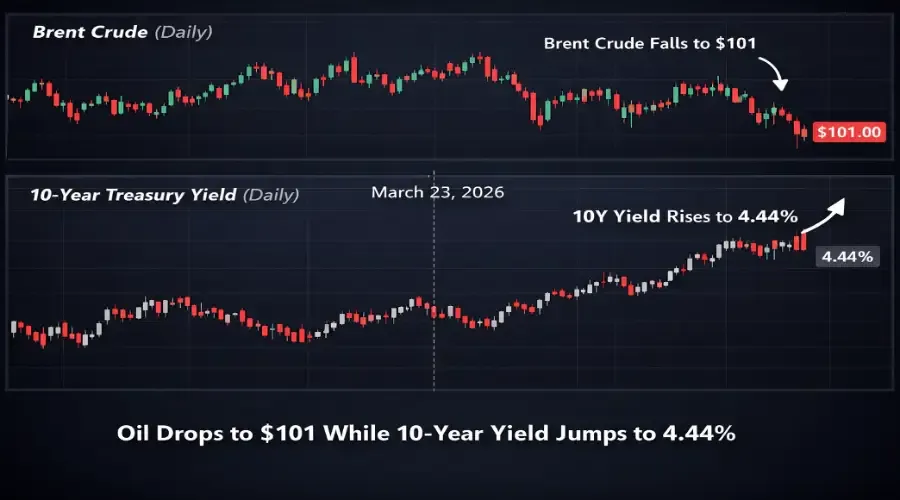
As Brent crude pulls back to $101 while the 10-year Treasury yield rises to 4.44%, markets are signaling a structural shift where inflation expectations are embedded and no longer tied to daily oil moves.
The Divergence That Matters
In the early weeks of the Iran-Qatar energy shock, the market’s logic was straightforward: oil up → inflation expectations up → yields up → equities down. That relationship was tight, intuitive, and easy to track. That correlation broke this week. On March 23, 2026, Brent crude declined roughly 1% to $101, and WTI fell 2% to $93. Yet the 10-year Treasury yield rose to 4.44%, its highest level since July 2025, while the 2-year yield spiked 10 basis points to 3.93%, signaling a sharp repricing of near-term Federal Reserve expectations. This divergence is the most analytically important signal of the current market phase. Markets are no longer trading oil—they are trading the Fed’s response to oil.
Why the Decoupling Matters
When yields rise independent of oil, it reflects a structural shift in market behavior. Inflation risk has become sticky, with bond investors pricing sustained energy supply disruption rather than reacting to short-term crude fluctuations. At the same time, the Fed’s policy path has repriced, moving from expectations of rate cuts toward a “higher for longer” or even tightening scenario. This shift directly impacts equities, where valuation is now driven by interest rates rather than commodity moves. The Iran statement around Hormuz remaining restricted reinforces this dynamic, as forward supply uncertainty keeps the inflation premium embedded in bond markets.
What the Data Shows
The current configuration highlights a clear divergence across assets. Brent crude declined to $101, while the 10-year yield rose to 4.44% (+18–20 bps over the recent move) and the 2-year yield jumped to 3.93% (+10 bps session). At the same time, the S&P 500 declined toward a six-month low, and the Nasdaq-100 underperformed, reflecting sensitivity to rising discount rates. The most important signal is the 2-year yield move, which directly reflects short-term Fed expectations rather than long-term inflation trends. This indicates that markets are actively repricing upcoming Federal Reserve decisions, not just adjusting long-term assumptions.
How to Monitor the Divergence Going Forward
The key question is whether this decoupling persists or reverses. Three signals matter most. First, the EIA crude inventory data will indicate whether supply tightness remains intact. Second, Federal Reserve communication, particularly from key officials, will determine whether policymakers validate the market’s inflation concerns. Third, AIS tanker traffic in the Strait of Hormuz provides real-time confirmation of whether supply disruption continues. If yields remain elevated even as oil fluctuates, it confirms that inflation expectations are structurally embedded.
Portfolio Implications
Growth and technology stocks remain the most exposed, as higher discount rates compress valuations even without earnings changes. Fixed income portfolios face direct pressure, with rising yields leading to mark-to-market losses in long-duration bonds. Balanced portfolios lose their traditional diversification benefit, as both equities and bonds decline together in an inflation-driven regime. This reflects a broader shift where cash, short-duration instruments, and energy-linked assets gain relative importance.
Frequently Asked Questions
Why are Treasury yields rising even though oil prices have pulled back?
Because inflation expectations are now embedded in the bond market, yields no longer react to daily oil price changes. Instead, they reflect a sustained view that energy-driven inflation will persist, forcing the Fed to maintain restrictive policy.
Does this mean oil no longer matters for markets?
No. Oil remains the core driver of inflation expectations, but its role has shifted from a daily trigger to a structural input. Short-term moves matter less than sustained trends in supply and pricing.
What is the main mechanism impacting equities right now?
The dominant mechanism is the discount rate effect. As the 10-year yield remains elevated at 4.44%, the present value of future earnings declines, leading to valuation compression, especially in long-duration growth stocks.
Bottom Line
The divergence between falling oil and rising yields is not a contradiction-it is a structural signal that inflation expectations have become embedded in rate markets. Bond investors are no longer reacting to daily crude movements but are pricing a sustained energy-driven inflation regime. For equities, this means the dominant force is no longer oil itself, but the higher discount rate environment created by persistent yields. Until the underlying inflation narrative changes, this decoupling is likely to remain the defining feature of the current market.
Related Reading - BreakoutBulletin
→ Oil Shock Series Post 3: Why the Fed Cannot Cut When Oil Is at $90 https://www.breakoutbulletin.com/article/oil-shock-sector-map-winners-losers-guide
→ The Energy Shock Deepens: VIX 27, Yields Spike, Equities Test Lows https://www.breakoutbulletin.com/article/hormuz-tanker-traffic-collapse-energy-stocks
→ Hormuz AIS Monitoring Guide: How to Track the Supply Signal Ahead of Headlines https://www.breakoutbulletin.com/article/what-happens-if-the-strait-of-hormuz-closes-tomorrow-hour-by-hour
DISCLAIMER :
This article is for informational and educational purposes only and does not constitute financial, investment, or trading advice. You are solely responsible for your own investment decisions and should consult a licensed financial professional before acting on any information in this post.