
Published: March 24, 2026
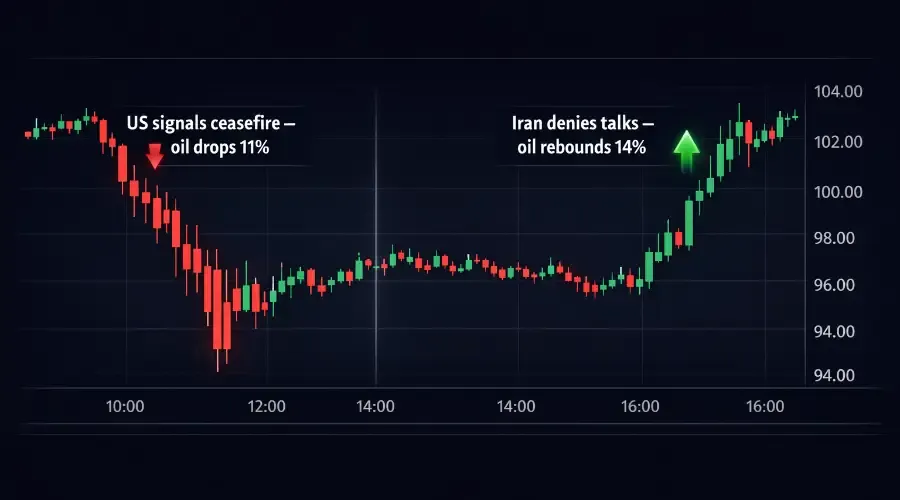
Brent crude whipsaws 25% after conflicting US-Iran statements, exposing the fragility of the macro narrative and forcing a rapid repricing of Fed rate-cut expectations.
Key Takeaways
-
Oil fell 11% on a false ceasefire narrative, then rebounded 14% after Iran’s denial - a 25% round-trip in one session
-
The 10-year Treasury yield moved from 4.40% to 4.43%, while S&P 500 futures shifted from +1.1% to flat
-
Fed rate-cut probability swung 13% in hours, showing deep linkage between oil and monetary policy
-
The real edge lies in tracking data, not headlines
What Happened on March 24
Oil whipsawed 25% in a single session—but the real signal was how quickly the macro narrative broke. What initially appeared to be a confirmed de-escalation reversed within hours, forcing a rapid repricing across crude, Treasury yields, and Federal Reserve expectations. This is not just volatility-it is a live macro transmission event.
Brent crude dropped roughly 11% from $101 to $88 after a US official described “productive talks” with Iran and announced a pause in strikes. Within hours, Iran denied any contact, calling the statement “fake news.” The reversal removed the de-escalation narrative and restored the supply shock premium, sending oil back above $100.
At the same time, the 10-year Treasury yield dipped to 4.40% and recovered to 4.43%, while S&P 500 futures moved from +1.1% to flat. The key takeaway is the speed of reversal, confirming how fragile the current macro setup has become.
The Narrative Split - What the Market Is Pricing
The market is currently balancing two mutually exclusive narratives. On one side, the US signaled ongoing talks and temporary de-escalation. On the other, Iran issued a direct denial, rejecting any engagement. Both cannot be true simultaneously.
That shift matters because markets are not trying to determine which side is correct-they are pricing the uncertainty between them. This creates a regime where headlines move price, but confirmation drives trends.
Why This Event Matters More Than It Appears
This was not just an oil move-it was a macro repricing event. Oil sits at the start of a transmission chain:
Oil → Inflation → Fed Policy → Yields → Equity Valuations
When the ceasefire narrative briefly took hold, markets priced lower inflation risk and higher probability of rate cuts. When that narrative collapsed, those expectations reversed immediately. This explains the 13% swing in Fed rate-cut probability, making monetary policy the hidden driver of the move.
The Three Signals That Actually Matter
In environments dominated by conflicting narratives, the edge comes from tracking observable data—not statements.
Signal 1 - Tanker Flows (Kpler / AIS)
The most important real-time indicator of supply normalization. A sustained move above 15M barrels/day signals real de-escalation.
Signal 2 - Official Policy Confirmation
A follow-up statement validating or retracting the ceasefire claim determines narrative credibility.
Signal 3 - Nuclear Escalation Indicators (IAEA)
Any enrichment signal above 60% indicates parallel escalation, reinforcing the supply-risk narrative.
In practical terms: price reacts to headlines-but trends follow data.
What This Means for Markets
The whipsaw reveals a deeper structural issue: markets are operating in a headline-sensitive regime, where macro direction depends on external confirmation rather than internal fundamentals.
For equities, this creates instability because valuation depends on interest rates, and interest rates depend on oil-driven inflation expectations. This is why even a temporary oil move can trigger cross-asset volatility across stocks, bonds, and currencies.
Scenario Framework - How Markets Typically Respond
-
If escalation continues, oil retests highs while equities face pressure from rising yields
-
If the situation stalls, oil consolidates and markets enter a low-conviction range
-
If a deal is confirmed, oil unwinds the supply premium, supporting equities
The key is not prediction—it is recognizing confirmation in real time.
Non-Obvious Insight : The Real Signal
What makes this event structurally important is not the oil move-it is the failure of narrative confirmation. Markets briefly priced a resolution that did not exist.
That shift matters because it reveals how quickly false signals distort macro expectations, especially when tied to Federal Reserve policy.
This is not just volatility-it is a breakdown in narrative reliability.
What to Watch Next
The next directional move depends on three variables:
-
Tanker flow data - confirms physical supply changes
-
Policy communication - validates or rejects the narrative
-
Rate expectations (FedWatch) - reflects inflation interpretation
Together, these form the real-time macro framework.
Frequently Asked Questions
Why did oil recover so quickly after falling 11%?
Because Iran’s denial removed the ceasefire narrative, restoring the supply-risk premium that had been briefly priced out.
Can traders rely on official statements in such environments?
Not without confirmation. Diplomatic narratives can mislead, but physical data confirms reality.
What does this mean for the Federal Reserve?
It shows that rate expectations are now directly linked to oil-driven inflation dynamics.
Bottom Line
The 25% oil whipsaw is not just a volatility event—it is a macro signal that markets are pricing uncertainty, not clarity. The removal and reinstatement of the supply shock premium show how dependent current market conditions are on external confirmation.
Do not trade the headline-track the confirmation.
Related Reading from BreakoutBulletin
-
Why the March Oil Shock Changes the Fed Calculus - Not Just Prices, Policy https://www.breakoutbulletin.com/article/oil-inflation-fed-rate-cuts
-
The $100 Oil Reality: Hormuz Tanker Traffic Collapse https://www.breakoutbulletin.com/article/hormuz-tanker-traffic-collapse-energy-stocks
-
What Happens If the Strait of Hormuz Closes Tomorrow https://www.breakoutbulletin.com/article/what-happens-if-the-strait-of-hormuz-closes-tomorrow-hour-by-hour
Disclaimer
This article is for informational and educational purposes only and does not constitute financial, investment, or trading advice. You are solely responsible for your own investment decisions and should consult a licensed financial professional before acting on any information in this post. ©2026 BreakoutBulletin.com