
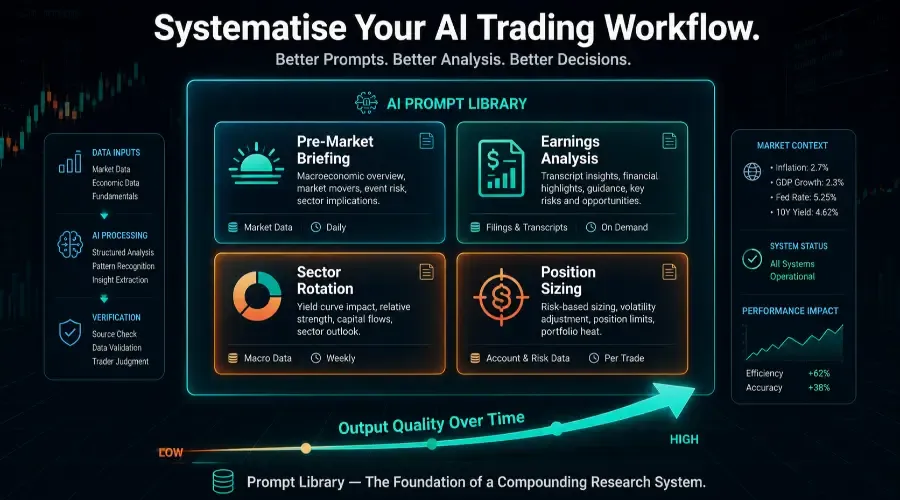
There's a ceiling to what any individual AI interaction can produce. A single prompt is a one-time transaction – you ask, you get an answer, you move on. Tomorrow you write a slightly different prompt for the same type of analysis and get slightly different output. The quality of your AI trading research depends entirely on how well you framed the question that day.
Prompt engineering for traders is what breaks through that ceiling. Not a fancier way to ask questions – a systematic approach to building AI interactions that produce consistent output, get better over time, and eventually make the research phase of your trading process the most efficient part of your day rather than the most variable.
One important caveat before going further: better prompts multiply sound analysis. They do not substitute for it. A beautifully engineered prompt for earnings analysis still produces noise if the underlying analytical framework is weak. Everything this hub covers assumes the prior work – the sector rotation models, the technical setup criteria, the macro regime classification – is already solid. Prompt engineering is the multiplier on that foundation, not a shortcut around it.
This is the advanced hub of the How to Use AI for US Stock Market Trading series. The pillar post gives you the full series map if you're coming to prompt engineering before working through the earlier hubs.
Why Prompt Engineering Is the Highest-Leverage Skill for AI Stock Analysis
The quality of your prompts is the multiplier on everything else in your workflow. Better prompts make your data gathering more valuable. They make the verification habit – the discipline of fact-checking every AI-supplied figure against the source – more important, because outputs are specific enough to be worth checking. They make workflow structure more efficient because consistent prompts run faster than improvised ones.
The compounding is real. A trader who has spent three months refining a pre-market briefing prompt, an earnings analysis template, and a weekly review framework is working with tools that produce substantially better output than the first versions did – not because the AI improved, but because the inputs did. The prompt library is intellectual capital that accumulates.
To see the difference concretely: a Level 1 pre-market prompt might read "Summarise what's moving in the market today." A refined version reads: "Act as a senior macro analyst. Using only the data I'll paste below, identify: (1) the primary macro catalyst driving pre-market moves, (2) which sectors face the largest gap risk and why, (3) one overlooked second-order implication. Output in three labelled sections. Do not introduce data I haven't provided." Same question, structurally different output. The second version took three iterations to reach – which is the three-use rule: test a prompt three times on real sessions before locking in the template, so the final version is built on evidence of what actually worked, not what seemed like it should work.
The Three Levels of Trading Workflow Automation
Understanding where you are – and where you're trying to get – helps you prioritise the work this hub covers.
Level 1 – Manual Prompting
Every prompt is written from scratch. The trader uses the role-context-data-task-constraints framework (assigning an expert persona, specifying data constraints, defining output format) and produces good output – but every session starts from zero. No accumulated infrastructure. The skill lives in the trader's head, not in a system.
Level 2 – Prompt Library
Reusable templates for the 8 to 12 categories of analysis the trader runs regularly – pre-market briefing, earnings analysis, technical setup assessment, sector rotation, position sizing, weekly review. Each template is the refined version of the prompt that produced the best output for that task. The quality ceiling from Level 1 becomes the floor. Most traders should reach Level 2 within the first month of serious AI integration.
How to Build a Reusable Prompt Library for Trading is the starting point for anyone moving from ad-hoc prompting to a systematic approach: the eight categories, the variable field structure, where to store it, and the three-use refinement rule that builds compounding quality over time.
Level 3 – Chained Workflows
Individual prompts connect into sequences where the output of one step becomes the structured input for the next. A macro regime classification feeds a sector rotation analysis, which feeds a stock selection prompt, which feeds a position sizing calculation. The full chain produces output that is directly actionable.
One important clarification: most mature systematic trading processes are a hybrid. A few chained workflows for core daily tasks, a library for less frequent analyses, and occasional manual prompts for edge cases. The three levels are a teaching model, not a rigid prescription.
One critical safety note for chained workflows: an error at Step 1 compounds through every subsequent step. A wrong macro regime classification doesn't just affect that output – it corrupts the sector selection, the stock screen, and ultimately the position sizing that follows. Verify the first link in every chain before proceeding.
How to Chain Prompts for Multi-Step Stock Analysis covers how to connect individual templates into a four-step analysis sequence, macro regime to sector to stock to position sizing, where each output becomes the structured input for the next step.
What Automation Can and Cannot Do
The gap between what traders sometimes imagine AI automation can do and what it actually does in practice is worth addressing directly.
What it can do:
- Compress a two-hour AI-assisted market research session into 25 minutes of structured, high-quality analysis.
- Enforce process consistency by embedding risk rules and strategy parameters into every relevant template.
- Surface the event risk you'd overlook on a distracted morning or the sector rotation signal you'd miss because you were focused on an individual name.
What it cannot do:
- Replace real-time market access – the live data layer remains entirely separate.
- Execute trades – the analysis produces a decision input, not an order.
- Substitute for judgment – a chained workflow informs the trading decision; it doesn't make it.
- Eliminate verification – automating the prompt process doesn't automate fact-checking specific figures. That step remains manual and non-negotiable.
How This Hub Is Structured
Seven posts build the complete automated pre-market routine and full research infrastructure.
How to Build a Reusable Prompt Library for Trading
The eight prompt categories every library should contain, how to structure templates with variable fields, where to store them, and the three-use refinement process. Start here regardless of experience level.
How to Chain Prompts for Multi-Step Stock Analysis
The four-step LLM for stock analysis chain – macro regime to sector selection to stock selection to position sizing – how to pass output between steps without losing quality, and the quality control that prevents errors from amplifying across the chain.
How to Use AI and Search Together as a Two-Stage Research System
Perplexity for live data, Claude for deep analysis – the Stage 1 to Stage 2 handoff and the use cases where this two-stage approach produces the largest quality improvement: earnings week, macro event days, breaking news with sector implications.
How to Build a Personal Trading Assistant Using AI Projects
Claude Projects as a persistent AI workspace that already knows your strategy parameters, risk rules, and sector focus without requiring that context to be re-stated each session. Includes the maintenance habit – prompt libraries are living documents that need periodic review as model behaviour changes, strategy rules evolve, or data sources shift.
AI Tools Comparison for Traders – Claude vs ChatGPT vs Perplexity vs Gemini
An honest comparison across the tasks that matter for financial data synthesis, with a side-by-side output comparison on a specific analytical task. The goal is to help traders pick the right tool for each task, not to declare a winner.
What AI Still Cannot Do for Traders – And Which Tools Fill the Gaps
The honest ceiling of algorithmic trading strategies supported by AI, with specific tool recommendations for each gap: live data, trade execution, real-time sentiment, guaranteed accuracy.
How to Use AI for Trading Content Creation and Research Reports
For traders who also create content – newsletters, analysis reports, educational material. Covers the legal framing that distinguishes educational content from advisory content, using the BreakoutBulletin workflow as the practical example.
The Before and After
Before this hub: 90-minute nightly research sessions. Prompts written from scratch. Output quality varies with how carefully each prompt was constructed that day. No systematic way to build on what worked previously.
After building what this hub covers – after several weeks of refinement: a 25-minute session using a prompt library that covers every recurring analytical task. Macro regime analysis chains into sector selection into individual stock assessment without quality loss at any step. A Claude Project that already knows strategy parameters and risk rules. Perplexity and Claude operating as complementary tools in a structured two-stage workflow.
The output quality is better. The time investment is lower. The consistency is higher. And the whole system improves weekly as prompts are refined – research infrastructure that compounds rather than resets every session.
Prompt engineering is most valuable when it's applied to a defined strategy rather than generic market commentary. Strategy-Specific Applications with AI covers how to calibrate prompts to specific trading approaches so the library you build here produces directly actionable output.
Q&A: AI Trading Research Workflows
Q: Can AI replace human judgment in a trading research workflow?
No. AI excels at processing large volumes of data, summarising earnings transcripts, and identifying patterns in technical setups – the core of systematic trading process work. It cannot account for real-time market sentiment, geopolitical nuance, or events outside its data. Use it as a high-speed research assistant that informs decisions, not as a replacement for execution judgment or risk management.
Q: Why is chaining prompts better than one comprehensive prompt?
Chaining modularises complex analysis. Breaking a workflow into steps – macro regime classification, sector rotation identification, stock selection, position sizing – lets you verify the output at each link. This prevents logical errors or hallucinations from propagating from the start of your research all the way to your final trade plan. A single long prompt with no verification checkpoints has no circuit breaker.
Q: What is the most common mistake traders make starting with AI tools?
Failing to provide context. Generic questions produce bland, surface-level answers. To unlock professional-grade output from AI-assisted market research, provide the persona ("Act as a quantitative macro analyst"), specific data constraints ("Use only this 10-K filing"), and a clearly defined output format ("Present the risks in a table with probability and magnitude columns"). Those three elements – persona, constraint, format – are what separate useful AI output from generic summaries.